The banking industry is entering a new era where artificial intelligence, customer expectations, regulatory scrutiny, and operational resilience are converging to reshape how financial institutions operate.
According to Accenture’s Top Banking Trends 2026, the institutions that thrive over the next decade will be those that successfully balance innovation with trust. While digital transformation remains a priority, the focus is shifting from simply digitizing services to creating intelligent, adaptive, and secure banking ecosystems powered by AI and data.
Banks are increasingly investing in generative AI, hyper-personalized customer experiences, cloud modernization, and operational automation. At the same time, they face growing challenges related to cybersecurity, regulatory compliance, third-party risk management, and digital trust.
The report is a guide to a future where the limits that once defined banking are disappearing. For generations, technology, structure and risk appetite constrained what banks could achieve. Today, those boundaries are dissolving. Generative AI (gen AI), digital assets and the potential for new business models are rewriting the rules, creating possibilities that were unimaginable just a few years ago.
The report distills insights from Accenture’s global client work, boardroom conversations and research, offering a clear look at what’s happening and why.
The Age of Unconstrained Banking
Key Areas: Money, experience, work, technology, risk and competition.
Trend 1: The future of money – Dumb money gets smarter
A new phase is taking shape in how money is stored, moved, used and made smarter—and ultimately, how it works for banks and customers.
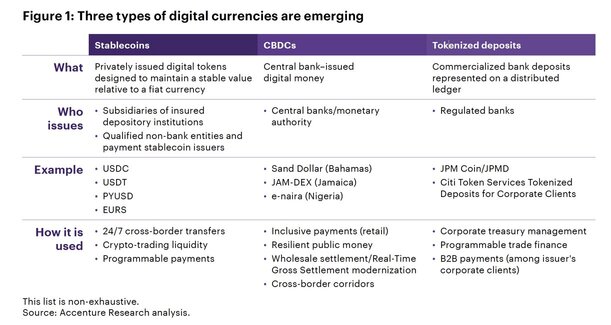
Digital currencies such as stablecoins, central bank digital currencies (CBDCs) and tokenized deposits are poised to enter the mainstream, redefining where and how money flows. Payment rails, the networks that move money between parties, are evolving. New interoperable rails—shared payment infrastructures that allow different systems and networks to connect seamlessly—along with data-rich, programmable payments, are making today’s transactions smarter.
Global Money Router
When digital currencies, tokenized deposits and CBDCs connect with real-time payment rails, card networks and FX platforms, money flows across the fastest and most efficient routes. These interoperable payment rails function as a global “money router,” shifting control from closed networks to open orchestration layers.
Seventy-eight percent of financial institutions expect fraud to increase significantly due to the expansion of digital currencies and agent-based systems. Yet 60% still lack dedicated response plans or forensic tools, relying instead on basic procedures and workflows that won’t scale in an autonomous environment.
Trend 2: The Future of Experience
People will expect to do more online with their primary banks than they do today (which is mostly checking their balances or paying bills). They will expect their online interactions to be as fluid and adaptive as they are when talking with a knowledgeable branch manager. And they will expect these experiences to follow them beyond their bank’s apps and website to external AI platforms.
To meet these expectations, banks are beginning to rethink user experiences, designing their own GPTs from the “outside-in” centered on customer intent. This means understanding context at a more granular level, understanding customer needs in real time and following them across channels and time. It also involves finding ways to show up for their customers when they are using third-party agents as their proxies in the market, for example, when shopping for services.
86% of consumers would trust their main bank to deliver smart AI assistants
Trend 3: The future of work and talent
Agentic AI shatters traditional capacity barriers
By 2026, agentic AI is expected to expand beyond early scaled deployments towards broader adoption across the banking industry. Leading banks are deploying AI agents across operations, where they work alongside employees and independently handle defined tasks. These shifts are rapidly changing the nature of work and will ultimately unlock new efficiencies and growth.
Over time, many employees may manage teams of specialized AI agents, massively expanding productivity and innovation—the essence of a “10x bank.”
Growth will no longer be constrained by how many people a bank can hire. The vision of the “10× bank”— where one person manages a team of AI co-workers to deliver exponentially greater impact—is coming into focus. Yet success depends on putting people at the center of change. Executives must empower employees to reimagine workflows and co-design intuitive human–AI interactions that elevate work rather than replace it.
Beyond leadership, three tenets will shape lasting impact: rethinking work around business intents rather than rigid processes; building inhouse AI expertise supported by ecosystem partnerships and equipping HR to manage a combined human-AI workforce.
Trend 4: The future of technology
The high cost of low cost
For decades, banks have invested heavily in customer-facing technology while delaying core modernizations. The result is a growing mountain of tech debt, rising costs and complexity that comes from years of quick fixes on outdated systems. Over the past 15 years, the cost of banking technology has grown around four times faster than banking revenue, with most of that spending going just to keep systems running. This imbalance can’t continue.
The next wave of leadership in banking will hinge on how quickly institutions can turn this weakness into strength. Modernizing their technology core can create a new growth engine.
The imperative now is to redefine what technological strength means for banks. The leaders will be those who use modernization to convert tech debt into digital capital, making their systems adaptive, intelligent and resilient.
Nearly 70% of IT spending now goes toward maintaining these systems and meeting ongoing regulatory demands, leaving little room to support innovation and growth
Trend 5: The future of risk and regulation
Seeing the big picture beyond the pixels
Banks analyze individual risks in detail and see them clearly, but the broader picture fades as they do. Financial, operational, cyber and geopolitical risks are colliding in ways that make even the best-prepared institutions struggle to see that full picture.
Risk in banking isn’t just multiplying at breakneck speed; it’s blurring and intertwining. The paradox is that as risk teams become more specialized and data-rich, their overall perspective becomes increasingly fragmented.
Despite spending heavily on risk management, financial-crime compliance alone costs global institutions about $200 billion every year—banks remain focused on the pixels, not the picture.
The banks that move ahead will treat risk as a source of insight and advantage. They will use data and analytics to anticipate threats, connect insights across domains and empower people to act early. By embedding risk management into daily decisions, they will turn fragmented oversight into orchestration that builds resilience and trust.
To be clear, trust, reliability, security and personal attention, the core values of banking—will continue to drive the industry. But nearly everything else will transform.
Trust will be the currency of AI-Powered Banking
Financial institutions have always operated on trust. In the AI era, that trust will increasingly depend on an organization’s ability to secure data, protect customer identities, and govern intelligent systems responsibly.
While AI promises unprecedented gains in efficiency and customer engagement, it also introduces new risks. Autonomous agents, AI-generated content, expanded third-party ecosystems, and increasingly complex cloud environments create opportunities for innovation but also expand the attack surface.
Banks that focus solely on deploying AI capabilities may find themselves exposed to operational, regulatory, and reputational risks. Conversely, institutions that build security, governance, and resilience into their transformation programs from the outset will be better positioned to realize sustainable value.
At Reputiva, we believe the future of banking will be built on three foundational pillars:
- Secure AI Adoption — Ensuring AI initiatives are governed, monitored, and aligned with organizational risk tolerance.
- Cloud and Infrastructure Resilience — Building scalable, secure, and compliant digital platforms.
- Identity-Centric Security — Protecting customer, employee, and machine identities across increasingly interconnected environments.
The banks that lead in 2026 and beyond will not simply be the most digital, they will be the most trusted.
Build a Secure Foundation for the Future of Banking
As banking organizations accelerate AI adoption and digital transformation initiatives, cybersecurity and governance must remain at the center of every strategic decision.
Reputiva helps financial institutions strengthen their security posture through:
- Cloud Security Assessments
- AI Security and Governance Advisory
- Identity and Access Management (IAM)
- Zero Trust Architecture
- Regulatory and Compliance Readiness
- Microsoft 365 and Google Workspace Security
- Cloud Cost Optimization (FinOps)
Whether you’re modernizing legacy systems, implementing AI solutions, or strengthening cyber resilience, Reputiva can help you build a secure and scalable foundation for growth.
Book a consultation today to discuss your organization’s cloud, AI, and cybersecurity priorities.