The Google Cloud White Paper: Cloud Infrastructure in the Agent-Native Era outlines the state of the IT industry and the fundamental shift from deterministic, cloud-native microservices to probabilistic, autonomous agentic AI. The paper highlights the requirements of agentic applications, the technical imperatives, and open-source standards for an agent-native infrastructure.
Google provide a vision for turning a chaotic sprawl of autonomous agents into a standardized, secure, performant, and governed “internet of agents.”
The ability to deploy agents effectively is no longer a luxury—it is a core competitive differentiator for enterprises. However, as organizations move from experimental pilots to production-grade ecosystems, they are encountering a phenomenon known as “agent sprawl.”
Key Takeaways
Agent Sprawl
Agents are being developed at an unprecedented rate across heterogeneous frameworks, protocols, and locations—from the cloud core to the local workstations of “invisible insiders.” This sprawl introduces a non-deterministic complexity that traditional cloud-native infrastructure was never designed to handle. As agents and tools combine data access, external connectivity, and execution power, new risk vectors arise and drive new governance requirements.
To move past the current stagnation in AI adoption, the cloud must evolve from a passive transport mechanism into an active, intelligent participant that understands agents as a core primitive.
The pivot from cloud-native to agent-native
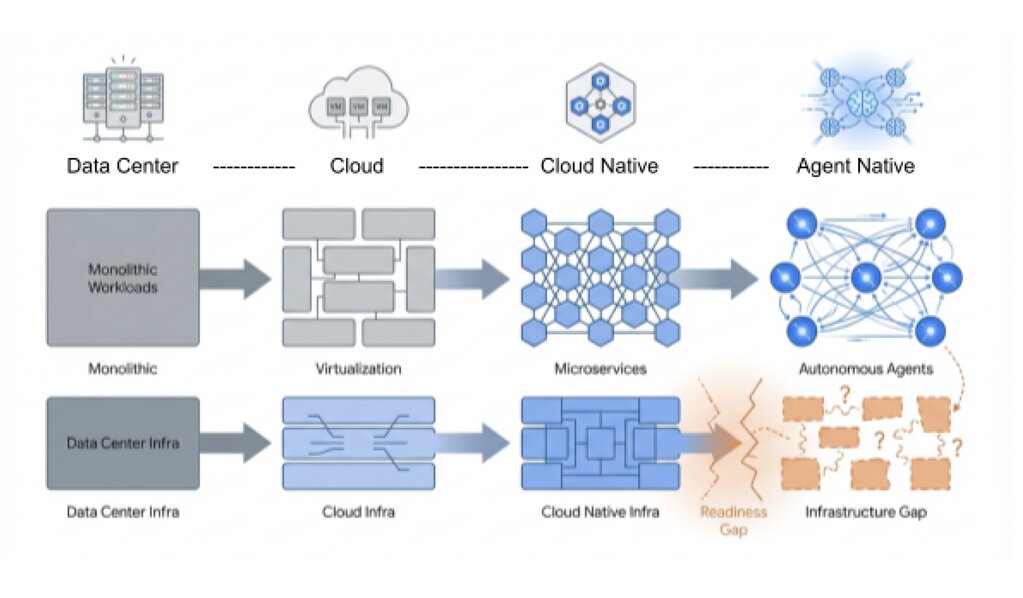
Enterprise technology is pivoting from the determinism of cloud-native microservices—characterized by predictable HTTP request-response cycles—to the probabilistic autonomy of agentic AI. This transition redefines how software is built, secured, connected, and operated. The industry is moving from cloud-native to agent-native.
The Agentic Advantage
Enterprises envision a future workforce composed of autonomous digital agents capable of reasoning, planning, and executing complex, multi-step tasks. The ability to deploy agents effectively is now seen as a core competitive differentiator, with organizations recognizing that the “Agentic” advantage will define market leadership in the latter half of the decade.
44% of North American organizations plan to deploy 21 or more AI applications in the coming year alone.– 2026 IDC Special Report on AI in Networking
The Agentic AI Infrastructure Gap
The actual movement of AI projects from select to substantial use has stagnated. Projects that succeed in the sandbox fail in production. They remain blocked by infrastructure that simply wasn’t designed for the unique behaviours of autonomous agents. We are attempting to run agentic AI workloads on cloud-native infrastructure.
- Cloud-native was built for deterministic microservices.
These applications are stateless, ephemeral, and communicate via predictable HTTP/REST pathways. The infrastructure assumes that if a service is healthy, the request will succeed. Security is perimeter-based, and traffic patterns are largely between users and the application front-end.
- Agent-native involves probabilistic agentic workflows.
Agents maintain state (memory), engage in complex reasoning loops, and generate unpredictable traffic patterns as they autonomously decide which tools to call. A “healthy” agent may still hallucinate, enter an infinite loop, or decide to exfiltrate data based on a malicious prompt.
Agents represent a fundamentally new class of workload with unique requirements for state, identity, connectivity, and governance.
Barriers to Success in Applying AI Across the Network
-
Security and governance
-
Observability
-
Cost and Complexity
-
Integration
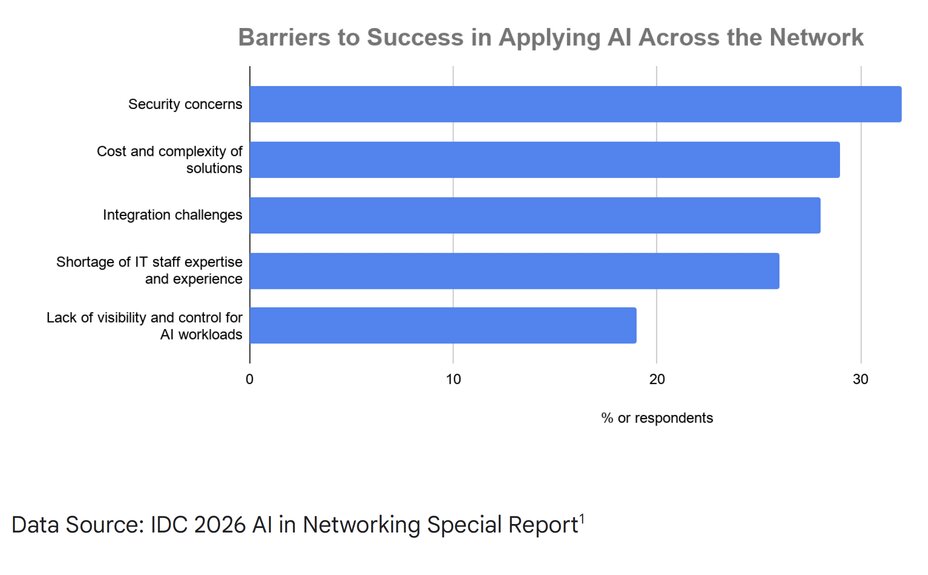
As reported by IDC1, security is the top-ranked impediment for almost every industry vertical. It is also the leading concern regarding distributed AI workloads at the edge and agentic AI.
Shift Down Operations
In the context of agentic AI, where complexity explodes due to the non-deterministic nature of the workloads, shift-down operations are a must. Shift down operations push the immense complexities of authorization, security, and networking down into the infrastructure, effectively simplifying operations that would otherwise be hard to sustain. The platform automatically handles the “plumbing”—identity issuance, secure connectivity, policy, and observability.
Just-in time provisioning
Scaling the large number of ephemeral connections and services involved in agentic applications requires a just-in-time approach to auto-provisioning the infrastructure. Just-in-time provisioning enables agents to deploy their own code and services without a human in the loop.
By shifting these complexities down, and automatically binding services to the right infrastructure resources, the agent-native cloud resolves the critical bottlenecks that are currently stalling adoption: security risks (the #1 barrier) and integration complexity (the #3 barrier).
Lethal Trifecta – The Invisible Insiders
Agents, and in particular client agents, possess what is described as a “lethal trifecta” of risk: they have access to corporate data, they connect to third-party tools and external large language models (LLMs) on the public internet, and they can execute actions, sometimes via untrusted local tools. Without robust governance, these client agents operate as “invisible insiders” that can exfiltrate sensitive data or perform unauthorized actions using the full privileges of the employee.
Client agents, often referred to as “agentic clients,” are autonomous AI assistants that operate locally on edge devices, mobile platforms, and developer workstations using desktop tools like Cursor, Claude Desktop, Gemini CLI, and VSCode.
The internet of agents: governing agent sprawl
New risk vectors arise with agent sprawl, with the potential for impact to brand reputation, leakage of sensitive data, exposure of personally identifiable information, regulatory compliance issues and the execution of destructive or unintended actions. Governance based on specialized security and observability with fluency in natural language and emerging AI protocols is required ubiquitously.
The agent-native cloud must adopt an evolved architecture where the cloud infrastructure natively understands agents as a core primitive. The infrastructure is the foundation on which the cloud relies for the delivery of enhanced functionality that understands agents to address the agentic application requirements.
The infrastructure must evolve from a passive transport and hosting mechanism into an active, intelligent participant in the agentic workflow. The evolved cloud infrastructure must address agent sprawl and the many-to-many scale challenge of connecting agents to thousands of potential tools and data sources. In order to fulfill this mission, the infrastructure must address the following imperatives:
- Governance
- Discovery
- Identity
- Authorization and policy enforcement
- Protection
- Observability
- Connectivity
Conclusion
The stagnation in AI adoption—the “stalled engine”—is a clear signal that the current era of infrastructure has reached its limit. We cannot build the future of autonomy on primitives designed for static microservices. Buyers are acutely aware of this gap and are actively seeking solutions that are “ready” for the unique demands of agentic AI.
An augmented cloud infrastructure with native agentic capabilities is the answer to this imperative. By “shifting down” the complexity of connectivity, security, and governance into the platform, it frees developers to focus on the high-value work of reasoning and automation. The cloud infrastructure, with authoritative agentic resource registries, native fluency in agentic protocols like MCP and A2A, and a deep integration of identity and security, serves as the fundamental enabler of this new architecture.
For the enterprise, the transition to the agent-native cloud is enabled by an enhanced infrastructure. It is the bridge that spans the gap.
Inspired by Google Cloud’s vision for an Agent-Native world, but what does this mean for your organization today?
At Reputiva, we help organizations move beyond experimentation to secure, well-governed, and production-ready AI systems designed for the realities of agentic workloads across AWS, Azure, and GCP.
Book a consultation to assess your readiness for agent-native infrastructure and avoid the risks of uncontrolled agent sprawl.