The rapid pace of adoption of AI across industries is reshaping entry-level roles and raising the stakes for graduates, institutions, and employers alike. This technological paradigm shift is more than an incremental improvement in productivity tools; it represents a disruption that is redefining the nature of work, skill acquisition, and the role of universities.
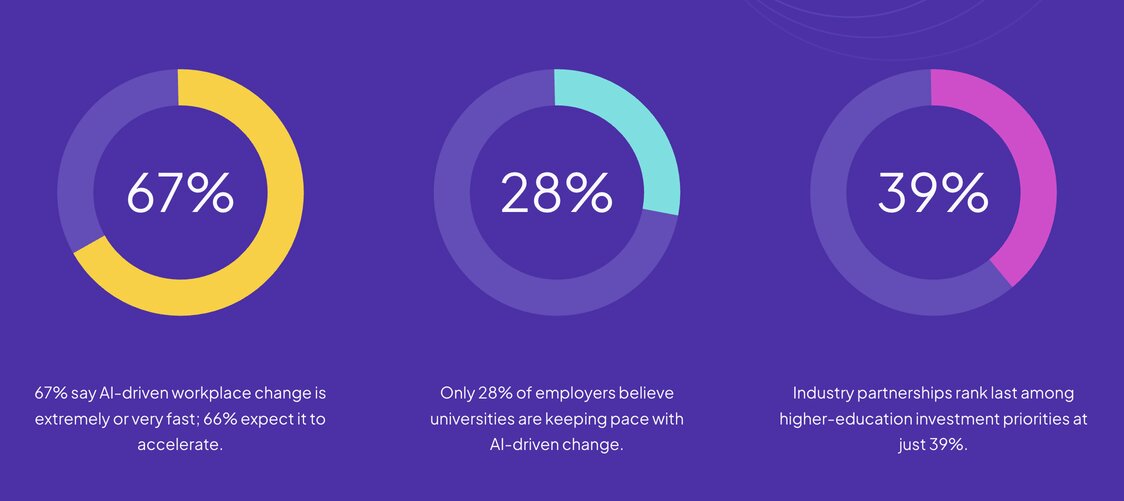
According to the 2026 AI Readiness Report, Two-thirds of learners, higher education leaders, and employers across six countries describe AI-driven workplace change as very fast or extremely fast. Only a quarter believe universities are keeping pace.
Inefficient career transitions and learning gaps contribute to annual losses of approximately $1.1 trillion in the United States alone, representing roughly 5% of its 2023 gross domestic product.
Rapid demographic change and technological advances are urgently transforming the global skills outlook. Economies and societies face large and growing skills gaps. Without the right interventions to accelerate the development of skills, these gaps threaten to become a skills chasm. – Pearson’s Lost in Transition: Fixing the “Learn to Earn” Skills Gap Report
The Transition Challenge
Today, graduates enter AI-shaped workplaces faster than curriculum cycles or governance models were designed to serve. Too often, what education signals as readiness does not align with what employers need — because access to AI tools does not equal applied readiness.
Artificial intelligence is fundamentally reshaping how organizations operate and the skills they expect from new hires, making this transition more complex than ever before.
Drawing on a six‑country study across Brazil, Malaysia, Saudi Arabia, the United Kingdom, the United States, and Vietnam, comprising 2,711 learners, higher education leaders, and employers, this research identifies a systemic pattern:
AI readiness does not falter at the point of intention. It falters at the points of alignment and execution, where what institutions deliver and what employers require have not been synchronized, and where learning is expected to translate into applied capability at work.
Learners are using AI widely, institutions are investing, and employers are hiring.
- Yet more than half of employers (53%) say their primary challenge is finding graduates with the right skills, and many graduates struggle to demonstrate applied AI capability at work.
- Employers rate graduates’ ability to critically evaluate AI outputs as their weakest competency, even as 78% of higher education leaders express confidence that employer expectations are being met.
- Only 24% of all respondents believe universities are keeping pace with AI‑driven change. These gaps are not about intent. They are about the system’s ability to deliver readiness at the speed and depth this moment demands.
What is AI Readiness?
AI readiness is the human capability to work effectively alongside intelligent systems: an integration of functional AI proficiency, strategic intelligence, ethical stewardship, and critical human skills such as adaptability, communication, and judgment. At its best, AI readiness strengthens the bridge from education to work. At its worst, its absence compounds longstanding weaknesses in that bridge.
AI readiness is the human capability to work effectively alongside intelligent systems
A portrait of the optimal AI-ready graduate
For a contemporary graduate, readiness is a multifaceted construct that combines the following:
1. Functional Proficiency
From day one, graduates must arrive functionally fluent in workplace-specific tools. These graduates enter the workforce with a dossier of completed projects. They are able to take standard AI tools and apply them to a professional workflow, a skill that only 14% of current graduates report that they have achieved to a high level as an outcome of extensive university training.
Currently, 39% of employers say that ‘hands-on’ experience is the most essential change needed in education today.
Key Competencies: Ability to use AI tools effectively; Skills in prompting or instructing; Understanding of how AI technologies work.
2. Strategic Intelligence
The AI-ready graduate will have successfully cultivated the ability to identify exactly where AI adds value and where it creates risk, a skill that 1 in 3 employers today report is of high importance when hiring into their organizations. They will appreciate how AI can be deployed as more than a productivity or efficiency shortcut.
Only a small fraction of employers today believe that graduates can identify where AI adds value to business processes, although 53% of students frequently use AI for core academic tasks.
Key Competencies: Ability to identify where AI can create value; Understanding of AI’s impact on a specific industry; Critical thinking about AI recommendations/outputs; Ability to work effectively alongside AI systems.
3. Ethical Stewardship
In an era of ubiquitous AI, the AI-ready graduate must be equipped to mitigate risk. They will understand bias, fairness, data privacy, and data integrity. They will be confident in navigating and complying with institutional and professional policies.
Key Competencies:
Critical thinking about AI recommendations/outputs; Ability to evaluate and verify AI outputs for accuracy; Understanding of AI bias, fairness, and limitations; Data privacy and ethical considerations.
4. Critical Human Skills
The optimal graduate will possess a skill set valued for what AI cannot replicate. Aware that current models have a finite shelf-life, they will bring an adaptable, agile mindset and value opportunities to learn, ensuring they remain relevant as the pace of change accelerates.
Nearly two-thirds of employers (61%) say critical human skills are equally important to functional AI proficiency, and half rank communication and collaboration as their #1 requirement for graduates.
Key Competencies: Adaptability and continuous learning mindset; Communication and collaboration skills; Creativity and innovative thinking; Complex problem-solving / Emotional intelligence.
Across all markets, only 1 in 8 (13%) of HE leaders characterize their faculty’s AI knowledge and skills as ‘very strong’.
The AI Readiness Friction Framework
The gap between institutional intent and graduate capability is real and widening. This research identifies where it breaks down: six structural friction points that impede successful transition from learning to work. Together, they form the AI Readiness Friction Framework.
The AI Readiness Friction Framework is a tool for identifying where the most consequential interventions lie. It illustrates where the education-to-work transition most consistently breaks down. These frictions reinforce one another but are not fully dependent on one another.
The AI Readiness Friction Framework identifies where and why readiness stalls across the learning‑to‑work pipeline. The framework enables leaders to diagnose where friction is most acute in their context and target intervention at root causes rather than symptoms.
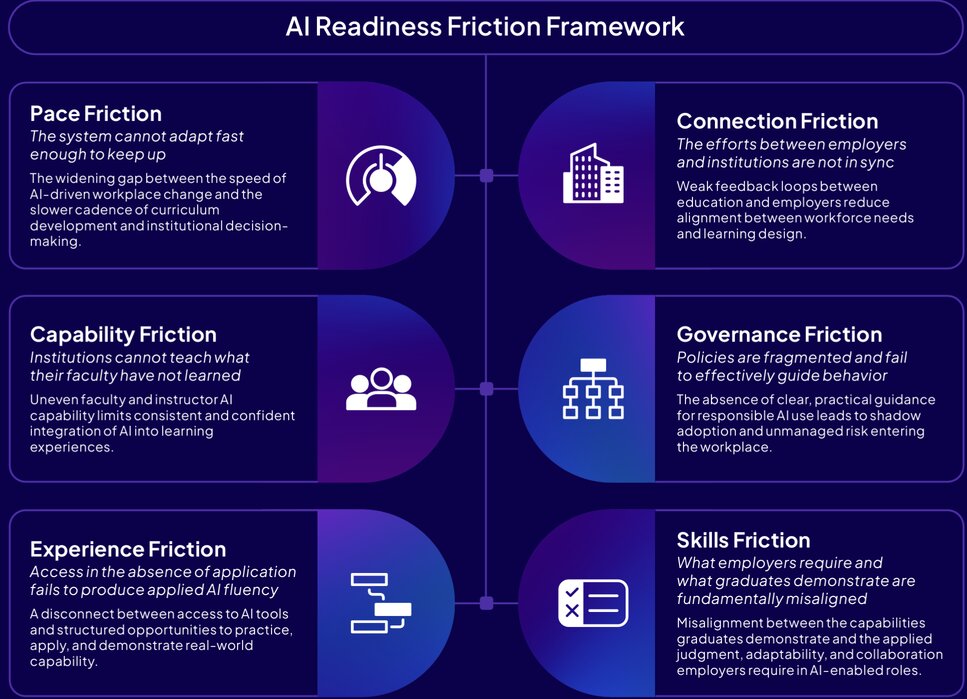
Bridging the AI readiness divide, from insight to execution
Friction accumulates across pace, connection, capability, governance, experience, and skills. Each friction reinforces the other and slows progress precisely when speed matters. When unaddressed, these frictions compound: pace overwhelms governance, weak connections distort signals, capability gaps constrain experience, and graduates arrive with theoretical knowledge, but inadequate applied experience.
The framework enables leaders to diagnose where friction is most acute in their context and target intervention at root causes rather than symptoms. AI-ready graduates do not emerge by chance. They are deliberately built through learning architectures designed to convert ambition into applied capability.
The evidence shows that failure is not random; it clusters around six compounding friction points that slow progress precisely when speed matters most: Pace, Capability, Experience, Connection, Governance and Skill.
From AI Adoption to AI Readiness
At Reputiva, we see this every day. Organizations are:
- Experimenting with AI
- Rolling out tools
- Encouraging innovation
But missing the most critical layer:
Security, governance, and real-world implementation
AI readiness is not about access to tools. It is about building four core capabilities:
1. Functional AI Proficiency
Can your team actually use AI tools in real workflows?
2. Strategic Intelligence
Do they know where AI creates value—and where it creates risk?
3. Ethical & Security Awareness
Are data, privacy, and compliance built into usage?
4. Human + AI Decision Making
Can your team validate, interpret, and act on AI outputs?
How Reputiva Helps
We help organizations move from AI Curiosity to AI Capability to AI Security. Through our structured approach:
1. Assess
- AI usage audit (including shadow AI)
- Security and identity risk assessment
- Data exposure analysis
2. Implement
- AI governance frameworks (aligned with NIST /ISO 42001)
- Secure AI architecture (AWS, Azure, GCP)
- Identity & access controls for AI tools
3. Monitor
- Continuous AI usage monitoring
- Policy enforcement
- Risk detection and response
Conclusion
AI adoption is not slowing down anytime soon. But the gap between AI adoption and AI readiness is growing rapidly. Organizations that fail to close this gap will face:
- Operational inefficiencies
- Security vulnerabilities
- Competitive disadvantage
Those who act now will build:
- Secure AI-driven systems
- AI-ready teams
- Sustainable competitive advantage
AI is already in your organization. The question is, is it secure, governed, and delivering value?
Book a Consultation – Let’s assess your AI readiness and build a secure, scalable AI strategy for your business.