Application security programs have matured significantly over the last decade. Organizations have invested heavily in code scanning, vulnerability assessments, shift-left practices, and pre-production testing designed to identify security issues earlier in the software development lifecycle.
Yet according to the 2026 State of Modern Application & AI Security Survey Report from the Cloud Security Alliance (CSA) and Miggo Security, production environments remain where risk consistently materializes. More than 80% of organizations experienced an application security incident involving a known vulnerability in the past year, despite widespread adoption of modern security tools and practices.
Built on survey data from more than 900 cybersecurity leaders and practitioners, the report examines where application security programs are breaking down in practice, why production environments continue to absorb incidents despite mature pre-production controls, and how organizations are adapting as runtime risk becomes harder to interpret, prioritize, and contain.
The challenge is no longer whether vulnerabilities can be detected; it is whether teams can act on that knowledge before those vulnerabilities are weaponized into working exploits.
Finding 1: Known Vulnerabilities & the Patch Gap Are Driving Real-World Incidents
Application security incidents are overwhelmingly tied to vulnerabilities organizations already knew about rather than unknown threats. Eighty percent of organizations experienced at least one incident involving a known vulnerability in the past year, while most respondents report remediation timelines for critical vulnerabilities measured in days rather than hours. Organizations taking longer to remediate reported substantially higher incident rates, reinforcing that the primary challenge is not discovering vulnerabilities, but reducing the exposure window between identification and mitigation.
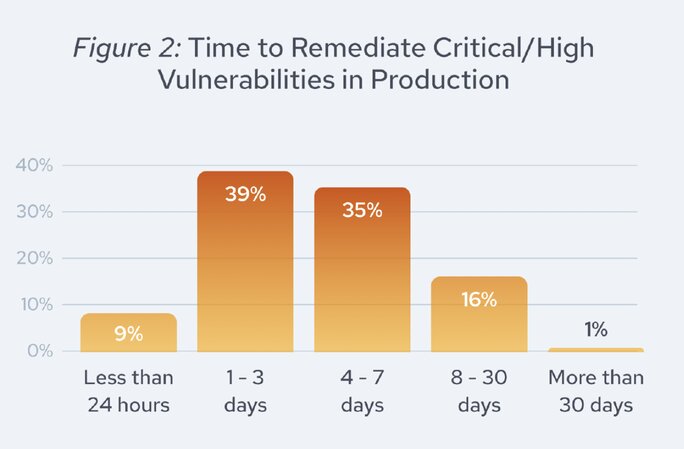
Incidents are not coming from the unknown; they are coming from the unresolved. Detection is not the failure point. The failure is in what happens between identification and remediation: a window that, for actively circulating vulnerabilities, stays open long enough to be exploited.
Security teams know what needs to be fixed; the gap is in how quickly they can close it and what to do between discovery and remediation to mitigate. This is an exposure window problem, not a detection problem.
The risk does not live in what goes unnoticed, but in what remains unresolved. Where those incidents occur, and whether the controls designed to prevent them are positioned at the right lifecycle layer, is what the next finding examines.
Finding 2. Runtime Is the Breach Battlefield — Incidents Slip Past Pre-Production Controls
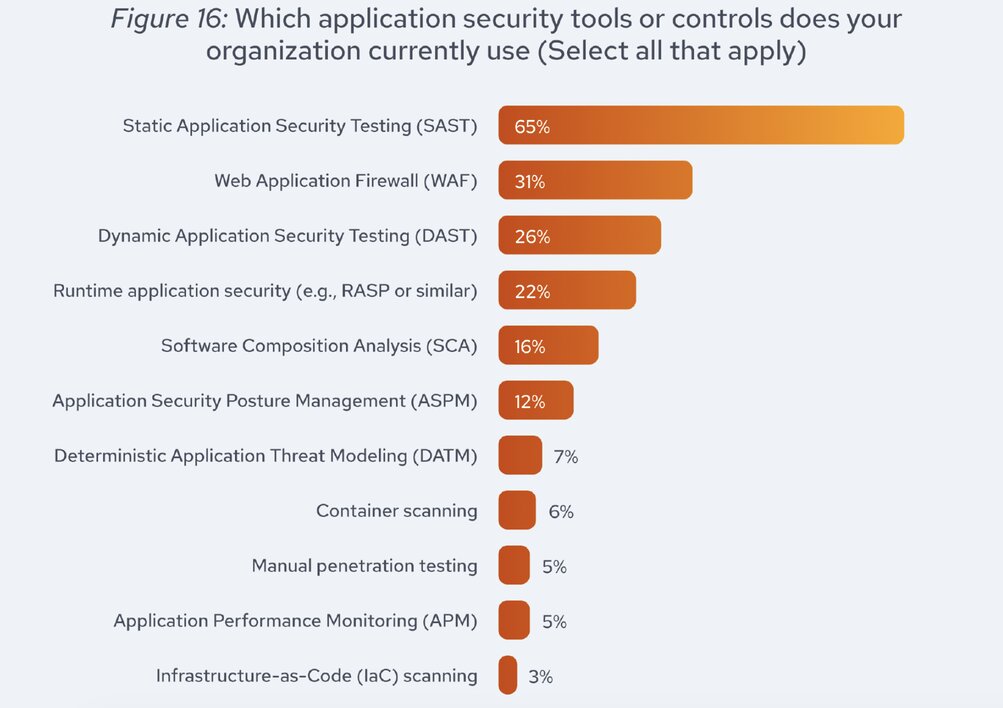
Pre-production tooling and shift-left practices are widely adopted, yet production incidents remain pervasive. Nearly half of organizations report incidents tied to vulnerabilities that were identified before release but still reached production, while another large segment report vulnerabilities that pre-production controls failed to identify entirely. The findings suggest that expanding detection coverage upstream does not necessarily translate into reduced runtime exposure when mitigation and enforcement capabilities remain concentrated outside production environments.
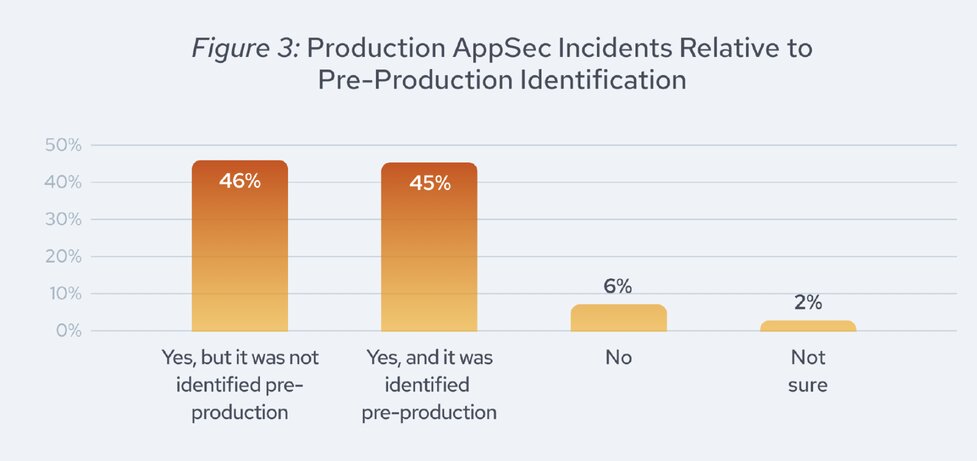
Despite widespread adoption of build-time tooling and shift-left practices, the overwhelming majority of organizations experienced application security incidents that reached production in the past year — including cases where the underlying vulnerability had already been flagged before release.
Finding 3: AI Is in Production, Security Is in Post-Mortem
AI-powered application components are already operating in production across most organizations, but runtime oversight remains largely retrospective. Most respondents rely on post-incident auditability or incomplete logging rather than real-time runtime visibility.
As AI systems introduce more dynamic and less predictable behavior into production environments, organizations are increasingly managing incidents after the fact rather than maintaining continuous enforcement and intervention capability while activity is occurring.
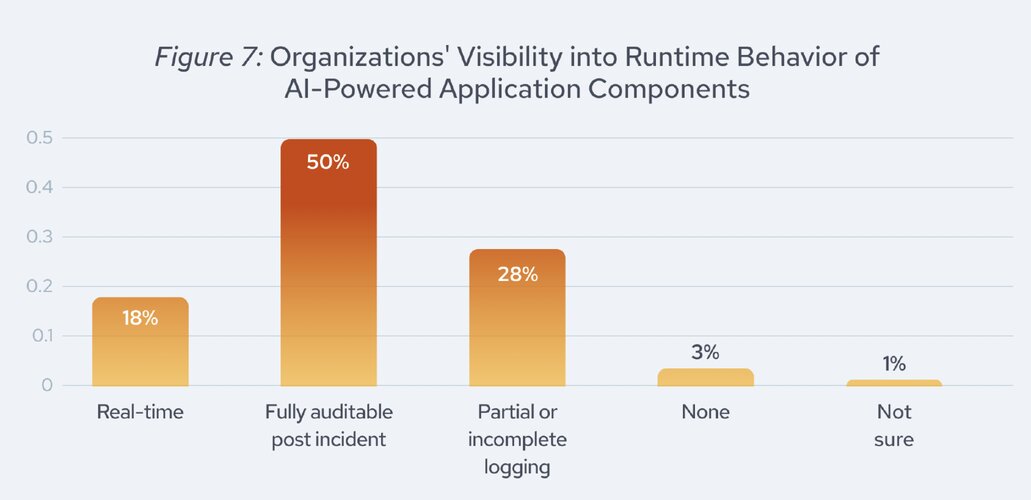
For most organizations, current AI runtime oversight means being able to reconstruct what happened after an incident, not observe or intervene while it is occurring. Given the speed at which AI components can execute decisions and propagate actions across connected systems, post-incident auditability closes the accountability loop without closing the exposure window.
Finding 4: The Main Bottleneck for Protection is Proof of Exploitability
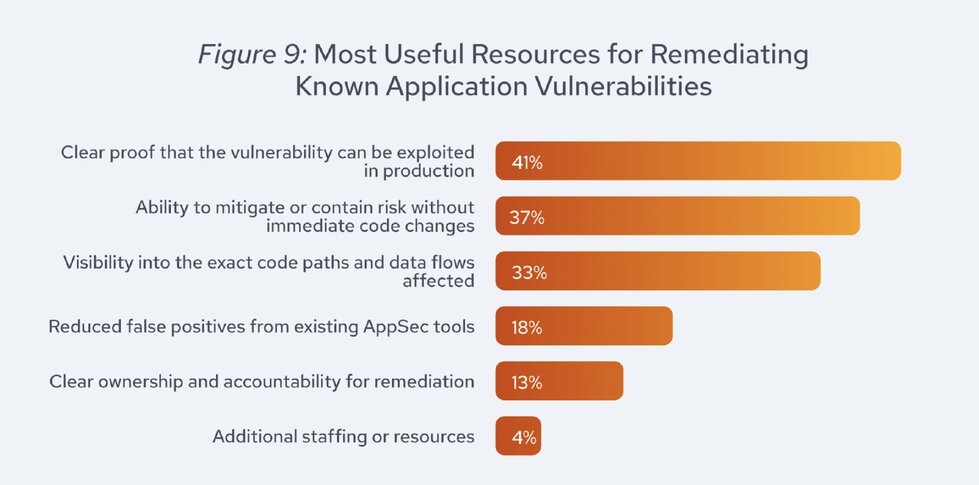
Organizations identify exploitability validation and runtime context as the most significant constraints in production security operations. The dominant challenge is distinguishing genuinely exploitable vulnerabilities from theoretical findings, while the most desired capability is proof that a vulnerability is reachable and exploitable within a specific production environment. Respondents consistently prioritize runtime evidence and contextual validation over additional staffing or broader scanning coverage, indicating that confidence in prioritization has become a larger operational issue than visibility alone.
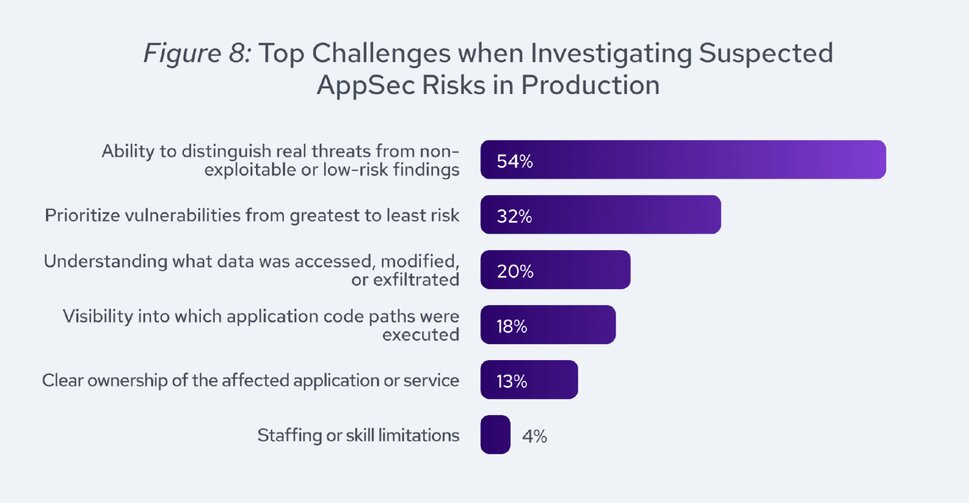
The hardest part of production security work, according to respondents, is distinguishing genuinely exploitable vulnerabilities from theoretical findings. What would most change remediation velocity is runtime evidence that confirms actual exploitability — whether a vulnerability is genuinely reachable in that specific environment. More staff working from incomplete context produces faster activity; it does not produce faster resolution.
Finding 5: The Will to Block Exists But Trusted Mitigation is Missing
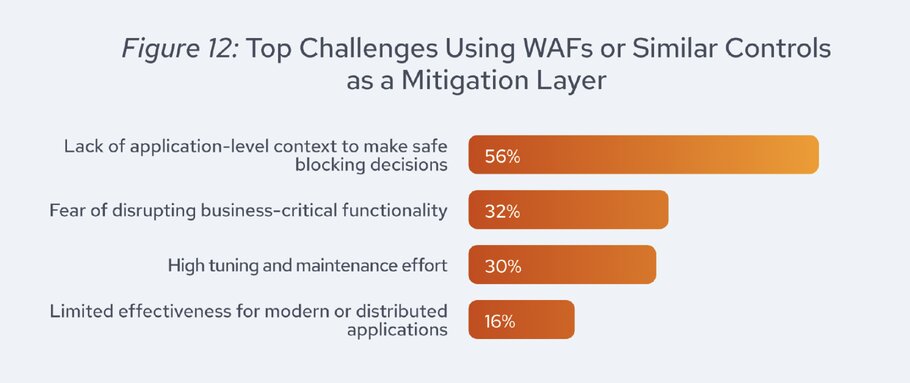
Organizations broadly support stronger runtime mitigation and virtual patching capabilities, but most do not trust current controls to safely enforce automated blocking in production. While WAFs and similar technologies are widely deployed, the majority of organizations operate them conservatively due to concerns around false positives, lack of application context, and the risk of disrupting business-critical functionality. The findings point to a gap between enforcement intent and enforcement confidence rather than a lack of interest in runtime protection.
Finding 6: Investment Intent Is Turning Toward Runtime Security
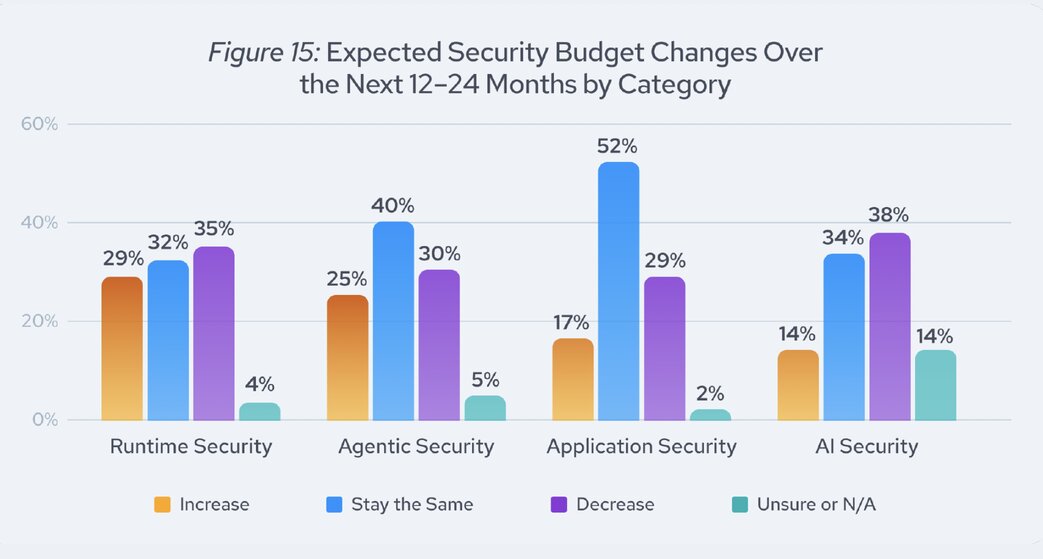
Security investment remains weighted toward pre-production controls, but organizations are increasingly recognizing the need for runtime visibility and defense. A substantial share of respondents plan to increase investment in runtime monitoring and protection over the next two years, reflecting growing concern that existing security models were designed for a slower threat environment.
As AI-assisted exploit development and vulnerability discovery continue to compress remediation timelines, organizations are beginning to shift focus from identifying vulnerabilities earlier to managing and mitigating them more effectively in production.
Application security programs have achieved broad maturity in vulnerability discovery and pre-production testing, but this report suggests that production environments remain the decisive layer where exposure turns into operational risk.
The missing capability is not additional coverage or headcount; it is runtime confidence, the ability to see and act on production behavior precisely enough to prioritize and mitigate. As AI-driven components enter production and make behavioral interpretation harder still, and as frontier AI compresses the time between disclosure and exploitation, the question for organizations whose investment has concentrated upstream is no longer whether risk reaches production — it is whether they can act on it quickly enough once it does.
Modern application security must extend beyond detection
The CSA report reinforces a trend we are seeing across cloud, cybersecurity, and AI environments: organizations have become very good at finding vulnerabilities, but many still struggle to reduce risk quickly enough once applications reach production.
Traditional application security investments have focused heavily on “shift-left” practices such as code scanning, testing, and vulnerability discovery. While these controls remain critical, the report demonstrates that attackers continue to exploit vulnerabilities after deployment, often within days of disclosure.
At Reputiva, we believe the next evolution of application security requires organizations to balance prevention with runtime protection.
This means:
- strengthening application security across development and production environments
- improving runtime visibility into application and AI workloads
- prioritizing vulnerabilities based on actual exploitability
- reducing remediation timelines
- improving cloud-native security monitoring
- securing AI-powered applications and services
- strengthening security posture across AWS, Azure, and GCP
As AI becomes embedded into production systems, organizations need security strategies that can keep pace with increasingly dynamic application behavior and shrinking exploitation windows. Security teams can no longer rely solely on what happens before deployment. They must also understand what is happening while applications are running.
Strengthen Application, and AI Security before risk reaches production
Whether your organization is deploying cloud-native applications, AI-powered services, APIs, or modern workloads, maintaining visibility and control across production environments is becoming essential for cyber resilience. Reputiva helps organizations strengthen:
- cloud security governance
- application security strategy
- AI readiness and AI security
- runtime visibility and monitoring
- vulnerability management programs
- identity and access management
- security architecture reviews
- AWS, Azure, and GCP security posture
Book a consultation to assess your organization’s application security, AI security, and cloud governance strategy and identify opportunities to reduce risk before vulnerabilities become incidents.