Artificial intelligence is rapidly becoming the next frontier of government transformation. From digital service delivery to improving citizen services to automating internal operations, AI, especially generative AI, is unlocking new levels of efficiency and innovation across public sector organizations.
But here’s the reality:
AI adoption in government is not just a technology upgrade; it’s a complete transformation of how governments operate, make decisions, and manage risk.
According to Microsoft’s 2024 “State and Local Government AI Roadmap,” governments are already moving beyond experimentation and into structured AI adoption, leveraging tools like copilots, chatbots, and data-driven automation to enhance both citizen experiences and workforce productivity.
The “Microsoft for Government e-book” highlights the growing challenges government agencies face, including cybersecurity threats, data fragmentation, hybrid work, and the need to build digital trust.
However, this shift comes with significant challenges:
- Data privacy and security risks
- Governance and compliance complexities
- Workforce readiness gaps
- Legacy infrastructure limitations
In this article, we combine insights from Microsoft’s latest government reports to outline a practical roadmap for public sector organizations looking to adopt AI while strengthening security, improving operations, and delivering better outcomes for citizens.
Key Insights from Microsoft for Government Reports
Digital and cloud technology play a critical role in enabling governments to continue serving their communities successfully in these changing times. Governments today face a myriad of challenges, including:
Cyber threats and security:
Today’s cybersecurity threat landscape requires resilience and agility from governments. They need comprehensive solutions to meet changing demands.
Establishing digital trust:
More people access government services via phones, tablets, and computers. Agencies must secure data and build trust, while ensuring equitable access.
Data sharing and collaboration:
Departments need to securely share data and collaborate across agencies. Unlock data-driven insights with access to multiple data sets and better analytics.
Hybrid work models:
Government employees need hybrid work solutions that accommodate varied scenarios and enable consistent, reliable access to data and systems.
Efficiency:
Governments need to optimize IT and program budgets. Employees need tools and resources to automate processes, improve productivity, and meet sustainability goals.
Skilling:
Innovative technology enables governments to attract talent, accelerate education, and hone skills to engage and retain employees.
Addressing the gap with technology
Governments face many complex and unique challenges as they work to modernize. The four crucial areas to digital transformation are enabling governments to effectively and efficiently serve their communities.
Deliver innovation in programs and experiences
With an uncompromising approach to security and privacy, your organization can drive increased public engagement, build trust, and facilitate equitable access to vital programs and services.
Empower the government workforce
Governments can enhance collaboration across agencies with solutions that enable secure, dynamic communication and support a hybrid workforce.
Transform government operations and services
Legacy systems are often slow, complex, and vulnerable. Government agencies can benefit from digital transformation across the front end and back office to increase resilience and improve sustainability. Incorporating innovative tools and services can help streamline repetitive processes and workflows and uncover meaningful data insights. Using cloud solutions can help build a strong, digital foundation that drives organizations into the future.
Secure government data and protect resources
Governments have heightened needs related to security. People expect privacy and security from their governments. Agencies need to protect personal data and mission-critical data. Employees need to securely collaborate across teams, departments, and agencies—ensuring that information reaches only the right people. It is critical that the security ecosystem remains compliant and secure.
Microsoft for Government Offerings
- Government operations & Infrastructure
- Public Safety & Justice
- Public Health & Social Services
- Public Finance
Microsoft’s State and Local Government AI Roadmap
For years, governments have relied on AI for insights, such as providing early warnings of natural disasters and identifying potentially fraudulent benefits claims. Now the latest in AI, generative AI, can unlock even more opportunities to help governments improve efficiency and enhance services.
The paper defines a roadmap for government adoption of AI by identifying the government policies and operations most affected by the new technology and providing readiness guidance based on the work of leading governments that have already deployed AI-based solutions.
The roadmap outlines common steps governments should consider to responsibly begin benefiting from AI innovations. They can be performed in any order.
- Set direction and prepare the workforce
Develop a plan for AI – America’s AI Action Plan | New York City AI Action Plan
Implement an AI training program – Free AI training from LinkedIn Learning.
Gain experience with generative AI – Microsoft CoPilot | - Implement AI governance
Define a principles-based approach to AI governance – NIST AI Risk Management Framework (RMF)
| ISO/IEC 23894:2023Information technology — Artificial intelligence — Guidance on risk management
| Microsoft Office of Responsible AI
Create AI roles and responsibilities – Maryland Senior Advisor for AI | New Jersey State’s Chief AI Strategist.
Develop and implement an AI use policy – Boston | San Jose | The State of Kansas - Update procurement practices
Gain trust through certification and compliance practices – Microsoft Trust Center
Create a cloud and AI Center of Excellence
Create procurement guidance for cloud and AI services.
Leverage AI for procurements – Port Authority of New York and New Jersey’s Beacon chatbot - Review data governance and security
Assess and automate data governance practices
Accelerate cloud migrations. - Foster AI innovation with trusted technology partners
Seek input on potential uses – The State of North Dakota AI learning cohorts | The State of California Governor’s AI Executive Order
Hold an AI Discovery event
Create sandboxes for testing
Encourage government pilots
Scale with success
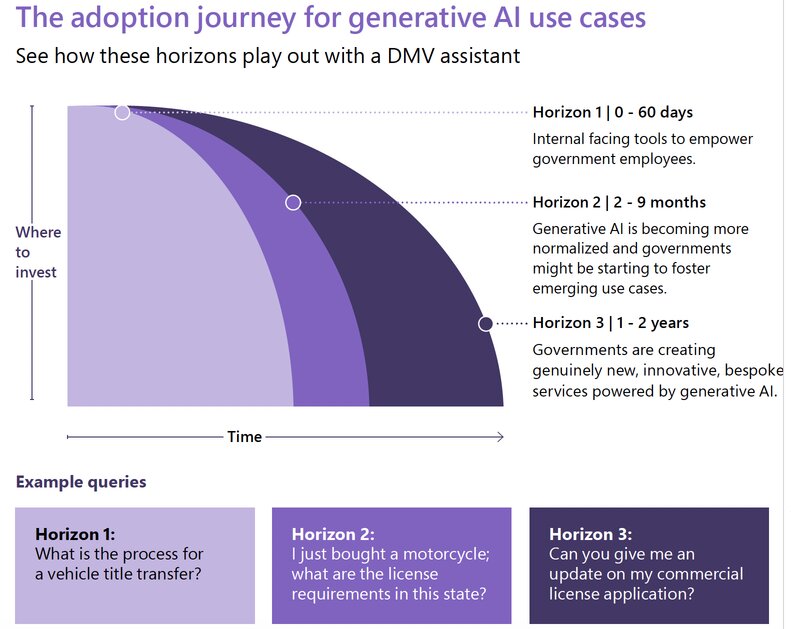
Governments are primarily using AI in two ways:
- External use cases to simplify the constituent experience when engaging with government services. For example, a chatbot that residents can engage with 24/7 to obtain authoritative information about government services; and
- Internal use cases to empower government employees with insights at their fingertips. For example, summarizing a case file with years of notes to help a new case worker quickly get up to speed on a matter.
Planning your AI and digital transformation strategy?
Reputiva helps government agencies and public sector organizations design secure, AI-ready cloud environments by combining identity, data governance, and Zero Trust principles to ensure safe, scalable transformation.
Book a consultation