The fifteenth annual Flexera 2026 State of the Cloud Report sheds light on the cloud computing trends, the pressures facing IT professionals and the strategic initiatives they’re utilizing to remain competitive in today’s dynamic and evolving landscape.
This year’s report shows cloud has entered a new phase—one where value, governance and conquering complexity define success. Generative AI (GenAI) is accelerating, and hybrid cloud remains the dominant architecture.
Success in the cloud isn’t just about technology—it’s about aligning stakeholders to drive business value.
According to the Flexera 2026 State of the Cloud Report, organizations are entering a new phase of cloud maturity, one defined by AI adoption, governance, and the challenge of managing hybrid and multi-cloud complexity.
What’s changing isn’t just the technology but also how success is measured.
Key Findings
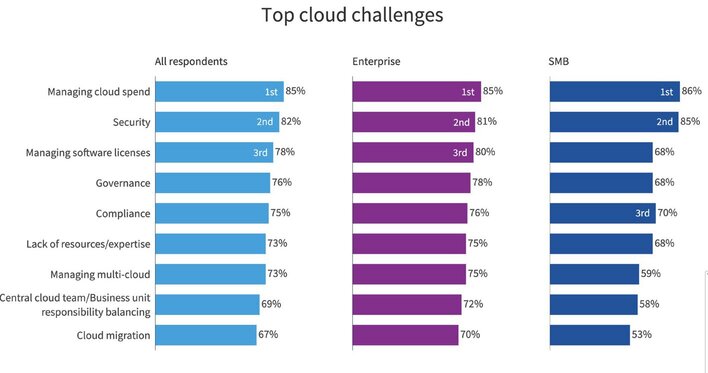
Managing cloud spend and security remain top challenges
85% of respondents say managing costs is their number one priority. It’s no surprise that cost (85%) and security (82%) continue to be the leading challenges for organizations. In fact, this marks the fourth consecutive year that cost has outranked security as the top concern, after a decade with security in the lead. Managing software licenses isn’t far behind, with 78% of all respondents ranking this in third place.
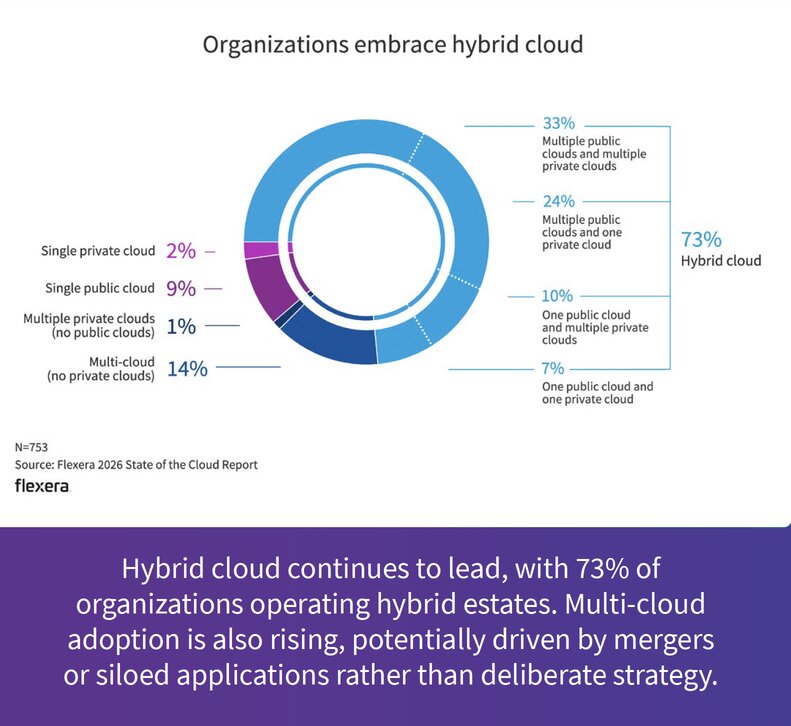
Organizations embrace hybrid cloud
The majority of organizations now use a hybrid cloud model, a figure that has increased by 3 percentage points compared to last year. Multi-cloud adoption has also risen by 2 percentage points year over year; however, just 14% of organizations surveyed operate exclusively in a multi-cloud environment without a private cloud
73% of all organizations embrace hybrid cloud
Cloud enters the value era
Organizations are moving beyond the early FinOps focus on cost-cutting. The 2026 report shows a clear pivot toward measuring business value instead of just savings. Metrics like value delivered to business units jumped 12 percentage points, while cost efficiency and cost avoidance declined.
This shift signals growing maturity: FinOps is evolving into a role that helps articulate the business value of technology.
More teams are adopting unit economics to understand cost per service and align spending with outcomes, with nearly half (49%) using this approach, compared to only 40% last year.
Cloud success is no longer about trimming budgets—it’s about proving ROI and enabling innovation.
AI adoption accelerates—and oversight rises
GenAI has become pervasive. In terms of public cloud services used by all organizations, GenAI has jumped 8 percentage points to the third-place spot (58%), and nearly half say they use it extensively. Organizations recognize that AI brings not only opportunity but also complexity and risk. Governance frameworks, cost visibility and automated controls are becoming essential as AI workloads expand.
Cost challenges persist
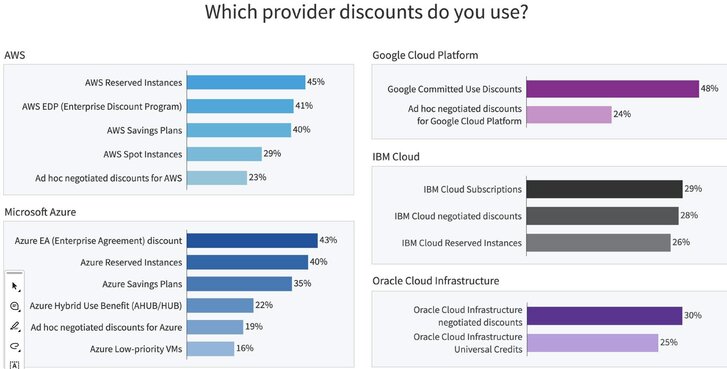
Estimated wasted cloud spend ticked up to 29%, reversing a five-year downward trend. Despite clear savings, fewer than half of organizations are utilizing any one commitment discount per cloud provider. These patterns underscore the persistent challenge of managing costs in an environment where innovation and flexibility often outweigh predictability and control.
Centralization and governance gain momentum
Organizations are formalizing cloud oversight to tame complexity and align strategy. Adoption of CCOEs rose to 71%, and FinOps team prevalence climbed to 63%. Governance responsibilities are expanding beyond cloud teams to include business units and software asset management (SAM) teams, reflecting a more holistic approach to managing cloud usage and costs.
The rise of centralized governance signals that organizations see cloud as a strategic asset requiring disciplined oversight.
MSPs evolve to meet new demands
Managed service providers (MSPs) and systems integration partners remain critical for managing complexity—but with the rise of AI, their service catalog is changing. Nearly half of MSPs plan to offer AI consulting and SaaS management services, while two-thirds are adopting AI for cybersecurity use cases.
Success in 2026 and beyond will hinge on maximizing value, effective oversight and managing complexity. Organizations that approach FinOps strategically, embrace disciplined discounting and establish robust AI controls will not only keep costs in check, but they’ll also unlock the full potential of cloud to fuel growth, resilience and innovation.
Conclusion
The Flexera 2026 report makes one thing clear:
Cloud success is no longer defined by how much you save but by how much value you create.
Organizations that succeed will:
- Align cloud strategy with business outcomes
- Invest in governance and FinOps maturity
- Manage hybrid and multi-cloud complexity effectively
Because in today’s environment, the cloud is not just infrastructure
It is a strategic driver of innovation, efficiency, and competitive advantage
Turn Cloud Complexity Into Business Value
The cloud is evolving, and so should your strategy. At Reputiva, we help organizations:
- Optimize cloud across AWS, Azure, and GCP
- Implement FinOps and cost governance frameworks
- Secure hybrid and multi-cloud environments
- Align cloud investments with business outcomes