IBM Institute for Business Value (IBM IBV), in partnership with Oxford Economics, surveyed 2,000 executives in the third and fourth quarters of 2025 about how they expect their organization to evolve over the next five years. Responses from leaders across 33 geographies and 23 industries reveal a seismic reconfiguring of operational practices and strategic assumptions.
The IBM Enterprise in 2030 Report highlights five predictions for 2030 that leaders can act on today to bring the smarter enterprise to life. The five predictions for 2030 include:
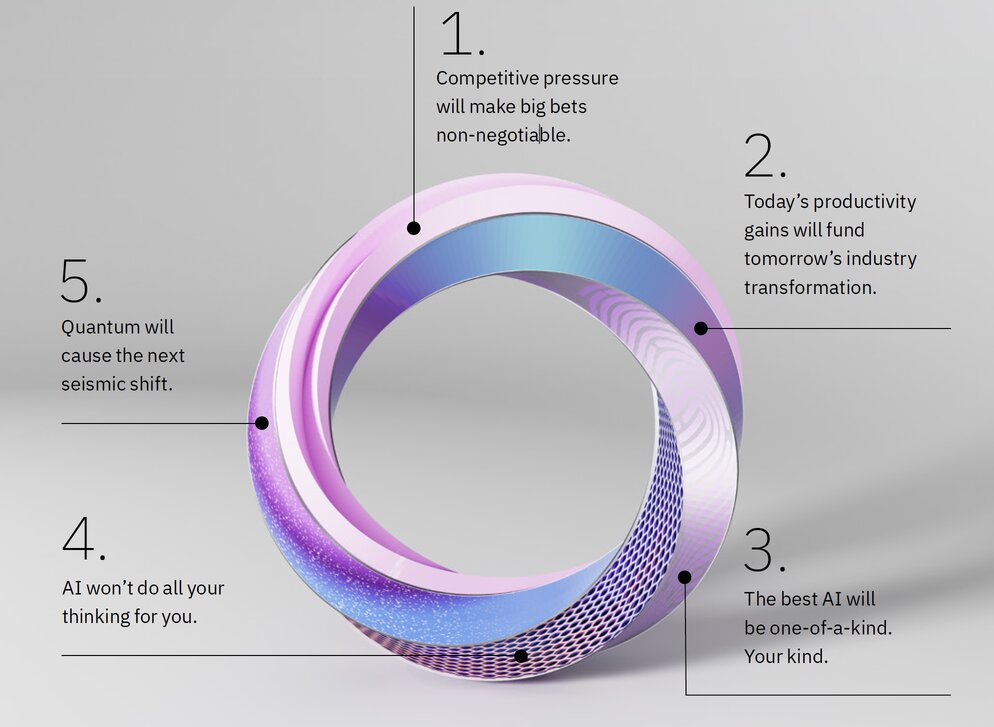
- Competitive pressure will make big bets non-negotiable.
- Today’s productivity gains will fund tomorrow’s industry transformation.
- The best AI will be one-of-a-kind. Your kind.
- AI won’t do all your thinking for you.
- Quantum will cause the next seismic shift.
The AI ROI Blind Spot
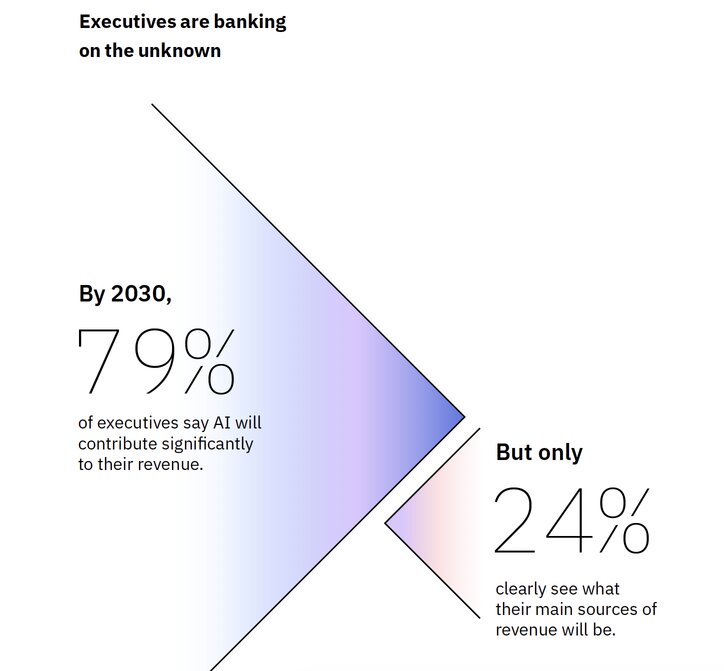
79% of executives say AI will significantly contribute to their revenue by 2030, but only 24% can clearly see where that revenue will come from. That gap between expectations and outcomes presents the leadership challenge of this decade.
Tailored Technology
Winning CEOs won’t chase competitive advantage. They’ll code it into existence. That requires tailored technology—digital agents, AI models, and data that capture each organization’s business logic. Generic algorithms and off-the-shelf agents alone won’t differentiate. The real advantage (and ROI) comes from AI capabilities that no competitor can replicate.
AI-first Enterprise
It’s not about bolting AI onto existing ways of working. It’s pivoting to an AI-first enterprise. Most executives—57%—now say their competitive advantage will come primarily from the sophistication of their AI models by 2030. While people will remain essential, organizations will need to build differentiating technology for even the best teams to deliver an edge in an AI-first world.
The dawn of the smarter enterprise
The enterprise of the future won’t win by fine-tuning today’s operations. In tomorrow’s AI-powered global economy, success will flow from lightning-fast decision-making and real-time course-correction. Getting there requires rewiring the enterprise to make it less monolithic, more modular—less like hardware, more like software.
What emerges is the smarter enterprise. Where traditional enterprises are built around fixed processes, linear decision-making, and periodic executive reviews, the enterprise of the future embeds transformation into its operational DNA. It uses every interaction, transaction, and outcome to continuously become smarter, faster, and more responsive.
Prediction 1
Competitive pressure will make big bets non-negotiable
In 2030, success won’t be measured by steady progress toward long-term targets. It will be defined by how much an enterprise disrupts its industry quarter by quarter. The biggest risk won’t be making the wrong bets—but making bets that are too small.
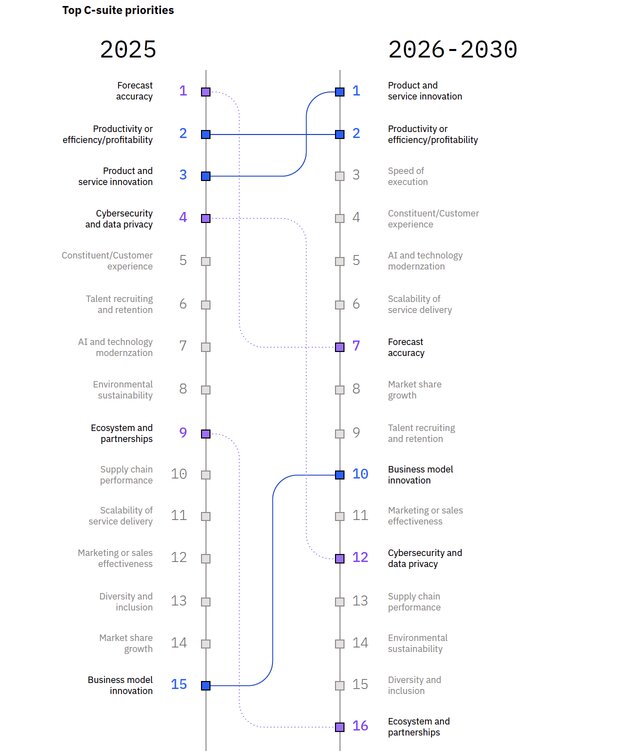
IBM research indicates that winning in 2030 will depend on a combination of creativity, confidence, and speed: 55% of executives say competitive advantage in 2030 will depend more on speed of execution than making perfect decisions. These leaders know they’ll have to make bigger bets faster—with less complete information at their disposal.
Unlike today’s calculated risks, tomorrow’s bets will prioritize entering uncharted markets, creating entirely new revenue streams, and challenging traditional business logic.
The smarter enterprise transforms velocity into wisdom, using every interaction as a data point to refine its understanding of what works, what doesn’t, and what’s next. It’s always on and continuously adapting.
Prediction 2
Today’s productivity gains will fund tomorrow’s industry transformation.
Today’s AI investments are driving unprecedented productivity gains. And these efficiency improvements are just the opening act. A two-phase revolution has already begun.
- Phase one, focused on using AI to eliminate waste, accelerate processes, and amplify human capability within existing business models, is already well underway.
- Phase two leverages the resources freed up from those productivity gains to reimagine entire industry verticals—and the first to get it right could earn an unassailable advantage.
The smarter enterprise will operate with resource abundance that previous generations of leaders couldn’t have hoped for. Traditional trade-offs between growth and profitability, innovation and efficiency, or scale and agility become obsolete when AI eliminates the scarcity that forced those choices in the first place. When capital, talent, and operational barriers no longer limit what’s possible, the question shifts from “what can we afford to do?” to “what should we choose to create?” Vision, adaptability, and courage become the primary differentiators.
Cybersecurity is evolving from a cost center that prevents or manages threats to a strategic capability that enables rapid, safe innovation. Smarter enterprises aren’t just more secure—they move faster, take smarter risks, and build competitive advantages
Prediction 3
The best AI will be one-of-a-kind. Your kind
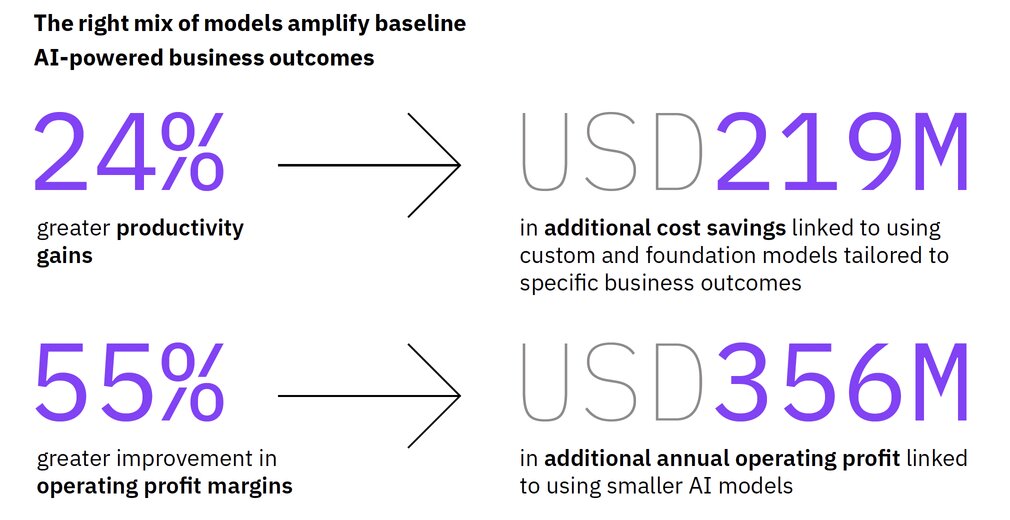
Tomorrow’s competitive advantage won’t come from using the largest AI models. It will come from using AI in a way that no one has before. As AI becomes ubiquitous, uniqueness becomes essential. When every organization has access to the same large foundation models, the differentiating factor becomes how well these different models are combined and customized—and how unique enterprise data is incorporated to achieve targeted business objectives.
Prediction 4
AI won’t do all your thinking for you.
Today’s job roles will be unrecognizable in the enterprise of the future. Already the half-life of human skills is shrinking. While a smarter enterprise will amplify the unique strengths of humans and machines, IBM’s analysis shows that tomorrow’s AI should lead in some areas that today require a human touch.
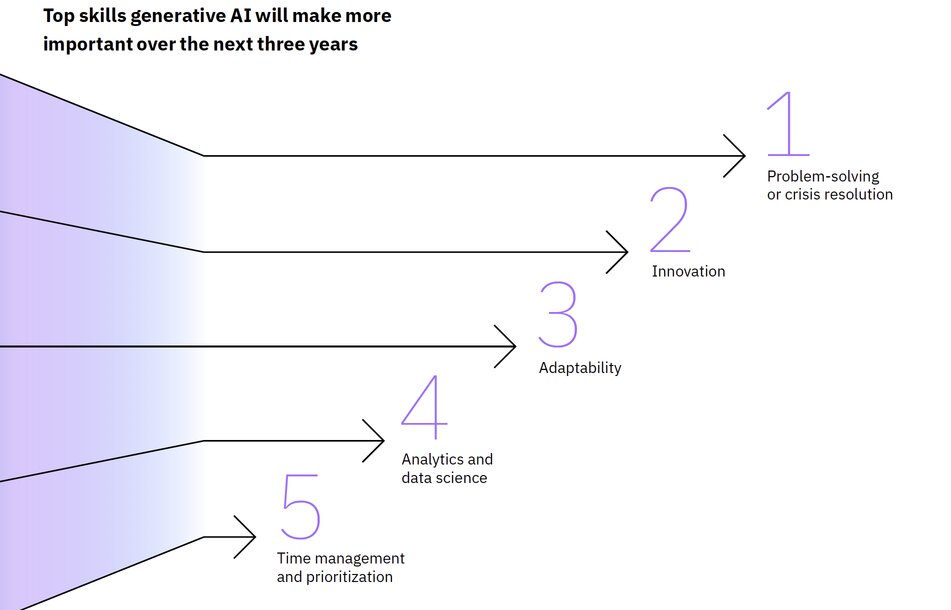
Today, organizations hire specialists for job roles that require targeted expertise. But tomorrow, AI will be the specialist in many situations. When trained and governed properly, AI models, agents, and assets have the potential to take on tasks that a human would need years to master. In that environment, human expertise becomes a cost the organization must justify. While critical thinking will still be essential, competence won’t be a differentiator. Human creativity and ingenuity—the brilliant ideas that break new ground—is what will deliver a competitive advantage.
As pre-AI workflows become obsolete, employees will need to envision entirely new functions that can manage AI-first operations. Instead of teams of people who use AI to augment individual job roles, they need orchestrators who can manage AI across multiple domains and integrate insights that span traditional departmental boundaries.
Prediction 5: Quantum will cause the next seismic shift.
Quantum has the potential to accelerate computing—and to unlock use cases beyond the abilities of even today’s most powerful high-performance computers. Signals of quantum computing providing potential value are already emerging in applications as diverse as drug discovery, financial modelling, and materials simulation.
Quantum computing, with its ability to process and analyze certain data structures in ways that can’t be replicated classically, pushes past today’s computational limits—including the limits of AI. While AI can unlock problems at a large scale, quantum algorithms can address complex problems by exploiting underlying structure. Quantum and AI working together will offer truly transformative computational capabilities.
Quantum-ready organizations—those that rank in the top 10% of our 2025 Quantum Readiness Index—are three times more likely to belong to multiple ecosystems than other organizations.
Building the AI-First Enterprise
The IBM Enterprise in 2030 report makes it clear: the future belongs to organizations that are not just adopting AI, but redesigning their operations around it. This means moving toward agent-driven workflows, real-time decision-making, and continuously adaptive systems, powered by hybrid and multi-cloud environments.
At Reputiva, we help organizations build this foundation; aligning AI, cloud across AWS, Azure, and GCP, and security into a cohesive, scalable strategy.
Start building your AI-first enterprise today, securely and at scale.