Coursera partnered with Amazon Web Services (AWS) to survey 750+ senior technology executives across six countries who are leading digital transformation initiatives. AI transformation is accelerating, but according to the Coursera-AWS From Cloud to AI report, organizations are realizing something important: AI success still depends on strong cloud foundations.
The report found that 95% of technology leaders prioritize cloud transformation as a key business goal, while cloud skills are ranked even more critical than AI skills over the next three years.
Key Findings
95% prioritize cloud transformation as a key business goal, with leaders ranking cloud skills (like cloud development and cloud engineering) as more critical than AI skills (like ChatGPT and applied machine learning) for the next three years. Despite increasing automation—with 99% expecting AI-assisted codebases—technology leaders emphasize that investments in talent development are essential to achieving their transformation goals.
1. Cloud foundations enable AI success
Ninety-five percent of technology leaders identify cloud transformation as a key business goal, with cloud skills (63%), like cloud development and cloud engineering, ranked as more critical than AI skills (47%) for the next three years.
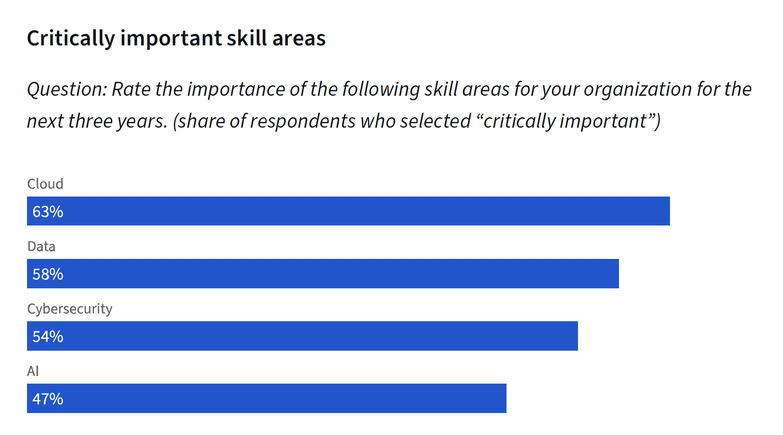
Technology leaders are prioritizing the development of foundational capabilities like cloud, data, and cybersecurity over AI skills.
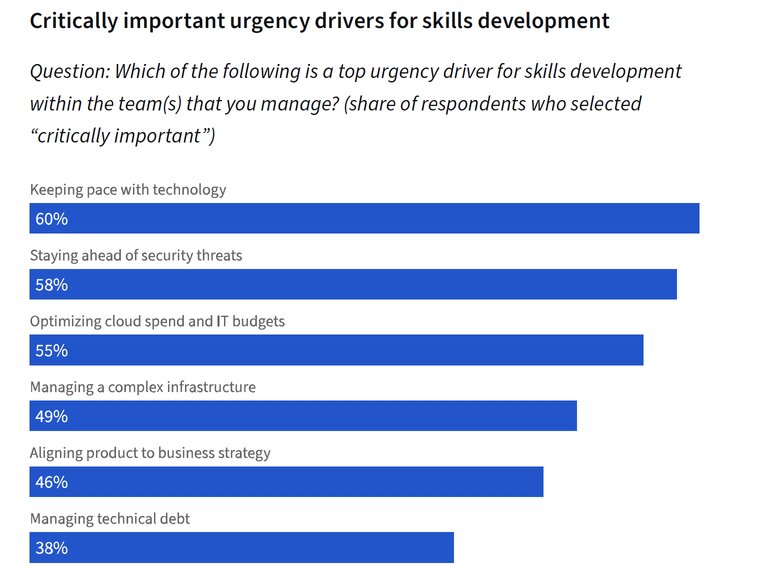
Keeping pace with technology is the number one urgency driver for skills development among leaders. This pressure to remain current amid rapid technological change influences how leaders prioritize their transformation initiatives and skills investments.
2. Task automation is transforming technical work
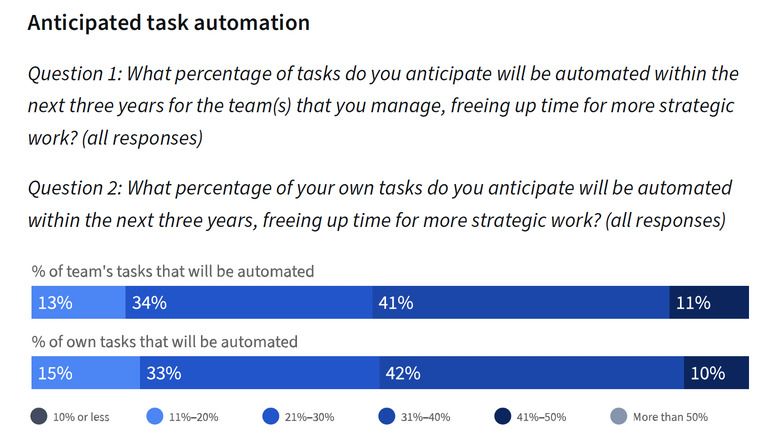
Fifty-two percent of technology leaders anticipate that 30–50% of their tasks and their teams’ tasks will be automated within three years, with 99% expecting AI-assisted codebases.
Technology leaders are preparing for automation to transform their teams, workflows, and workplace demands. Respondents expect that they and their teams will see up to half of their tasks automated by AI within three years.
No role is immune—including leadership
Nearly every respondent in our survey anticipates that some of their own tasks will be automated within the next three years. More than half (52%) expect that 30–50% of their personal workload will be handled by AI systems, freeing up time for more strategic work. Research from McKinsey & Company has found that employees most often spend time saved by automation on entirely new activities or on existing responsibilities that have not been automated.1
The transformation of software development
The impact on software development will be particularly profound. Nearly all respondents (99%) anticipate their codebases will be partially AI-generated or developed with AI assistance within three years. Among these leaders, 86% expect that between 20% and 50% of their organization’s code will involve AI in its creation.
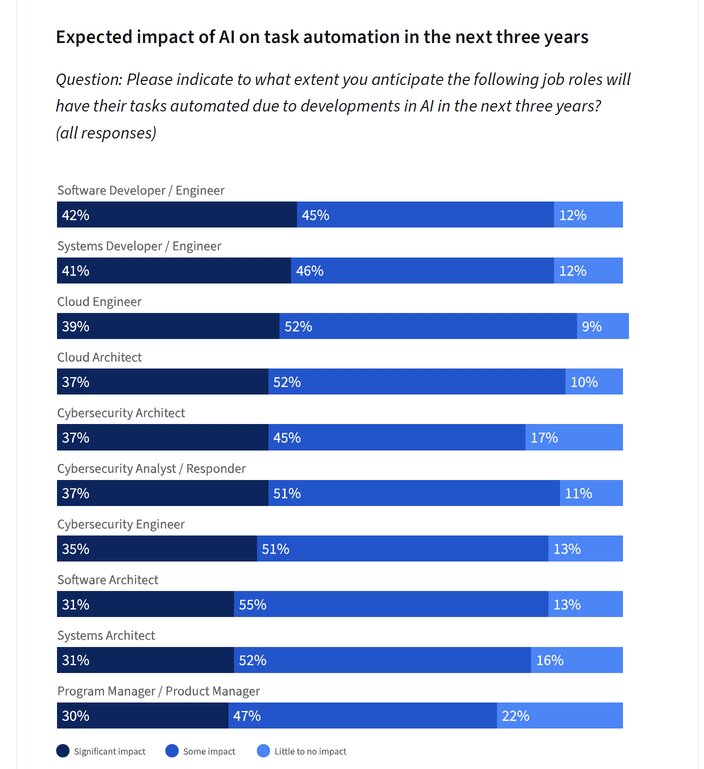
The more a role involves repetitive technical work, the more AI will reshape it. As coding tasks become increasingly augmented by AI, the role will likely evolve toward more design-oriented work and prompt engineering, rather than traditional line-by-line coding.
The Upskilling Imperative
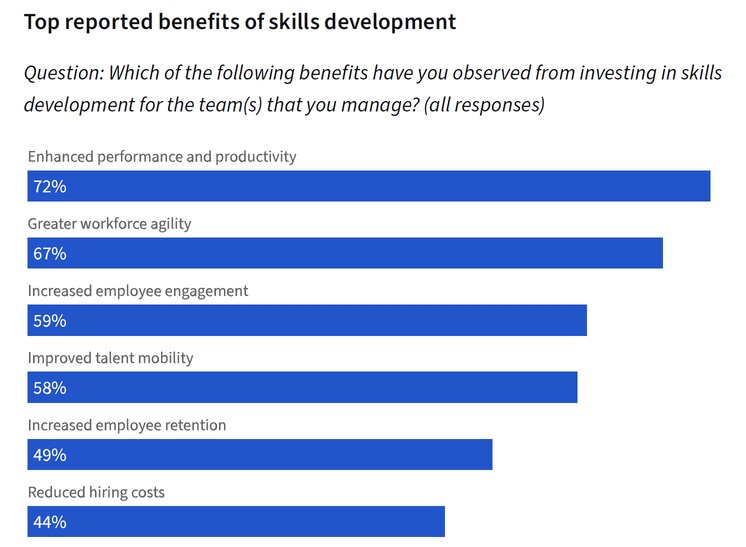
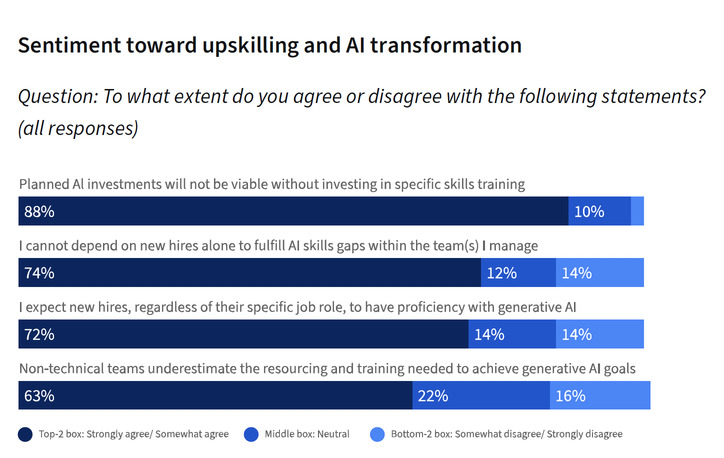
88% of leaders agree that their planned AI investments will not succeed without increasing investments in training, and 77% recognize that upskilling is essential to realizing broader transformation goals over the next 12–18 months. This creates a clear mandate for technology leaders to incorporate talent development into their digital transformation roadmaps.
3. Human talent is irreplaceable
Nearly nine out of ten (88%) leaders agree their planned AI investments will not succeed without increasing investments in skills development, while 77% recognize that upskilling existing employees is essential to achieving transformation goals in the next 12–18 months.
4. Training must mirror workplace challenges
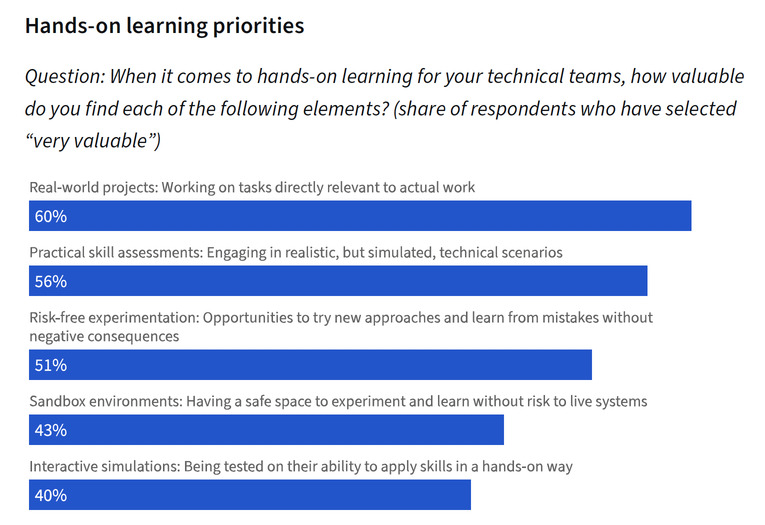
Sixty percent of technology leaders believe real-world projects directly relevant to work are the most valuable element in technical training, with practical skills assessments (56%) and risk-free experimentation environments (51%) completing the top priorities for effective learning.
As technology teams face unprecedented transformation, the approach to skills development must evolve accordingly. The research reveals that traditional training methods are insufficient in preparing teams for AI-driven environments. Instead, technology leaders are prioritizing immersive, contextual learning experiences that closely simulate workplace challenges.
Real-world projects directly relevant to work tasks (60%) emerged as the most valuable element. Leaders emphasized that learning experiences should bridge directly to the specific challenges their teams face, rather than teaching generic concepts in isolation.
The traditional model of individual learning, disconnected from work tasks and team contexts, is giving way to a more integrated approach that blends learning with actual work challenges.
From Cloud to AI Requires More Than Technology
The organizations that win will not be the ones with the most AI tools but the ones with the strongest cloud foundations, security posture, and talent strategy.
At Reputiva, we help organizations align cloud, AI, and cybersecurity into a scalable, secure transformation roadmap.