Artificial intelligence has rapidly evolved from experimental technology to an operational necessity. Organizations are deploying AI assistants to draft emails, summarize meetings, support customers, and automate business workflows. At the same time, autonomous AI agents are beginning to perform tasks with minimal human intervention.
According to Proofpoint’s 2026 AI and Human Risk Landscape Report, AI adoption is accelerating faster than security programs can adapt. The report surveyed more than 1,400 security professionals worldwide and found that while 87% of organizations have deployed AI assistants beyond the pilot stage, only a minority feel fully prepared to secure and investigate AI-related threats.
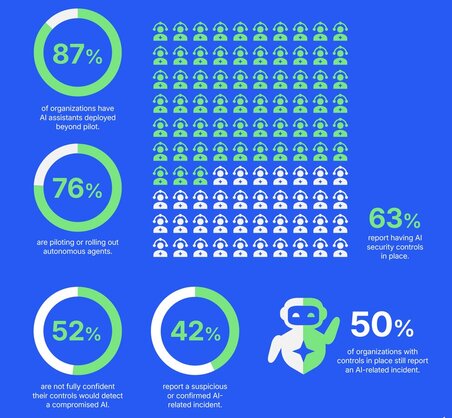
87% of organizations report AI assistants beyond pilot, and 76% are actively piloting or rolling out agents.
That speed has turned collaboration channels into the primary attack surface. AI now operates across email, SaaS apps, file-sharing tools, and messaging platforms. It is in these environments that people and AI agents work together on trusted information. The report quantifies the issues that are making collaboration security even more difficult to solve, from the pace of AI deployment to the effectiveness of current controls to the ability to investigate when something goes wrong.
The report highlights a growing reality: AI is no longer creating a new security perimeter. Instead, it is expanding risk across email, SaaS applications, collaboration platforms, file-sharing systems, and digital workflows simultaneously. Organizations must now secure not only users and identities but also the AI systems acting on their behalf.
AI deployment has outpaced security, and the response remains uneven
AI assistants are mainstream. Autonomous agents are next.
AI has crossed the line from experimentation to operational dependency. The vast majority of organizations say AI assistants are already beyond pilot. And autonomous agents – AI that can independently plan and execute multistep task without ongoing user input —are moving into active rollout.
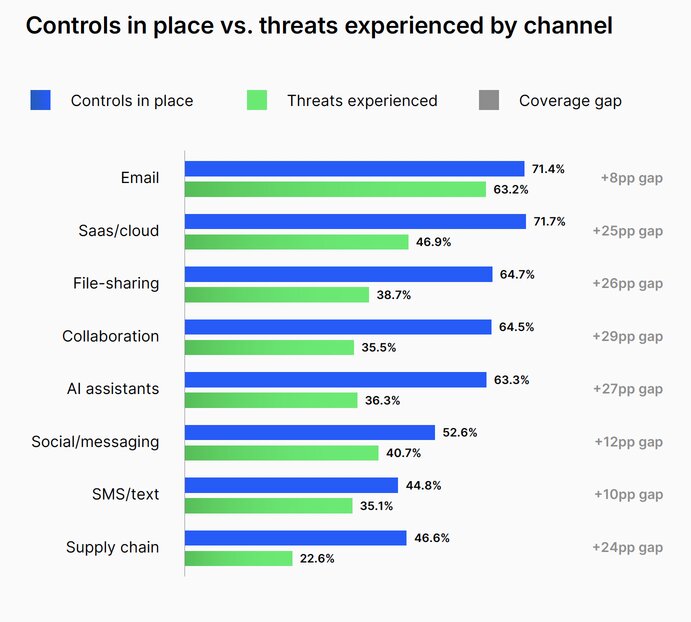
More than half of organizations have security controls across collaboration channels, but they can’t confidently say those controls work
- 63% report having AI security controls in place.
- 52% are not fully confident that those controls would detect a compromised AI.
- Among organizations with controls in place, 50% have already experienced an AI-related incident.
- When asked what’s missing, 56% want multichannel controls, and 52% want controls that are specific to AI-powered tools and agents.
Coverage is being mistaken for control. Deployment is broad, but visibility and trust are still weak.
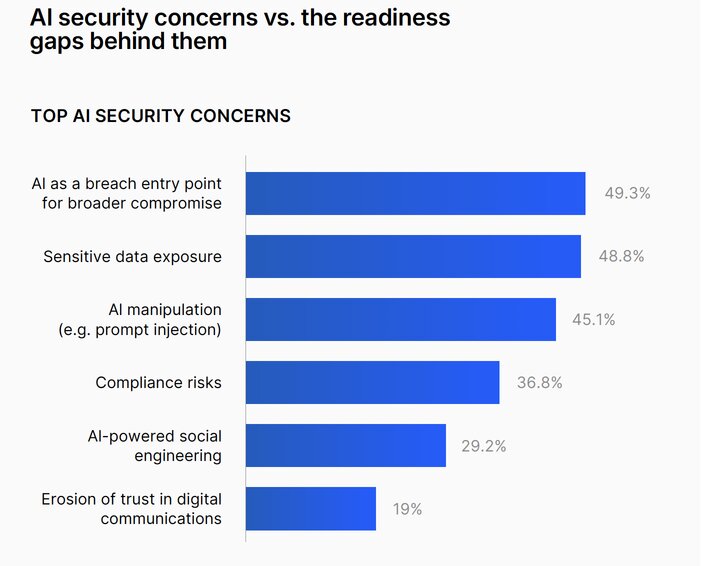
Collaboration security is the defining challenge
Threats are appearing in more channels. AI expands the number of trusted interactions across collaboration channels. And attackers can exploit those interactions across identity, content, and automation layers simultaneously.
URLs are used 4x more often than attachments in malicious emails.
Tools Sprawl
AI lowers the barrier for attackers and enables them to scale attacks quickly. When threats operate at machine speed, disconnected tools slow down security response and give attackers an advantage.
An AI-powered social engineering attack might start in email, escalate through a collaboration tool, and exfiltrate data through an AI assistant’s connected integrations. Unified visibility is required to reconstruct that chain. Reconstructing that chain requires unified visibility that point tools can’t provide.
The bottom line
AI adoption has outrun the security models designed to govern it. Organizations can’t confirm that their controls are effective. And when something goes wrong, many can’t fully investigate what happened. Two structural forces make each stage harder.
Collaboration channels are the primary stage for AI risk, not the backdrop. And tool sprawl is the structural reason these gaps persist.
Trust Problem
Organizations are asking AI to act on their behalf – with customers, with partners, and inside workflows that drive revenue. Every one of those interactions depends on trust that the AI isn’t being used to deliver malicious content through trusted channels, that the data it acts on hasn’t been poisoned, and that the identity won’t cascade across connected systems.
When security can’t verify those things, the consequences go beyond technical exposure. Agent rollouts stall, work reverts to manual paths, and collaboration with suppliers becomes harder to secure and harder to scale.
AI Security starts with securing the collaboration surface
One of the most important insights from the report is that AI is transforming collaboration channels into primary attack surfaces.
Historically, organizations focused on securing endpoints, networks, and applications. Today, AI assistants and agents operate directly within email platforms, Microsoft 365 environments, Google Workspace, SaaS applications, cloud storage repositories, and collaboration tools such as Teams and Slack. As AI gains access to trusted business data and workflows, attackers gain new opportunities to exploit that trust.
At Reputiva, we believe organizations should view AI security through the lens of digital readiness rather than solely through technology adoption. AI readiness requires:
- Strong identity and access management
- Secure collaboration environments
- Data governance and classification
- AI-specific security controls
- Continuous monitoring and visibility
- Security awareness and AI literacy
- Cloud security across AWS, Azure, and GCP
- Incident response capabilities that span users, AI agents, and collaboration channels
The report reveals that many organizations have deployed AI faster than they have deployed governance. Security teams often lack visibility into AI actions, struggle to correlate threats across channels, and face increasing complexity from fragmented security tools.
The organizations that will benefit most from AI will not necessarily be those that deploy the most AI solutions. They will be the organizations that build secure foundations for AI adoption through strong cybersecurity, cloud governance, data protection, and digital readiness programs.
AI is not replacing traditional security challenges. It is amplifying them.
Build a secure foundation for AI Adoption
AI adoption is accelerating across every industry, but successful AI transformation requires more than deploying new tools. Organizations need secure collaboration environments, modern identity controls, strong data governance, and the visibility required to manage AI-related risks across the entire digital workplace.
Reputiva helps organizations assess and strengthen:
- AI readiness and governance
- Microsoft 365 and Google Workspace security
- Identity and access management
- Cloud security across AWS, Azure, and GCP
- Data protection and compliance
- Security awareness and AI literacy
- Digital transformation and digital readiness strategies
Book a consultation with Reputiva to evaluate your organization’s AI readiness, cybersecurity posture, and collaboration security strategy before AI risks become business risks.