Artificial intelligence is transforming how governments operate, but technology alone will not determine success. The 2026 MNP Municipal Report, People First, Technology Enabled: The Future of Municipal Work, examines how municipalities across Canada are preparing their workforce for an increasingly digital future. Based on responses from nearly 300 local government organizations, the report explores workforce planning, digital transformation, AI adoption, leadership, organizational culture, and citizen service expectations.
While many municipalities have embraced cloud technologies, digital tools, and emerging AI capabilities, the research reveals that the biggest barriers to transformation are no longer technological; they are organizational. Leadership capacity, workforce development, governance, skills shortages, change management, and digital literacy are now determining whether AI investments deliver measurable public value.
The report reinforces a growing reality across every sector: successful digital transformation is ultimately about enabling people, not simply deploying technology.
The findings show that while modernization is a clear priority, progress is inconsistent. Approaches to skill development vary, and the pace of change is straining organizational capacity; governance has not kept pace with technology adoption and AI use.
Key report insights
A fundamental shift is underway with municipal work
Local governments are navigating demographic shifts, evolving service expectations, and increasing complexity in how work is performed. An aging workforce, competition for talent, and changing employee expectations are converging as municipalities are being asked to modernize services and improve responsiveness.
Digital transformation is redefining how work gets done across the organization
Technology is reshaping local government operations across service delivery, finance, HR, asset management, and regulatory functions. Automation, data, analytics, and emerging uses of AI are changing role expectations and skill requirements, increasing the need for digital literacy and structured reskilling.
Roles are evolving as work is carried out differently across the organization
Automation and AI are reducing the time spent on routine, manual tasks, while increasing the emphasis on analysis, problem-solving, coordination, and direct engagement with residents. As a result, roles are beginning to function differently across municipalities. While there is broad recognition that these changes are coming, many organizations are still working through how to translate them into day-to-day practices across teams and functions.
Service expectations are driving new service delivery models
Residents and businesses expect accessible, seamless, and digitally enabled services that reflect their experiences with other organizations. Meeting these expectations requires stronger cross-department coordination, clearer end-to-end service ownership, and a workforce equipped to operate in integrated, citizen-centric service models.
Strong leadership and digital capability are critical to enabling transformation
As municipalities modernize how work is performed and services are delivered, strong leadership and growing digital literacy across the organization are becoming increasingly important. Leaders play a key role in setting direction, building confidence, and supporting new ways of working, while employees need the skills and fluency to use digital tools effectively. These combined capabilities enable municipalities to drive meaningful transformation, strengthen operational performance, and deliver better outcomes for their communities.
Organizational priorities and challenges
Top priorities in 2026
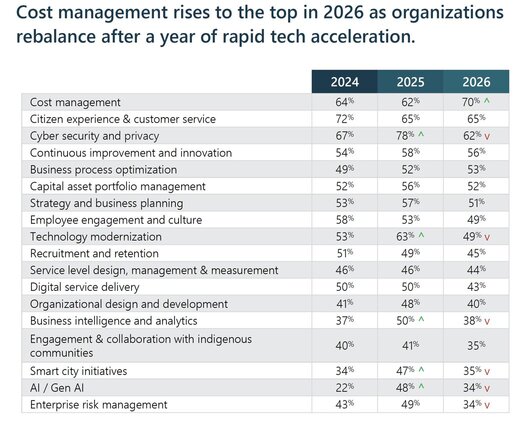
While service delivery and cyber security remain core priorities, 2026 reflects a strategic shift toward cost discipline and optimization following a year of rapid digital acceleration
- Cost management (70%) rising from 62 percent in 2025 and now the clear top priority
- Customer service (65%), steady year-over-year
- Cyber security and privacy (62%), declining from its 2025 peak (78%)
Persistent challenges
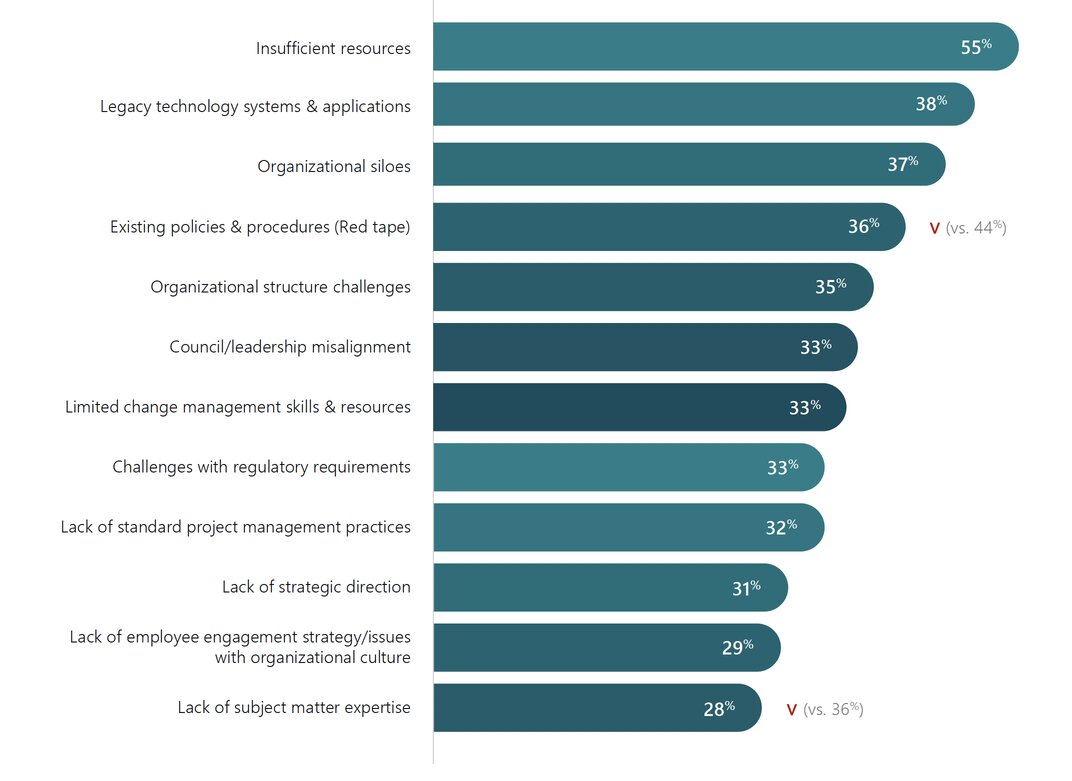
While governance friction (red tape) has eased and subject-matter expertise pressures have declined since 2025, workforce capacity, structural complexity, and legacy systems continue to constrain organizational progress.
- Insufficient resources (55%), remains the top constraint
- Legacy technology systems (38%), continue to limit agility
- Organizational siloes (37%), increasing slightly from 2025
Strategic priorities: evolving landscape
Cost management and citizen experience are the joint top priorities this year, signaling a strong focus on doing more with limited resources while still meeting service expectations. Viewed together, they suggest organizations are under pressure to balance fiscal discipline with visible, front-line outcomes for residents.
Organizational barriers: what’s gaining & losing impact
Resource constraints remain the most significant barrier, alongside ongoing impacts from legacy technology and organizational siloes. This suggests that capacity, complexity, and structural limitations are the primary factors constraining progress, even as expectations and priorities continue to rise.
Digital Literacy
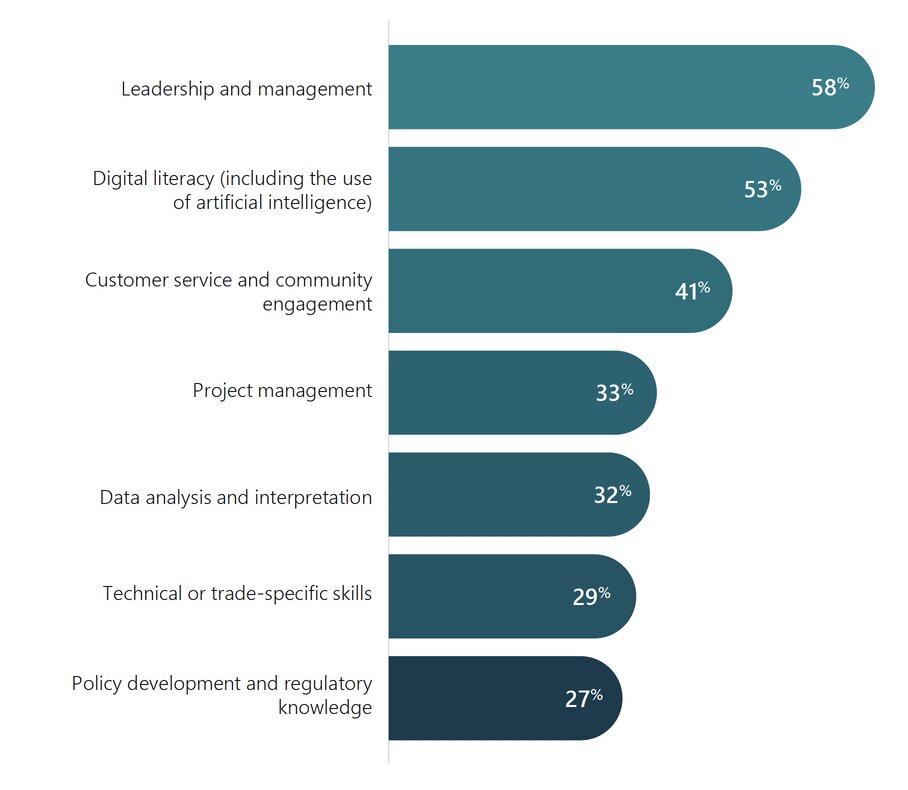
Digital literacy is becoming a core capability, with more than half of respondents identifying it, including the use of AI-enabled tools, as essential for future service delivery. As technology becomes more embedded in everyday municipal operations, the ability for employees at all levels to work confidently with digital tools is becoming increasingly important.
Future-ready skills & competencies
Leadership and management, alongside digital literacy including AI, are viewed as critical future-ready skills, outpacing technical or trade-specific capabilities. This highlights a strong emphasis on adaptable leaders who can guide teams, apply digital tools effectively, and deliver strong service outcomes in increasingly complex environments.
AI and Digital Enablement
Turning AI adoption into a structured capability
The introduction of AI is changing not just what work is done, but how it is governed. Employees no longer simply complete tasks; they oversee automated activity, validate outcomes, and intervene when rules or data fall short of local realities. This shift places new importance on end-to-end process design that makes ownership explicit, embeds human checkpoints, and ensures professional judgment remains central to service delivery.
Ultimately, what AI delivers will come down to how well organizations align their people, processes, and leadership to support it. Municipal governments that treat AI as part of how work gets done, not just a standalone digital initiative, will be more likely to improve services, support employees, and maintain public trust.
Survey results show that AI and digital enablement vary widely across municipalities. Some organizations have approved AI tools and are applying them within internal services, while others remain cautious or are still early in their exploration. Use of AI in externally facing services remains more limited, often tied to readiness, risk, and governance.
AI ambition is moving faster than governance, training, and skill development structures.
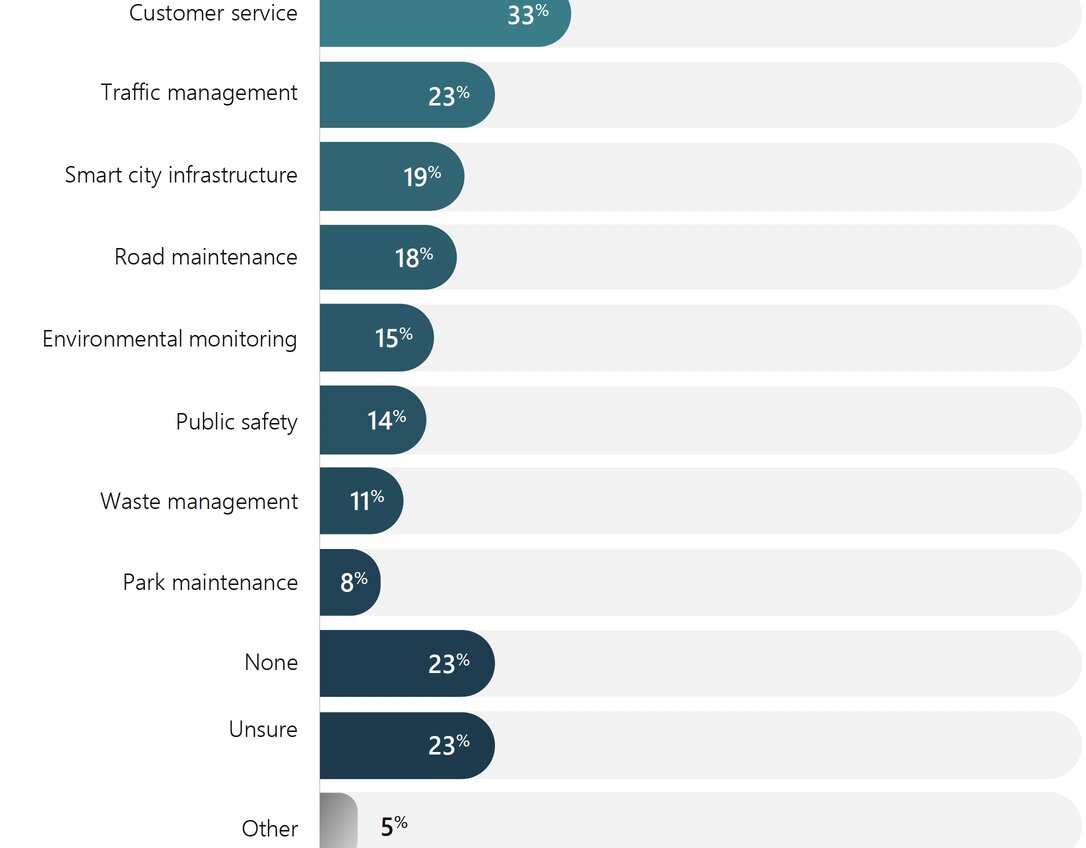
Use of AI in external services
AI adoption is highest in customer service and traffic management, likely because these functions involve high volumes of repeatable activities, existing service and operational data, and well-proven use cases. They also offer visible improvements to responsiveness and reliability for residents, making them lower-risk, higher-value entry points for municipalities facing cost, capacity, and service delivery pressures.
Use of AI in internal services
AI use within internal services is most prevalent in communications, HR, and finance, where work is information-intensive, process-driven, and often supported by established systems and documented workflows. These functions present clearer opportunities to improve productivity and reduce administrative burden, helping municipalities create capacity across the organization.
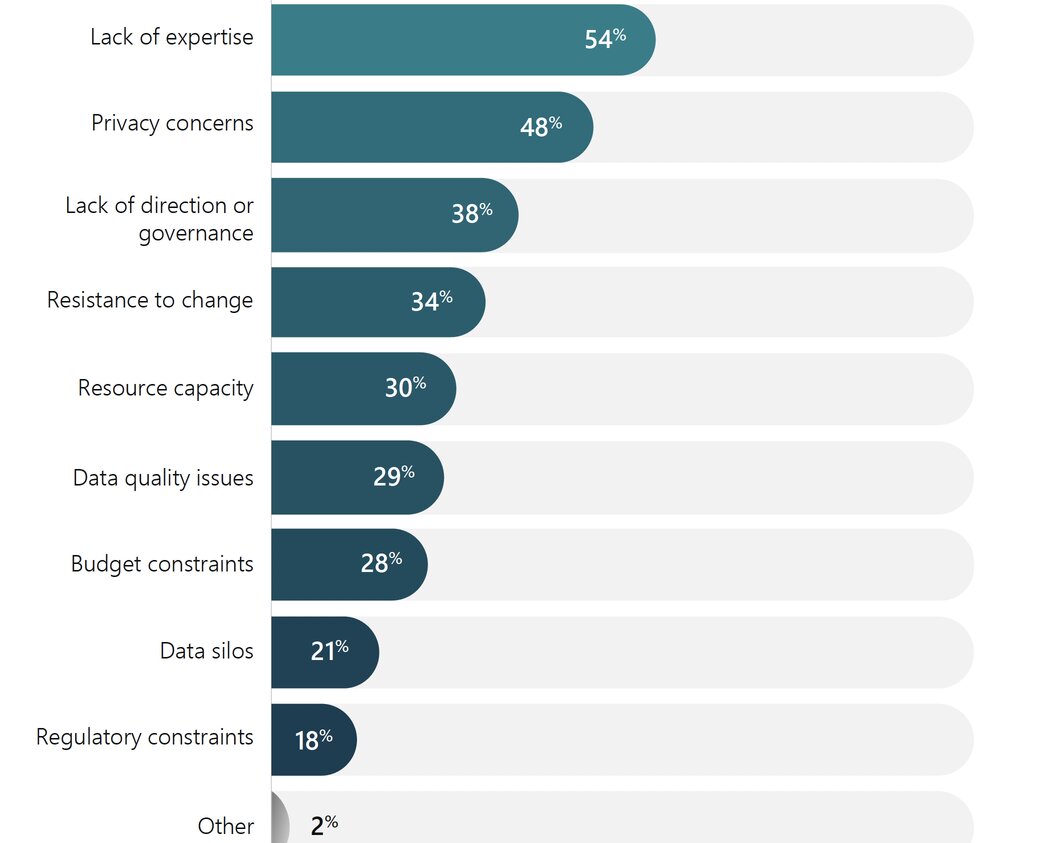
Challenges in implementing data analytics & AI
Expertise gaps, privacy concerns, and governance challenges continue to affect how local governments approach AI implementation.
AI Readiness starts with People, Governance, and Security
One of the strongest messages from the MNP report is that municipalities are not struggling because they lack AI tools; they are struggling because many organizations have not yet built the governance, workforce capabilities, and digital foundations required to use those tools effectively.
This is precisely where Reputiva believes organizations should focus.
AI adoption without cybersecurity, cloud governance, workforce readiness, and responsible AI practices creates unnecessary operational and security risks. Organizations that invest in digital literacy, AI governance, cloud security, and change management today will be far better positioned to improve citizen services, increase operational efficiency, and build long-term public trust.
Whether supporting municipalities, educational institutions, nonprofits, healthcare providers, or small and medium-sized businesses, Reputiva helps organizations move beyond technology deployment toward sustainable digital transformation—where people, processes, and security evolve together.
Build an AI-Ready Public Sector with Confidence
Digital transformation isn’t measured by how many AI tools an organization purchases—it’s measured by how effectively its people can use them securely, responsibly, and strategically.
Reputiva partners with municipalities and public sector organizations to strengthen AI readiness through:
- AI Governance and Responsible AI Advisory
- Cloud Security Assessments (AWS, Microsoft Azure & Google Cloud)
- Microsoft 365 and Google Workspace Security
- Cybersecurity Risk Assessments
- AI and Cybersecurity Awareness Training
- Digital Readiness and Workforce Enablement Programs
- Cloud and AI Strategy for Public Sector Organizations
Preparing your workforce today means delivering better public services tomorrow. Contact Reputiva to build a secure, resilient, and AI-ready organization.