Reputiva Limited has completed the AWS SimuLearn: Generative AI Architect learning plan, marking the fourth completed learning plan in our 12-module AWS SimuLearn Challenge.
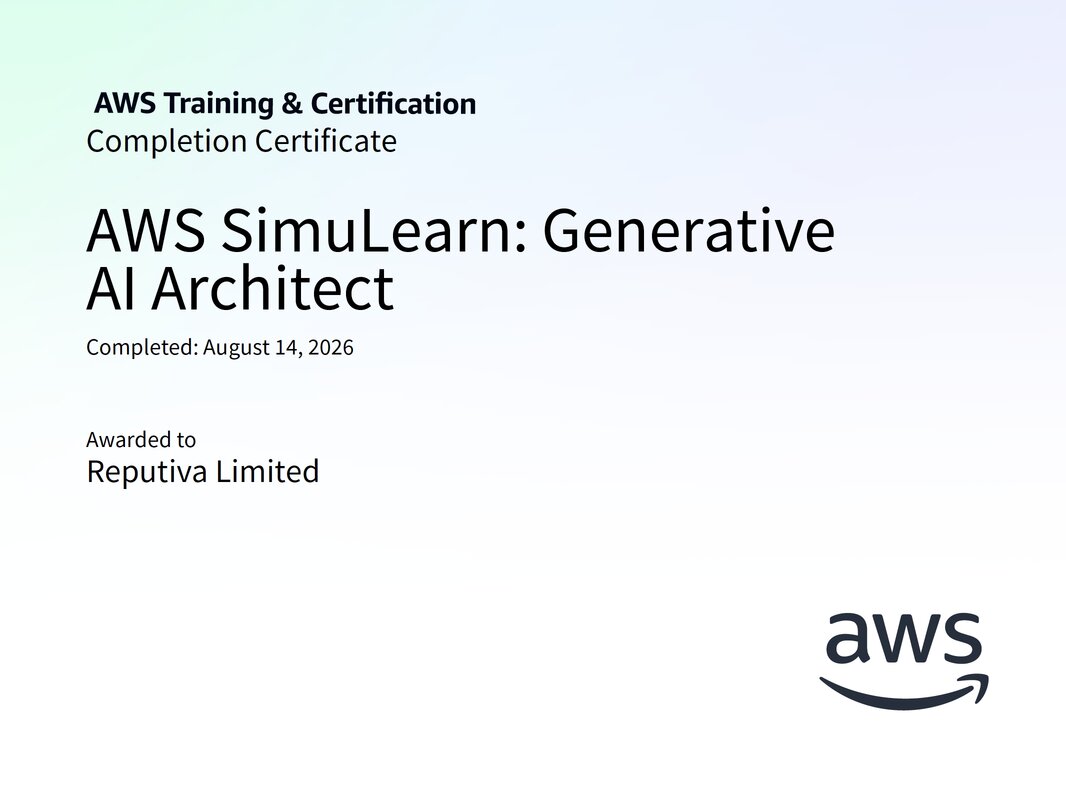
This milestone follows the completion of AWS SimuLearn: Cloud Practitioner, Solutions Architect and Serverless Developer , continuing Reputiva’s commitment to continuous cloud learning, hands-on practice, and staying current with how modern cloud solutions are designed, built, validated, and operated.
Why AWS SimuLearn matters
Cloud learning is changing. Traditional learning often focuses on videos, reading materials, and exam preparation. Those are still useful, but cloud professionals also need practical experience: understanding customer requirements, making architecture decisions, building solutions, and validating outcomes.
AWS SimuLearn is designed around that practical model. AWS describes SimuLearn as an immersive, risk-free learning environment that helps learners develop technical and soft skills through interactive customer conversations, solution concept videos, hands-on labs, and practical exercises.
The AWS SimuLearn Generative AI Architect Learning Path
The AWS SimuLearn: Generative AI Architect learning path is designed to help learners build practical generative AI architecture skills through immersive, scenario-based learning.
The learning path includes 23 solution-building simulations that help learners understand how to leverage generative AI on AWS. Instead of relying only on passive learning, AWS SimuLearn places learners in realistic customer-style scenarios where they engage with virtual customers, gather requirements, develop architecture proposals, learn how to build solutions, and complete hands-on validation activities
- Cloud Computing Essentials
- Cloud First Steps
- Introduction to Generative AI
- Prompt Engineering with Amazon Bedrock
- Code Generation with Prompt Engineering
- Build and Deploy Tools Using LLM Agents
- Set Up Private Access to Amazon Bedrock
- Generate an AWS Q&A Application
- Serverless Chatbot Using Private Data
- Generative AI for Personalized Marketing
- Generative AI App for Teaching and Learning
- Fine-Tuning an LLM on Amazon SageMaker
- Bias Mitigation for a Translation Service
- Automate Fine-Tuning of an LLM
- Fine-Tune a Base Model with RLHF
- Provision SageMaker in a Secure Environment
- Moderating AI Chat App Conversations
- Harness the Power of LangChain
- Enhance LLM Capabilities with a Vector Database
- Build RAG Applications with Knowledge Bases
- Intelligent Video and Audio Q&A with LLMs
- Moderator for Generative AI Content
- Modern Data Architectures with LLMs
From AI awareness to applied AI architecture
Many organizations are interested in generative AI, but there is often a gap between awareness and implementation. It is one thing to understand what generative AI can do. It is another thing to design a practical solution that can work safely and reliably in a real environment.
Generative AI architecture requires teams to ask important questions:
- What business problem are we trying to solve?
- What data does the solution need?
- How will access be controlled?
- What risks need to be managed?
- How will outputs be validated?
- How will the solution be monitored?
- What are the cost implications?
- How does the solution integrate with current workflows?
The AWS SimuLearn: Generative AI Architect path supports this kind of applied thinking. It helps move learning from theory toward practical design decisions and hands-on cloud experience.
Why this matters for Reputiva
Reputiva works at the intersection of Cloud, Cybersecurity, and FinOps. Generative AI touches all three areas.
- From a cloud perspective, organizations need strong architecture foundations to design and deploy AI-powered solutions.
- From a cybersecurity perspective, generative AI introduces new concerns around data protection, access control, prompt security, model usage, governance, and responsible adoption.
- From a FinOps perspective, AI workloads can introduce new cost patterns that require monitoring, optimization, and alignment with business value.
Completing AWS SimuLearn: Generative AI Architect strengthens Reputiva’s practical understanding of how AI architecture connects to cloud readiness, security posture, modernization strategy, and cost-aware implementation.
Cloud and AI Skills Must Be Continuously Practiced
Cloud and AI skills are evolving quickly. A good generative AI solution requires more than enthusiasm for new tools. It requires judgment, practical experience, and the ability to connect business requirements with secure, scalable, and responsible technical design.
That is why hands-on learning matters.
For Reputiva, the AWS SimuLearn Challenge is not just about collecting badges. It is a structured effort to keep building applied cloud capability across architecture, serverless development, generative AI, security, and industry-specific cloud scenarios. Cloud and AI skills must be continuously practiced, not just periodically proven.
What comes next
With AWS SimuLearn: Cloud Practitioner, AWS SimuLearn: Solutions Architect, AWS SimuLearn: Serverless Developer, and AWS SimuLearn: Generative AI Architect now completed, Reputiva has completed 4 of 12 planned AWS SimuLearn learning paths.
The next step is to continue through the remaining AWS SimuLearn challenge modules, with a focus on strengthening practical capability across cloud architecture, AI, security, serverless, data, and real-world solution delivery.
The goal remains the same: keep building cloud skills through hands-on, scenario-based learning that reflects how cloud solutions are designed, built, secured, governed, and operated in real environments.
On to 5 of 12 – AWS SimuLearn: Machine Learning.
Ready to strengthen your cloud foundation?
Book a Reputiva consultation to assess your cloud readiness, security posture, AI readiness, and modernization priorities.