Last week, Amazon Web Services announced AWS SimuLearn Learning Plan badges, giving learners a new way to demonstrate the hands-on cloud skills they develop through AWS SimuLearn.
The announcement introduced 12 verifiable digital badges, each tied to completing an entire AWS SimuLearn Learning Plan. To earn a badge, learners must complete all assignments within the plan, including simulated customer conversations, architecture design, hands-on solution building in AWS environments, and automated validation of the finished solution.
That announcement inspired a new goal for us at Reputiva:
Complete all 12 AWS SimuLearn Learning Plans in 12 weeks—one learning plan each week.
The challenge will take us across foundational cloud concepts, solutions architecture, artificial intelligence, cybersecurity, networking, serverless development, data analytics, machine learning, and industry-specific AWS use cases.
We have already completed the first milestone:
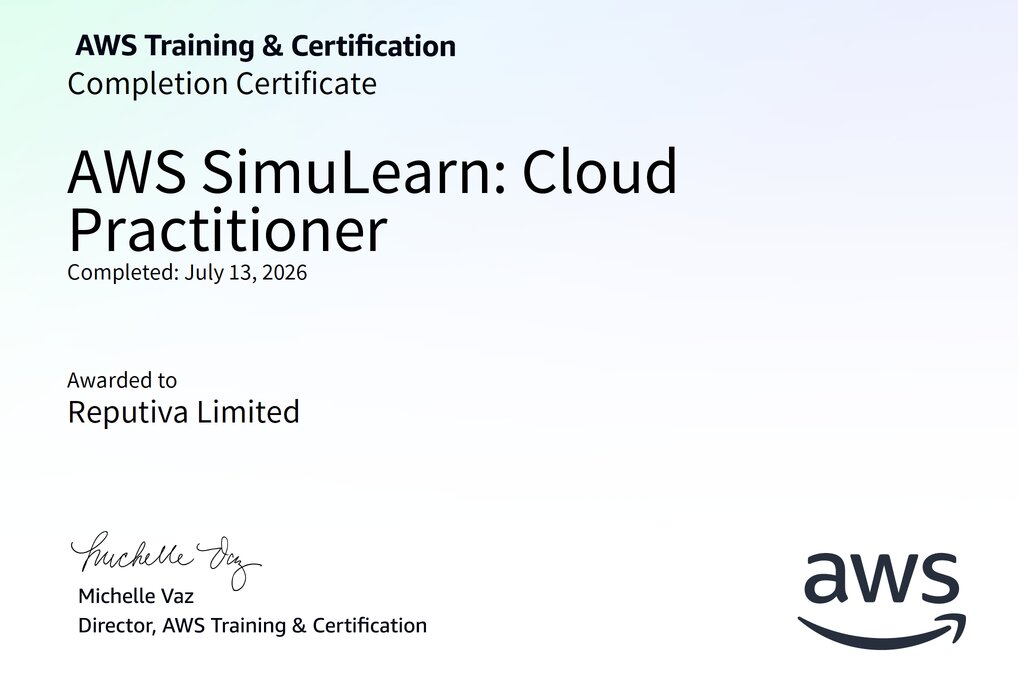
Week 1: AWS SimuLearn – Cloud Practitioner
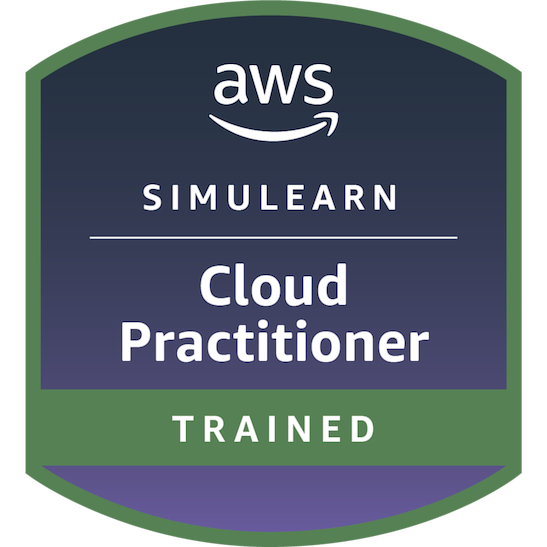
The completion certificate was awarded to Reputiva Limited on July 13, 2026.
Over the next 11 weeks, we will continue through the remaining AWS SimuLearn Learning Plans, documenting our progress and sharing lessons from each stage of the journey.
What is AWS SimuLearn?
AWS SimuLearn is an immersive learning experience available through AWS Skill Builder. It is designed to move learners beyond passive training by combining theory, guided implementation, independent problem-solving, and technical validation.
Each SimuLearn assignment uses practical scenarios in which learners may engage with virtual customers, understand requirements, design architectures, build solutions in AWS environments, and validate the finished implementation.
SimuLearn combines instructional videos, guided console labs, independent implementation challenges, and automated validation.
Based on the Cloud Practitioner Learning Plan, the experience follows three main stages:
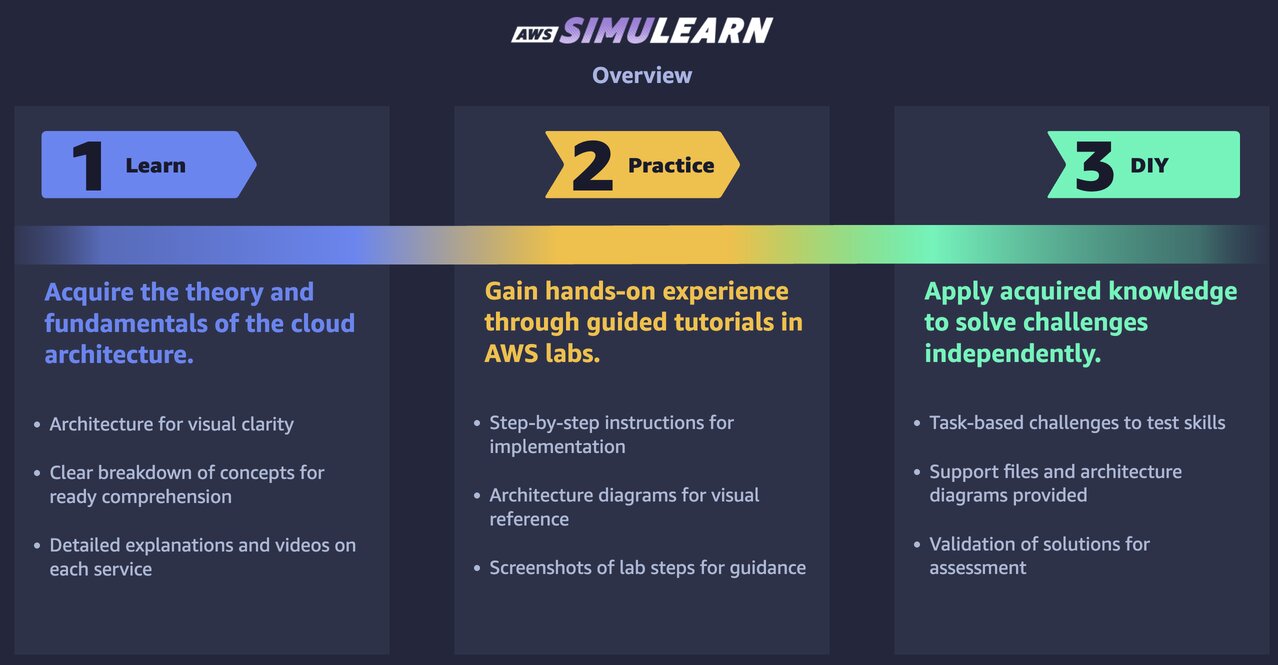
1. Learn
The first stage introduces the AWS services, technologies, and architectural concepts required for the assignment.
Learners work through:
- Instructional videos
- AWS service explanations
- Cloud architecture diagrams
- Foundational concepts
- Detailed breakdowns of how the services work together
The objective is to understand the theory behind the solution before beginning the practical work.
This stage helps answer questions such as:
- What problem does the service solve?
- How does it fit into the wider architecture?
- Why would it be selected for this scenario?
- What security, availability, performance, or cost considerations apply?
2. Practice
The Practice stage moves the learner into a guided AWS lab.
Learners use the AWS Management Console and follow step-by-step instructions to implement the solution introduced during the Learn stage.
The guided activities may include:
- Detailed implementation instructions
- Architecture diagrams for reference
- Screenshots of important configuration steps
- Hands-on configuration of AWS services
- Guided troubleshooting and validation
This stage reinforces the theory by allowing learners to see how AWS resources are configured and how the different services interact.
It also helps learners become more comfortable navigating the AWS console and translating architectural diagrams into deployed resources.
3. DIY
The final stage is the Do-It-Yourself challenge. Instead of following detailed instructions, learners receive a task, supporting information, and an architecture diagram. They are then expected to implement the required solution independently.
The learner must determine how to:
- Interpret the technical requirements
- Select the appropriate AWS services
- Configure the required resources
- Connect the components correctly
- Apply security and architecture principles
- Identify and correct configuration errors
- Produce a solution that passes automated validation
The DIY stage is where the learner demonstrates whether the knowledge gained during the Learn and Practice stages can be applied without step-by-step guidance.
The progression can be summarized simply:
Learn the concepts. Practise them in AWS. Apply them independently.
This structure is one of the strongest aspects of AWS SimuLearn because it guides learners from understanding to guided implementation and finally to independent execution.
From learning to verifiable badges
AWS launched SimuLearn Learning Plan badges on July 6, 2026. To earn a badge, a learner must complete all assignments in an eligible learning plan. As learners progress, they work through simulated customer interactions, architecture design, hands-on implementation in real AWS environments, and solution validation. Once the final assignment is completed, the badge is issued through Credly.
The Reputiva AWS SimuLearn 12-Week Challenge
Reputiva’s goal is to complete all 12 currently available SimuLearn Learning Plans over 12 weeks.
Week 1: AWS SimuLearn – Cloud Practitioner
The Cloud Practitioner Learning Plan provides the foundation for the challenge.
It introduces core cloud concepts and AWS services through training videos, architecture diagrams, guided labs, independent implementation tasks, and automated validation.
The plan contains 12 training components covering cloud essentials and foundational AWS services.
Status: Completed
Week 2: AWS SimuLearn – AI Practitioner
This learning plan will focus on foundational artificial intelligence, machine learning, and generative AI concepts, along with their practical application using AWS services.
Status: Upcoming
Week 3: AWS SimuLearn – Solutions Architect
The Solutions Architect Learning Plan will focus on turning business and technical requirements into secure, scalable, resilient, high-performing, and cost-conscious AWS architectures.
Status: Upcoming
Week 4: AWS SimuLearn – Serverless Developer
This learning plan will explore how applications can be designed and implemented using serverless services and event-driven architectural patterns.
Status: Upcoming
Week 5: AWS SimuLearn – Generative AI Architect
The Generative AI Architect Learning Plan will examine how generative AI solutions can be designed, integrated, secured, and deployed using AWS services.
Status: Upcoming
Week 6: AWS SimuLearn – Machine Learning
This learning plan will explore practical machine learning workflows, including data preparation, model-related activities, deployment considerations, and monitoring.
Status: Upcoming
Week 7: AWS SimuLearn – Security
The Security Learning Plan will focus on protecting AWS identities, data, infrastructure, applications, and workloads.
It is particularly relevant to Reputiva’s work in cloud security assessments, architecture, governance, risk management, and secure cloud adoption.
Status: Upcoming
Week 8: AWS SimuLearn – Networking
This learning plan will examine the networking foundations that support AWS environments, including connectivity, segmentation, routing, traffic flow, availability, and secure resource communication.
Status: Upcoming
Week 9: AWS SimuLearn – Data Analytics
The Data Analytics Learning Plan will explore how organizations can collect, process, store, analyze, and obtain value from data using AWS services.
Status: Upcoming
Week 10: AWS SimuLearn – Healthcare
The Healthcare Learning Plan will explore the use of cloud, data, AI, security, and other AWS capabilities within healthcare-related scenarios.
Status: Upcoming
Week 11: AWS SimuLearn – Manufacturing and Automotive
This learning plan will examine how cloud services can support modernization, analytics, connected systems, operational visibility, and innovation across manufacturing and automotive environments.
Status: Upcoming
Week 12: AWS SimuLearn – Financial Services
The final learning plan will explore AWS solutions within financial services scenarios, where security, resilience, governance, data protection, compliance, and operational reliability are critical.
Status: Upcoming
Why Reputiva is taking on the challenge
The Reputiva AWS SimuLearn 12-Week Challenge is not simply about collecting badges.
It is an intentional investment in continuous learning, practical capability, and stronger cloud advisory skills.
Strengthening hands-on AWS knowledge
There is a meaningful difference between understanding how an AWS service works and being able to configure it correctly in a working environment.
Hands-on exercises reinforce:
- How AWS services interact
- How architecture diagrams translate into resources
- How configuration choices affect security and performance
- How deployment errors can be diagnosed
- How technical requirements are validated
- How cloud principles are applied in practice
During the Cloud Practitioner Learning Plan, for example, one DIY exercise required configuring communication between a web server and a database server using AWS security groups. The task was not simply to recognize that MySQL uses TCP port 3306.
The database security group had to be configured to permit inbound access only from the web-server security group. Opening the database to the public internet or using an incorrect security-group source would not satisfy the validation requirements.
That exercise reinforced several practical concepts:
- Least-privilege access
- Workload segmentation
- Security-group referencing
- Controlled resource-to-resource communication
- Avoiding unnecessary public exposure
- Troubleshooting automated validation errors
These are the kinds of implementation details that become clearer through direct practice.
Building confidence through guided progression
The Learn, Practice, and DIY model provides a useful progression.
- The Learn stage develops understanding.
- The Practice stage builds familiarity through guidance.
- The DIY stage tests whether the learner can complete the work independently.
This structure reduces the gap between knowing a concept and being able to apply it.
A learner may understand the purpose of Amazon EC2, Amazon VPC, security groups, databases, and load balancing at a conceptual level. The deeper learning occurs when those services must be configured together to satisfy a specific architecture and pass validation.
Supporting stronger advisory services
Reputiva helps SMEs and other organizations navigate cloud, cybersecurity, FinOps, AI readiness, and modernization decisions.
Maintaining current, practical knowledge strengthens our ability to:
- Conduct more effective discovery conversations
- Understand organizational requirements
- Assess cloud environments
- Identify architecture and security risks
- Explain technical options clearly
- Evaluate trade-offs between solutions
- Recommend appropriate cloud services
- Support secure and scalable adoption
- Connect technology decisions to business objectives
Hands-on learning does not replace real production experience, but it strengthens the technical foundation supporting advisory work.
It also provides a structured environment for exploring services, testing configurations, correcting errors, and reinforcing best practices.
Practical validation is becoming an important part of cloud learning
The cloud-skills conversation should not be framed as a choice between certifications and hands-on experience.
Organizations need both.
- Certifications provide structured knowledge, recognized domains, and independent assessment.
- Hands-on learning demonstrates how that knowledge is applied when designing, configuring, securing, testing, validating, and troubleshooting cloud solutions.
AWS SimuLearn adds another dimension by combining:
- Customer conversations
- Architecture decisions
- Guided implementation
- Independent challenges
- Automated validation
- Verifiable digital badges
For SMEs evaluating cloud partners, consultants, or internal talent, these credentials can provide an additional signal of ongoing practical development.
A badge cannot fully capture a professional’s experience. It cannot replace production responsibility, sound judgment, or a detailed assessment of capability. However, it can demonstrate that the learner completed structured exercises, built solutions in AWS environments, and produced outcomes that met predefined validation requirements.
For Reputiva, the value of this challenge will not be measured only by the badges earned.
It will also be measured by:
- The architectural patterns explored
- The AWS services configured
- The errors encountered and resolved
- The security principles reinforced
- The customer requirements considered
- The technical decisions evaluated
- The lessons that can be applied to future advisory engagements
The goal
12 AWS SimuLearn Learning Plans.
12 weeks.
12 verifiable AWS badges.
Week 1 is complete.
Eleven learning plans remain.
Follow Reputiva as we continue the AWS SimuLearn 12-Week Challenge and share insights from each stage of the journey.
About Reputiva
Reputiva provides cloud, cybersecurity, FinOps, AI readiness, and digital modernization advisory services to help SMEs make informed technology decisions.
Our work focuses on helping organizations adopt technology securely, responsibly, and with a clear connection to their operational and business objectives.
Book a consultation with Reputiva to discuss your organization’s cloud readiness, cloud security, AWS architecture, FinOps, or AI-readiness priorities.