Canada has earned global recognition as an artificial intelligence powerhouse. It was among the first countries to launch a national AI strategy, ranks among the world’s leaders in AI research, and is home to hundreds of AI startups and world-class research institutions. Yet for many small and medium-sized enterprises (SMEs), AI remains more of a promise than a practical business capability.
A September 2025 report by The Diversity Institute, The Future Skills Centre, and Magnet, titled Bridging the Artificial Intelligence Gap in Small and Medium-sized Enterprises in Canada, highlights a growing disconnect between Canada’s leadership in AI innovation and the reality of AI adoption across the country’s business community. While many organizations are experimenting with AI tools, widespread implementation remains uneven, informal, and often unsupported.
Considering that SMEs account for approximately 98% of Canadian businesses and employ more than 63% of the private-sector workforce, closing this implementation gap is essential not only for individual business growth but also for Canada’s long-term productivity and global competitiveness.
The challenge is no longer whether AI has business value. The challenge is helping SMEs adopt AI securely, strategically, and with confidence.
The AI Adoption Gap
There is significant variation in the reported AI adoption rates among Canadian businesses, especially SMEs. Some studies show rapid adoption, and others show that adoption is lagging, with differences stemming from differences in how AI is defined, measured and interpreted. Different studies report very different adoption rates among Canadian SMEs:
- 12.2% (Statistics Canada, 2025)
- 66% (Business Development Bank of Canada)
- 71% (Microsoft Canada SMB Report, 2025)
The figures above illustrate that many businesses already use AI-powered features embedded in everyday software, but do not necessarily recognize them as AI. Tools such as Microsoft Copilot, Google Workspace with Gemini, customer relationship management platforms, accounting software, and marketing automation increasingly include AI capabilities that businesses use without formally identifying them as AI adoption.
Despite the rise in demand for AI skills, fewer than one in ten SMEs report access to formal AI training.
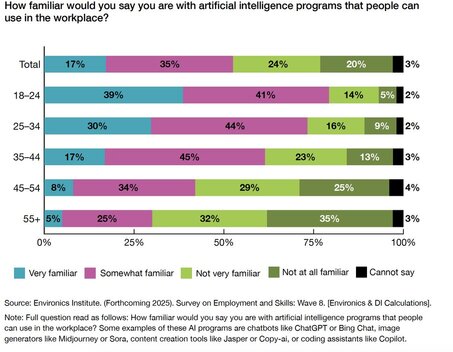
New data from the forthcoming 2025 National Survey on Skill Demands and Employment Practices in Small and Medium- Sized Enterprises shows that nearly one-half of employees who are using AI tools at work received no training, and over one-third had minimal employer guidance. This gap is especially critical for older workers: while 39% of 18-24-year-olds report being “very familiar” with AI tools, that number drops to just 5% among those aged 55+.
The biggest challenge isn’t technology
A common misconception is that SMEs struggle with AI because the technology is too complex. The report suggests otherwise. The greatest barriers are organizational rather than technical, including:
- Limited awareness of practical AI use cases
- Financial constraints and uncertainty about return on investment
- Cybersecurity and data privacy concerns
- Regulatory uncertainty
- Limited internal expertise
- Lack of leadership support
- Legacy systems and insufficient digital infrastructure
These challenges explain why many organizations remain stuck in experimentation rather than moving toward enterprise-wide implementation.
AI adoption among SMEs is not exclusively a technical challenge; it is also a skills and confidence challenge.
AI Skills are becoming a business requirement
Another major finding is that AI adoption is outpacing workforce readiness. The report notes that:
- Fewer than one in ten SMEs have access to formal AI training.
- Nearly half of employees already using AI tools have received no formal training.
- More than one-third report receiving minimal guidance from their employer.
This creates significant risks as employees increasingly experiment with AI independently, often without policies governing responsible use, data protection, or security.
AI Adoption must move beyond Experimentation
Employees frequently adopt consumer AI tools without organizational guidance, creating risks related to:
- Sensitive data exposure
- Intellectual property protection
- Inconsistent outputs
- Compliance
- Cybersecurity
- Shadow AI
The report argues that informal adoption should evolve into structured implementation supported by governance, practical training, and clear business objectives.
Four Priorities for Closing Canada’s AI Adoption Gap
The report recommends four priorities to accelerate AI adoption among SMEs:
1. Assess AI Readiness
Help SMEs understand their current capabilities, barriers, and opportunities before investing in AI.
2. Deliver Practical Learning
Provide accessible tools, coaching, templates, and workplace-focused learning that align with real business needs.
3. Pilot and Measure
Encourage SMEs to test AI through practical pilot projects, measure outcomes, and refine implementation based on results.
4. Strengthen the Ecosystem
Create stronger collaboration between SMEs, educators, technology providers, and policymakers to accelerate adoption through shared learning and coordinated support.
AI Readiness Is the Bridge Between AI Ambition and AI Impact