Cloud certifications have always played an important role in validating technical knowledge. They help professionals demonstrate credibility, help employers assess capability, and help customers identify trusted cloud expertise. But cloud technology is changing too quickly for certification to remain a one-time milestone. According to Harvard Business Review research, The average half-life of a skill used to be about 6 years; today, it’s about 2.5.
Across the three major hyperscalers (AWS, GCP, and Microsoft Azure), a clear shift is emerging: cloud credentials are becoming more continuous, practical, and aligned with real-world skills. The shift: from one-time passing of exams to continuous, hands-on learning.
The old recertification model is being challenged
Traditionally, recertification has often meant preparing for and retaking a full exam after a set period. That model still has value, but it does not always reflect how professionals actually maintain skills. The traditional re-certification period was 2 to 3 years, depending on the certification level and vendor.
Cloud practitioners learn continuously. They build, troubleshoot, configure, secure, migrate, optimize, automate, and adapt as services evolve. The hyperscalers appear to be responding to that reality.
AWS, Microsoft, and Google Cloud are each moving toward credentialing models that place more emphasis on applied learning, hands-on labs, real-world proficiency, and continuous skill development.
Amazon Web Services (AWS): Certification maintenance through Skill Builder
AWS recently announced a new way for eligible professionals to keep select AWS Certifications current.
Instead of retaking a full certification exam, eligible certification holders can maintain their AWS Certification for an additional year by completing curated training and hands-on labs through AWS Skill Builder. AWS says the path includes digital courses and practical activities tied to the certification domain, with automatic extension once the requirements are completed.
What’s supported at launch
This experience is available today in open Beta for the following certifications:
- AWS Certified Solutions Architect – Associate
- AWS Certified Developer – Associate
- AWS Certified CloudOps Engineer – Associate (can be used to maintain AWS Certified SysOps Administrator – Associate)
- AWS Certified DevOps Engineer – Professional
- AWS Certified Solutions Architect – Professional
Additional certifications are coming later this year, including AWS Certified Data Engineer – Associate, AWS Certified Security – Specialty, and AWS Certified Machine Learning Engineer – Associate.
Recertification is becoming a structured learning experience tied to current cloud practice.
Microsoft: Credentials closer to real-world work
Microsoft’s June 2026 Credentials roundup points in the same direction, though with a broader credentialing lens.
The update highlights Microsoft Pro Badges, AI-driven Certifications, and Applied Skills. Microsoft describes Pro Badges as credentials that recognize real-world skills and proficiencies demonstrated through everyday work without separate exams. The roundup also discusses a growing portfolio of AI-focused certifications and expanded Microsoft Applied Skills offerings.
Microsoft is not only updating certification exams. It is expanding the ways skills can be demonstrated.
Applied Skills already focus on scenario-based capability. Pro Badges go further by connecting recognition to demonstrated proficiency in work environments.
Google Cloud: Recertification through Google Skills
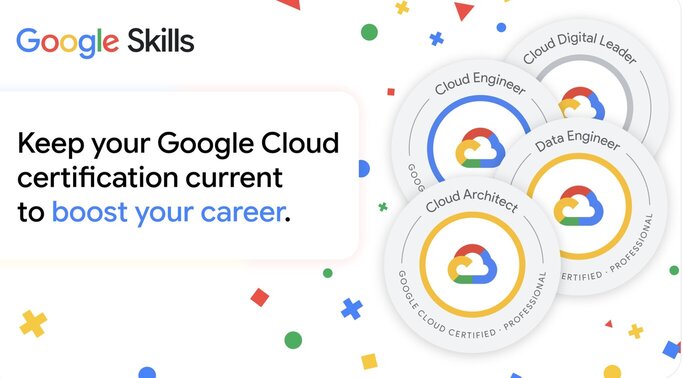
Google Cloud has now announced new ways to keep Google Cloud certifications current through Google Skills.
Google Cloud says certification holders can use Google Skills to complete up-to-date courses and skill badges to renew eligible Google Cloud credentials. The announcement also explains that skill badges include interactive, hands-on labs designed to validate the ability to apply knowledge to real-world problems.
The new streamlined recertification opportunity is available for Cloud Digital Leader, Associate Cloud Engineer, Professional Cloud Architect, and Professional Data Engineer. Once the required activities are completed while the certification is active, Google Cloud says the certification will automatically be extended by one year.
Google Cloud describes an active certification as a “living credential,” which captures the broader shift well:
The value of certification is increasingly tied to current capability rather than past achievement.
What the hyperscaler shift means
Taken together, these updates show a clear pattern. Cloud recertification is moving from:
- Exam-only validation to continuous, hands-on learning
- Static credentials to living proof of current capability
- Knowledge recall to applied cloud practice
- Periodic renewal events to ongoing skills maintenance
This does not mean exams are going away. They still remain important for structured validation, especially for foundational and role-based certification paths.
Why this matters for cloud teams and organizations
For organizations, this shift is important because cloud decisions are not theoretical.
Architecture choices affect resilience. Security decisions affect risk. Cost decisions affect margins. Data and AI decisions affect competitiveness. Identity and access decisions affect business continuity.
When teams rely on professionals whose skills are continuously refreshed through hands-on learning, organizations are better positioned to make informed cloud decisions.
For professionals, the message is also clear: earning a certification is no longer the finish line. The real advantage comes from staying current, building practical capability, and applying cloud knowledge in real environments.
Cloud Certification Is Moving Beyond the Exam
The hyperscaler shift in recertification reflects a larger change in digital skills. The future of cloud credentials is becoming more practical, more continuous, and more closely connected to real-world work.
For SMEs and growing organizations, this is a positive development. Many businesses depend on cloud consultants, internal IT teams, and technology partners to guide decisions across cloud architecture, cybersecurity, FinOps, modernization, AI adoption, and digital operations.
The stronger the connection between credentials and applied capability, the more useful those credentials become in real business environments.
Cloud certification is no longer just about proving what someone learned. Increasingly, it is about proving that they are still learning.
Need help keeping your cloud strategy, security posture, and team capabilities current?
Book a Reputiva consultation to assess your cloud readiness, security priorities, and modernization roadmap.