AWS compute services are designed to meet the varied demands of modern applications, from small-scale projects to enterprise-grade solutions. These services provide scalable computing power to help you build, deploy, and manage applications. Whether you need to launch virtual machines, run containerized applications, or run code without managing servers, AWS compute services provide the flexibility to match your specific workload needs.
AWS offers several compute options, including virtual machines, managed application platforms, containers, serverless functions, batch processing, and hybrid or edge compute. The challenge is not simply knowing the services. The real challenge is choosing the right compute model for the workload.
Why AWS compute decisions matter
Choosing the wrong compute service can lead to unnecessary complexity, higher cost, slower delivery, poor scalability, or more operational work than the team can realistically manage.
Before choosing an AWS compute service, organizations should understand:
- How much infrastructure control the workload needs
- How much operational overhead the team can manage
- Whether the application is monolithic, containerized, event-driven, or batch-oriented
- How predictable the traffic pattern is
- Whether the workload needs long-running processes or short-lived execution
- What security, networking, scaling, and cost requirements apply
A compute decision should begin with the workload, not the service name.
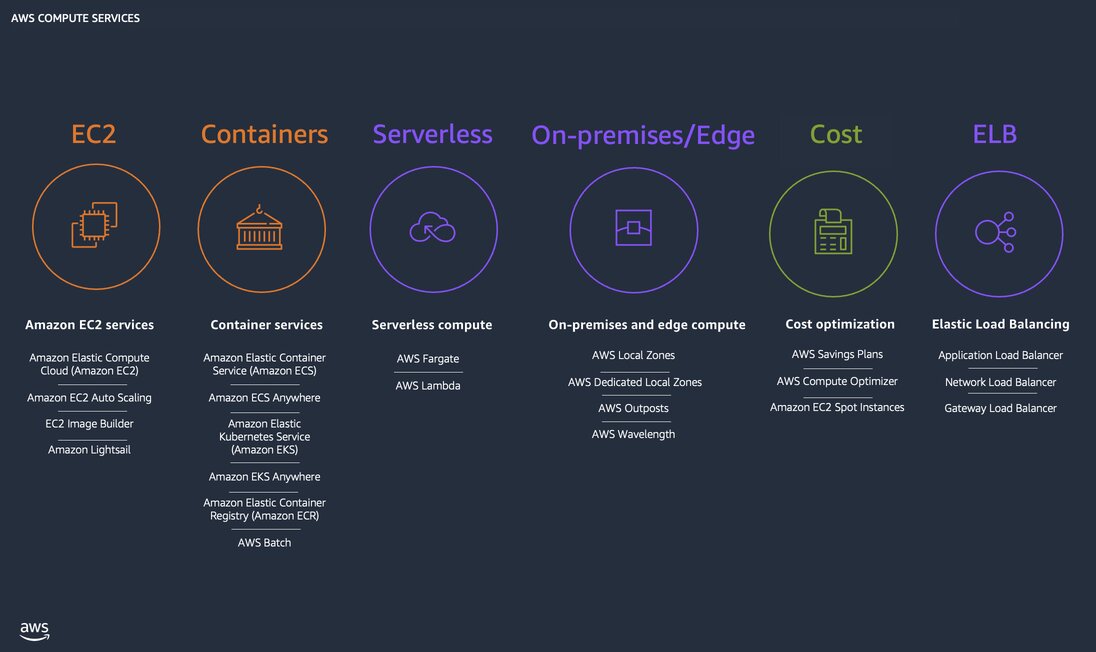
AWS compute options
Amazon Elastic Compute Cloud (Amazon EC2): Flexible virtual machines
An AWS service that provides on-demand, scalable computing capacity, with the goal of allowing you to develop, deploy, and scale applications faster. It lets organizations launch virtual servers, configure security and networking, and manage storage.
Use Amazon EC2 when you need:
- Full control over servers
- Custom operating system or runtime configuration
- Lift-and-shift migration
- Traditional enterprise applications
- Workloads with specific networking, storage, or security requirements
- Applications that are not ready for containers or serverless
EC2 gives the most flexibility, but it also requires more operational responsibility.
Amazon Lightsail: Simple cloud hosting
A set of core services designed to help you build websites or web applications. Consider Lightsail if you want a simple unified platform with a few foundational services, including virtual servers, HTTP load balancing, managed databases, public container deployment, content delivery network (CDN), DNS management, and domain registration. Lightsail provides fixed and predictable monthly pricing.
Use Lightsail when you need:
- Simple web hosting
- Predictable monthly pricing
- Minimal cloud complexity
- A straightforward environment for smaller workloads
AWS Elastic Beanstalk: Managed application deployment
A service that makes it easy to deploy, manage, and scale web applications and services. It supports several programming languages such as Python, Java, PHP, Node.js, Ruby, .NET, and Go. Elastic Beanstalk provisions EC2 instances, configures load balancing, sets up health monitoring, and dynamically scales the environment.
Use Elastic Beanstalk when you need:
- A managed deployment platform
- Less infrastructure management than EC2
- Support for common web application platforms
- A balance between automation and infrastructure visibility
AWS Lambda: Event-driven serverless compute
AWS Lambda is best suited for event-driven workloads where code runs in response to triggers. It automatically handles the underlying compute infrastructure, multi-zone high availability, and scaling from zero to tens of thousands of concurrent requests.
Use Lambda when you need:
- Serverless functions
- Event-driven processing
- Scheduled jobs
- API backends
- File or stream processing
- Short-running tasks
- Minimal server management
Lambda is a strong fit when the workload can be broken into small, event-driven units of execution.
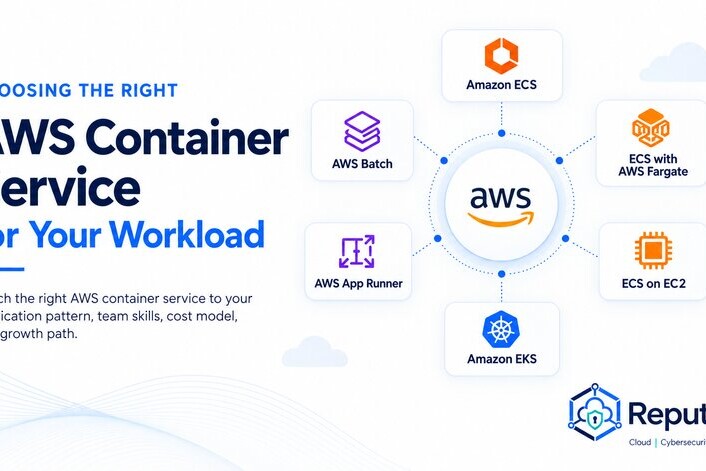
Amazon ECS, Amazon EKS, and AWS Fargate: Container workloads
Containers are useful when applications need consistent packaging, portability, and deployment across environments. AWS describes containers as reproducible compute environments that simplify packaging and dependency management.
Containers provide a discrete reproducible compute environment for building software to deploy in the cloud.
Amazon Elastic Container Service (ECS) – AWS-native container orchestration
A fully managed, highly scalable container orchestration service. It allows users to easily run, stop, and manage Docker containers across AWS or on-premises environments without the complexity of installing and operating your own cluster management software.
Use ECS when you want:
- AWS-native container orchestration
- Managed container operations
- Integration with AWS services
- Simpler container management than Kubernetes
Amazon Elastic Kubernetes Service (EKS)
A fully managed, certified-conformant Kubernetes service. It simplifies running containerized applications by handling control plane availability, scaling, and patching across AWS and on-premises data centers. It eliminates undifferentiated heavy lifting, letting developers focus on application deployment.
Use EKS when you need:
- Kubernetes compatibility
- Container portability
- Existing Kubernetes skills or tooling
- More control over orchestration patterns
A serverless compute engine for containers that removes the need to provision, patch, or manage underlying virtual machines. Fully integrated with Amazon ECS and Amazon EKS, it allows you to build applications simply by defining your container image, CPU, and memory requirements.
Use Fargate when you need:
- Containers without server management
- Long-running containerized applications
- Microservices
- Batch-style container workloads
- Less infrastructure operations
AWS App Runner
AWS App Runner is a fully managed container application service that allows developers to quickly build, deploy, and scale web applications and APIs directly from source code or a container image without managing underlying infrastructure.
Use App Runner when you need:
- Simple web app or API deployment
- Container-based delivery
- Minimal infrastructure management
- Faster path from code to running service
AWS Batch: Batch processing
AWS Batch is a fully managed batch computing service that plans, schedules, and runs your containerized batch ML, simulation, and analytics workloads.
Use AWS Batch when you need:
- Job queues
- Batch processing
- Data processing
- Scientific or financial modeling
- Scheduled compute-heavy tasks
- Managed batch orchestration
AWS Outposts, Local Zones, and Wavelength: Hybrid and edge needs
Some workloads require compute closer to users, facilities, or on-premises systems.
- AWS Outposts is a fully managed service that extends native AWS infrastructure and services directly to your on-premises data centers, colocation spaces, or edge locations
- AWS Local Zones extend cloud compute, storage, and databases closer to large metropolitan areas to deliver single-digit millisecond latency.
- AWS Wavelength deploys AWS compute and storage services directly inside 5G telecommunication providers’ data centers.
Use hybrid or edge compute when you need:
- Low-latency processing
- On-premises AWS infrastructure
- Local data processing
- Industry or regulatory requirements
- Edge application experiences
Key questions before choosing AWS compute
1. How much control do you need?
- Choose EC2 when you need deep control over the server, operating system, networking, or runtime.
- Choose managed or serverless options when you want AWS to handle more of the operational work.
2. How much operational overhead can the team manage?
The more control you choose, the more responsibility you usually carry. AWS Well-Architected guidance notes that selecting appropriate building blocks and managed services can help optimize cost and reduce administrative and operational overhead.
3. Is the workload event-driven?
If the workload responds to events, Lambda may be a strong fit.
4. Is the application containerized?
If yes, evaluate ECS, EKS, Fargate, or App Runner depending on orchestration needs and team skills.
5. Is this a simple web application?
Lightsail or Elastic Beanstalk may be better starting points than building everything directly on EC2.
6. Is the workload long-running or short-running?
- Long-running services often fit EC2, ECS, EKS, Fargate, or App Runner.
- Short-running event-driven tasks often fit Lambda.
7. Does the workload have variable demand?
Evaluate scaling requirements early. Compute choices should support how traffic grows, spikes, or changes over time.
8. What is the cost model?
EC2 pricing, serverless billing, container capacity, and managed service costs behave differently. AWS also has a separate decision guide for EC2 purchasing options, which is useful for optimizing VM-based workloads.
Compute Choices Should Match the Operating Model
The right AWS compute service isn’t always the most flexible or modern option. It is the option that best fits the workload, deployment model, team capabilities, security requirements, scaling patterns, and cost profile.
For some workloads, that may be Amazon EC2. For others, it may be Lambda, Fargate, ECS, EKS, Elastic Beanstalk, Lightsail, App Runner, or AWS Batch.
A good AWS compute strategy should answer four practical questions:
- How should the workload run?
- How much control does the team need?
- How much operations work should AWS manage?
- How should compute cost scale over time?
Practical next step
Before choosing an AWS compute service, create a workload compute profile.
Document:
- Application type
- Runtime model
- Traffic pattern
- Scaling requirement
- Deployment method
- Team skill set
- Operational capacity
- Security and networking requirements
- Cost sensitivity
- Modernization roadmap
That profile will make it easier to choose between Amazon EC2, Lightsail, Elastic Beanstalk, Lambda, ECS, EKS, Fargate, App Runner, AWS Batch, and hybrid or edge compute options.
Need Help Choosing the Right AWS Compute Service?
Reputiva helps organizations assess, secure, modernize, and optimize cloud environments across AWS, Azure, and GCP.
Book a consultation with Reputiva to assess your cloud readiness, compute strategy, security posture, or modernization roadmap.