As nonprofits face growing pressure to reach more people, improve donor engagement, secure sensitive data, reduce administrative burden, and demonstrate measurable impact, cloud adoption is becoming more than an IT decision. It is becoming a mission decision. AWS’s report, Powering Purpose in the Cloud: A Guide for Cloud Adoption in the Nonprofit Sector, notes that: nonprofits are increasingly using cloud technology to support fundraising, program delivery, data management, virtual services, operations, and innovation.
Cloud Adoption: A set of steps, skills, and decisions your organization executes and evaluates to advance your mission with cloud technology.
The opportunity is not simply to “move to the cloud.” The real opportunity is to build a stronger digital foundation that allows nonprofits to scale their mission, protect their data, improve efficiency, and serve communities more effectively.
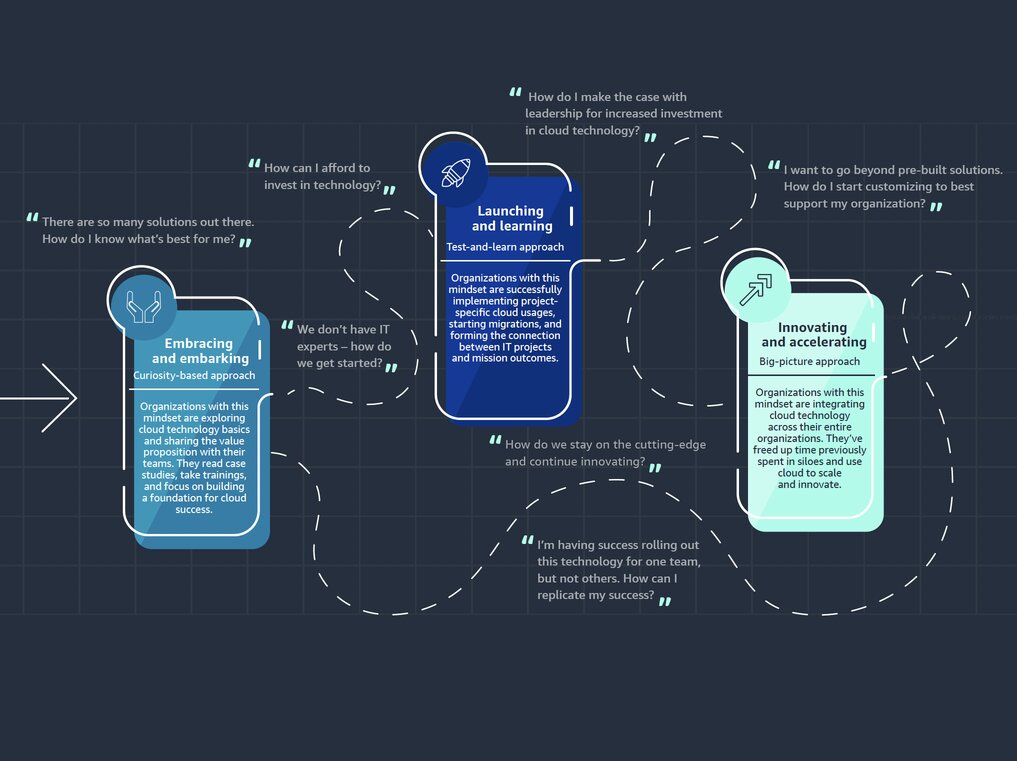
Cloud mindsets in the nonprofit sector
Embracing and embarking
At the beginning of the journey is a curiosity mindset that explores cloud projects that lay the foundation for future growth. What determines this mindset is ultimately the organization’s belief that technology is auxiliary—rather than integral—to mission delivery.
The most common organizational objectives for nonprofits in this mindset are to:
- Drive organizational awareness and increase donations and revenues
- Improve operational efficiencies and reduce costs in favour of allocating more funds towards the mission
- Expand programs and services.
To stay informed about technology, nonprofits in this group prefer to source from within their network and connections, in addition to using the internet and social media to drive their decision-making.
79 percent of nonprofits in this group believe they will expand their cloud usage in the future, particularly to reduce costs and increase security. At the same time, nonprofits in this mindset over-index in terms of concerns over cost and lack of knowledge, inhibiting many from making strategic investments.
There is typically a need for education and capacity building within the organization, and technology is often seen as a “cost” rather than an “investment,” which makes the leap to spending on technology even more challenging.
Launching and learning
Employing a “test and learn” approach and reaping the benefits of specific cloud implementations. If your nonprofit fits under this mindset, you’re likely at a stage in your journey where you feel comfortable leveraging technology and the cloud beyond foundational capabilities, but have yet to integrate it into your larger organizational strategy.
The most common organizational objectives for nonprofits in this mindset are to:
- Improve efficiencies and reduce costs in order to allocate more funds toward mission
- Expand programs and services
- Improve organizational sustainability
- Increase donations and revenues
When making decisions about technology investments, launching and learning organizations rely heavily on their IT department. The CEO/president/ executive director and the fundraising and development teams both play important roles, but the IT team is seen as the most trusted expert.
With a “test and learn” mindset, launching and learning nonprofits are moderate to heavy cloud users: 83 percent currently access some or most of their services in the cloud, and 9 percent access all of their IT systems, software, or tools in the cloud. 89 percent of this group plans to increase their cloud usage over the next one to two years.
For the embracing and embarking mindset, the sentiment might be “I don’t have the resources to get started,” but for the launching and learning mindset, it could be “I don’t have adequate internal alignment to make technology an organization-wide effort.
Innovating and accelerating
Beyond the basics, organizations in this mindset approach technology as a core part of their organizational strategy. As a result, they can innovate and scale quickly, leveraging the speed, security, and agility the cloud provides. Only 4% of the nonprofit sector operates with an innovative and accelerating mindset, viewing digital transformation as a core part of their institutional strategy. Although this group includes some of the larger organizations in the sector, 55 percent have less than $10 million in organizational revenue.
The most common goals for them are to:
- Expand programs and services
- Drive organizational awareness and increase donations and revenues, and
- Improve efficiencies and reduce costs in order to allocate more funds towards the mission
Improving process automation is a key goal for this group. For them, the biggest concern is how to better use technology. As such, top challenges in new technology investment mainly relate to organizational change management: insufficient user adoption, customizing solutions to meet organizational needs, and the ability to adapt to new technology.
Four Cloud Myths
- If my data is in the cloud, I will have less control, and it will be less secure
- The cloud is mostly relevant for software applications that my organization already uses
- My organization needs a large IT team to utilize the cloud
- To be a technology-driven organization, we need to utilize advanced services like artificial intelligence (AI) and machine learning (ML)
Four Cloud Facts
- Cloud strategy enhances organizational and mission strategy
- The cloud helps your organization reduce costs
- Leveraging the cloud paves the way for innovation
- You can leverage the cloud without expertise in coding and programming
Cloud Adoption is a mission strategy, not just an IT project
The AWS report highlights three stages of nonprofit cloud maturity: organizations that are just beginning to explore cloud, organizations that are testing and learning through specific projects, and organizations that treat cloud as a core part of their strategy. That maturity model matters because not every nonprofit needs the same solution.
The common thread is this: cloud adoption works best when it is tied to the organization’s mission, capacity, risk profile, and growth goals.
For nonprofits, cloud modernization should help answer practical questions:
- Can our staff access the tools and data they need securely?
- Can we protect donor, beneficiary, employee, and program data?
- Can we reduce manual administrative work?
- Can we generate better reports for funders and boards?
- Can we scale programs without scaling operational complexity?
- Can we use data to improve decision-making?
- Can we prepare responsibly for AI adoption?
This is where Reputiva helps.
We help nonprofit leaders assess their current digital environment, identify risks and gaps, prioritize modernization opportunities, and build a practical cloud roadmap that supports mission delivery.
Build a cloud roadmap that supports your mission
Cloud adoption does not have to begin with a large migration project. It can start with a focused review of your current tools, data, security, workflows, and digital priorities.
Reputiva helps nonprofits move from ad hoc technology use to secure, scalable, mission-aligned digital modernization.
Book a Nonprofit Cloud Readiness & Digital Modernization Assessment to understand where your organization stands today and what practical steps you can take over the next 90 days.