A new Business Development Bank of Canada (BDC) report, The Digital Transformation of SMEs in the Age of Artificial Intelligence, highlights a major opportunity for Canadian small and medium-sized businesses: digital maturity is no longer optional. It is becoming one of the strongest drivers of productivity, competitiveness, and long-term resilience.
If all Canadian SMEs reached the same level of technology use as the most advanced SMEs, Canadian GDP could grow by nearly 14% ($350 billion).
The report is based on the 2026 BDC survey on digital maturity. The survey was conducted between February 2 and 12, 2026, among 1,500 business owners and decision makers, members of the online panel of Forum Research or one of its affiliated panels.
Study Objective
Assess the level of adoption of digital technologies and artificial intelligence (AI) among Canadian SMEs, as well as the economic potential associated with faster adoption.
The study aims to take stock of digital technology use by SMEs and to estimate its impact on their productivity.
The Digital Transformation of SMEs is accelerating
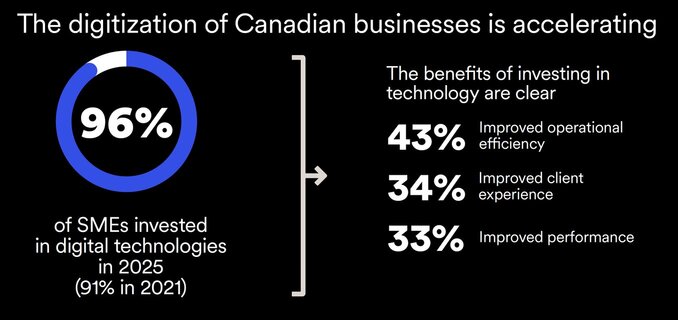
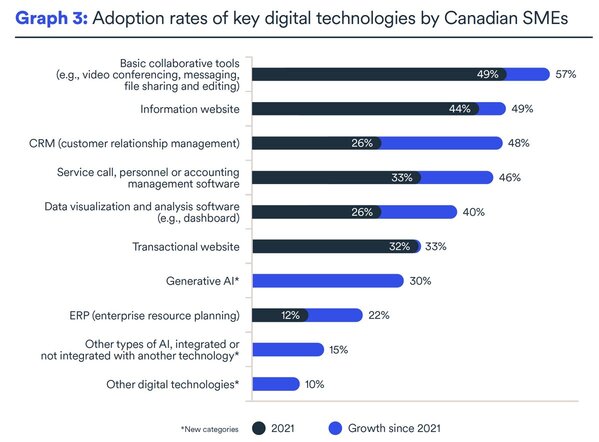
The study shows that 96% of SMEs have now adopted at least one digital technology, up from 91% in 2021. In addition, the use of all digital technologies has increased since 2021. This widespread momentum reflects growing entrepreneur awareness of the importance of technology to the competitiveness and resilience of their businesses.
Generative AI has also moved quickly into the SME market. BDC found that three in ten SMEs now use generative AI, and many are applying it to sales, marketing, administrative work, finance, HR, and customer-facing activities.
The benefits of using digital technologies are significant: improved operational efficiency for 43% of those surveyed and improved client experience for 34%.
Low digital technology adoption
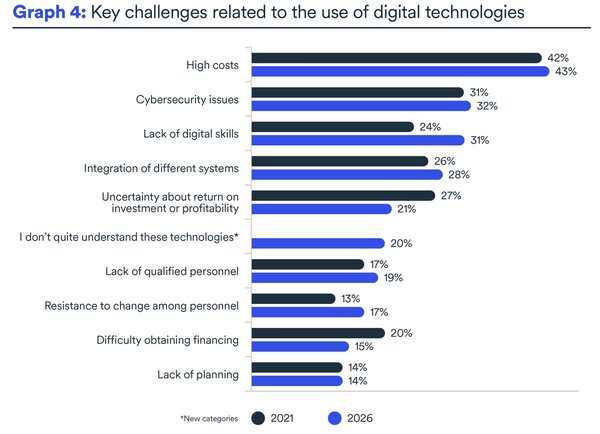
The level of adoption of digital technologies by businesses remains quite low despite advances in recent years. As in 2021, costs, lack of internal talent and cybersecurity continue to slow the use of technology. These problems particularly hinder adoption for the smallest businesses, which are too often behind the curve.
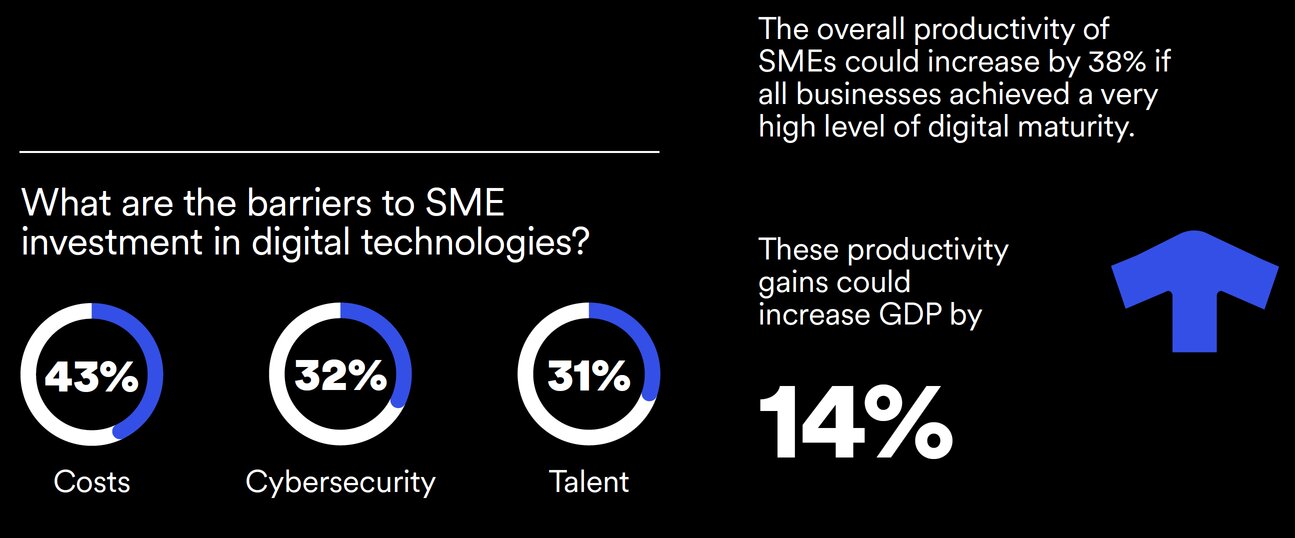
If all Canadian SMEs reached the same level of technology use as the most advanced SMEs, Canadian GDP could grow by nearly 14% ($350 billion).
The real gap is digital maturity
Digital maturity is about how well a business uses technology in a structured, integrated, and effective way. It includes the quality of the company’s systems, data, culture, planning, cybersecurity, and AI use. This is where many SMEs still have work to do.
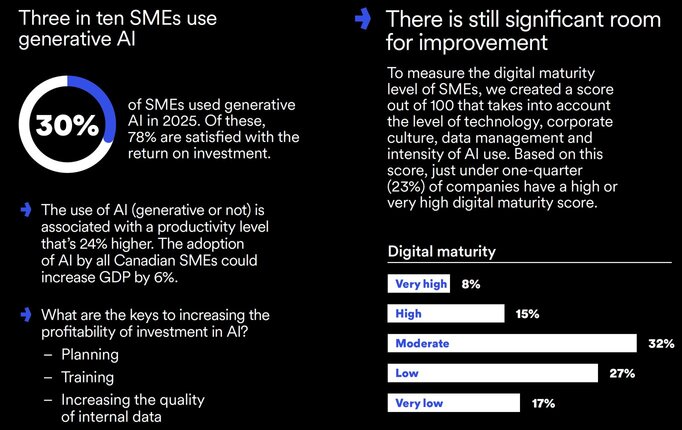
To realize this potential, it is essential to increase companies’ digital maturity, i.e., the degree to which a company uses digital technologies in a structured, integrated and effective way. Having the right tools is important, but it is also a matter of knowing how to use them to their full potential. This includes making a plan, training staff and having good data management.
BDC found that fewer than one-quarter of Canadian SMEs have a high or very high digital maturity score. In other words, many businesses have adopted tools but have not yet fully connected them to strategy, data, workflows, security, and measurable business outcomes.
The use of digital technologies is growing rapidly
Two-thirds of SMEs have a technology adoption plan, and 36% have a plan that includes the use of AI. Almost all SMEs (96%) have invested in digital technologies in the past 12 months with a median budget of $2,500. Budgets range from a few hundred dollars for many microbusinesses to multi-million-dollar budgets for some companies with more than 100 employees.
Cybercrime is slowing the digitization of businesses
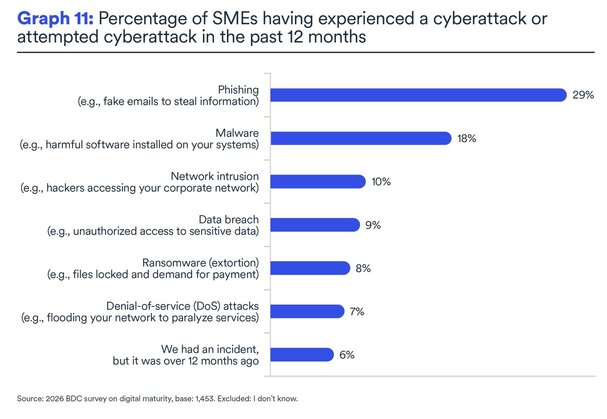
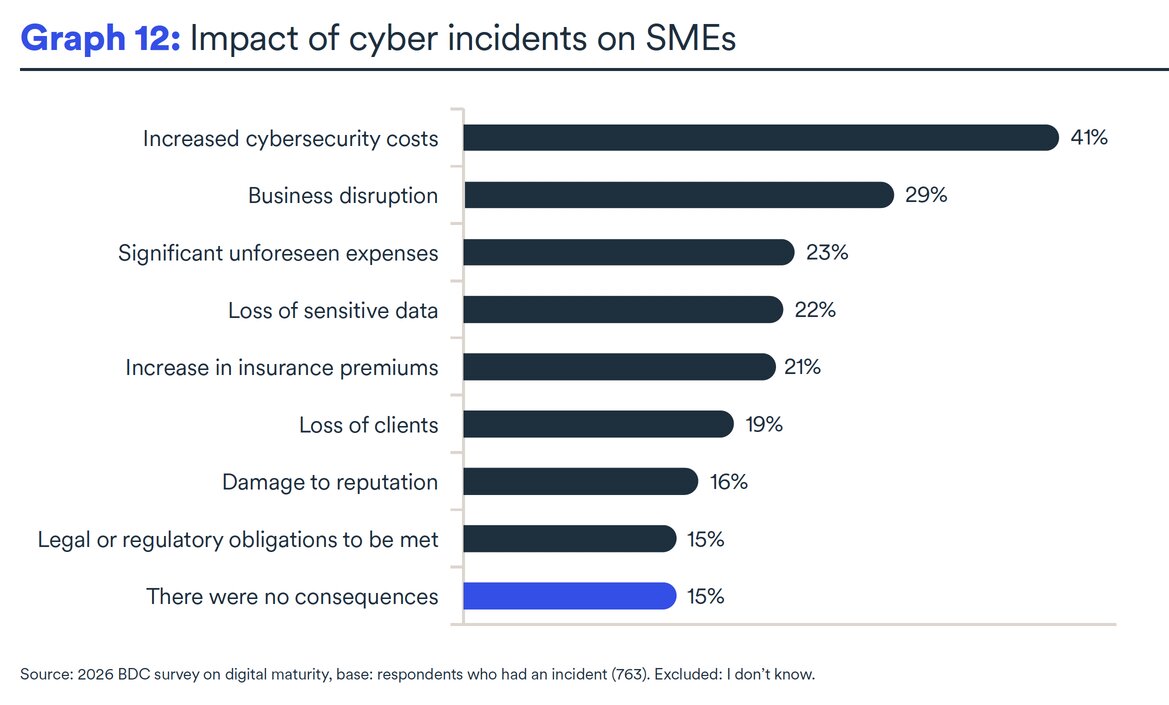
Increased digitization of businesses and their data unfortunately makes them more susceptible to cyberattacks. In 2021, 17% of SMEs were victims of attacks or attempted attacks over a 12-month period. In 2026, this percentage increased to 45%. Excluding phishing attempts, which can occur daily, the percentage is 31%. Large SMEs, which have more data, are more affected (63%), but micro-businesses are not spared (43%).
Even if most attacks fail, cybercrime increases costs for all businesses, as insecurity encourages them to spend money to protect themselves.
SMEs are spending billions to protect themselves
The main consequence of cyberattacks, whether they succeed or not, is that they increase the protection budget of SMEs. Companies also suffer losses in terms of time, money and reputation from successful attacks. Cybercrime, like any risk, can also increase the company’s insurance costs.
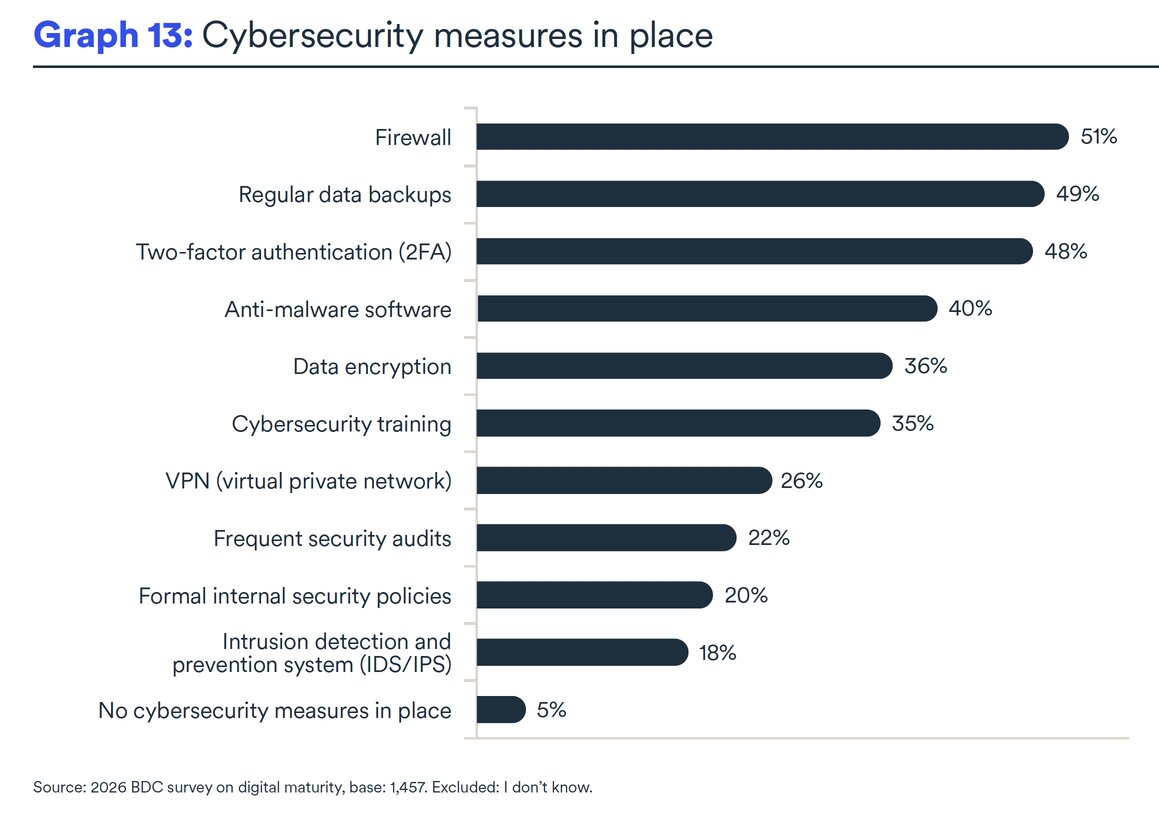
To protect themselves, 95% of SMEs have at least one cybersecurity measure in place. Measures are quite varied, but most often include firewall systems, regular backups, two-factor identification systems and anti-malware software.
Cybersecurity is now a digital growth issue
BDC found that 45% of SMEs experienced a cyberattack or attempted cyberattack in the past 12 months. Cybersecurity is now the second-biggest barrier to digital technology adoption, behind cost.
This is important because SMEs cannot fully benefit from AI, cloud, automation, or data-driven decision-making if their systems are not secure. As businesses digitize more of their operations, they also increase their exposure to phishing, malware, ransomware, network intrusion, data breaches, and business disruption.
For SMEs, cybersecurity should not be treated as a technical afterthought. It should be part of the digital transformation plan from the beginning.
A business that wants to adopt AI should also be asking:
- Who has access to sensitive data?
- Are cloud systems configured securely?
- Is multi-factor authentication enabled?
- Are backups tested?
- Are employees trained to recognize phishing?
- Are AI tools being used with customer or confidential business data?
- Are policies in place for safe and responsible AI use?
AI adoption success starts with strong digital foundations
At Reputiva, we believe the biggest opportunity for Canadian SMEs is not simply AI adoption. It is AI readiness. AI readiness means having the right foundations in place: secure cloud environments, clean and accessible data, integrated business systems, trained teams, practical governance, and cybersecurity controls that enable innovation safely.
The BDC report reinforces what we see across the SME market: many organizations are interested in AI, but they need help moving from experimentation to structured adoption. They need a clear roadmap that connects technology investment to productivity, security, and business outcomes.
The right path depends on the business’s maturity. But the goal should always be the same: use technology to reduce friction, improve decision-making, protect business assets, and create measurable value.
Ready to Assess Your Digital and AI Readiness?
Reputiva helps small and medium-sized businesses assess their digital maturity, strengthen cloud and cybersecurity foundations, and build practical roadmaps for AI adoption.
If your organization is exploring AI, cloud modernization, Microsoft 365, Google Workspace, cybersecurity, or digital transformation, now is the time to understand where you stand and what to prioritize next.
Book a consultation with Reputiva to assess your digital readiness and identify the practical steps your business can take toward secure, productive, and AI-enabled growth.
Reference: BDC, The Digital Transformation of SMEs in the Age of Artificial Intelligence, June 2026.