The Canadian government has released its new National Artificial Intelligence Strategy, titled AI for All. The core theme: AI is no longer a future technology conversation. It is now a national conversation about competitiveness, productivity, trust, security, and sovereignty. For Canadian businesses, nonprofits, public institutions, and community-serving organizations, the strategy signals a major shift. The question is no longer whether organizations should experiment with AI. The more important question is whether they can adopt AI safely, responsibly, and in ways that create measurable value.
For Canada to thrive in the era of AI, Canadians need to trust in its promise. Trust that they will share in its benefits and that it will be developed, adopted, and governed in ways that reflect our shared values.
The Canadian AI Strategy is based on:
Consultation
- 11,000 submissions from workers, entrepreneurs, researchers, students, and community leaders across the country.
Insights from 28-member expert AI Strategy Task Force
At Reputiva, we see this strategy as a call to action for organizations that are still trying to understand where AI fits into their operations, how to govern its use, and how to protect their people, data, systems, and customers in the process.
AI for All is not a slogan about access to tools. It is a commitment that every Canadian, in every region and at every stage of life can engage with AI from a position of strength
Canada’s AI Strategy
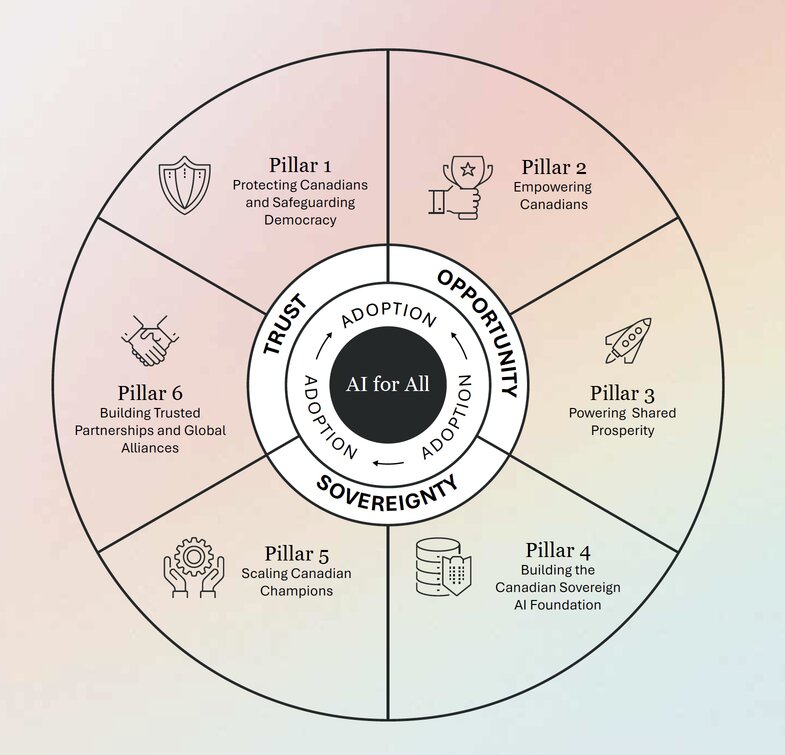
Canada’s AI strategy is about building trust, expanding opportunity, and strengthening sovereignty so that AI can be adopted widely and responsibly across the economy.
The strategy is built around six pillars:
- Protecting Canadians and safeguarding democracy
- Empowering Canadians
- Powering shared prosperity
- Building the Canadian sovereign AI foundation
- Building and scaling Canadian AI champions
- Building trusted partnerships and global alliances
The State of AI in Canada
Over 3,500 Canadian firms are actively developing advanced AI models, tools, and applications, collectively raising more than CAD$37 billion in venture capital funding. Some estimates for generative AI alone add $187 billion annually to the Canadian economy by 2030 and create hundreds of new Canadian firms.
Canada’s strong digital sector employs approximately 800,000 workers and contributes over $140 billion to GDP, with 150,000 jobs directly associated with AI.
Canada is an AI innovator
The foundational ideas behind today’s systems trace through Canadian researchers: Nobel laureate Geoffrey Hinton, and Turing Award winners Yoshua Bengio and Richard Sutton, the three so-called godfathers of AI.
Canada is home to one of only a handful of frontier model companies in the world.
Canada has major structural advantages in an AI world.
Canada brings deep human and institutional capital to the AI era: a highly educated workforce, one of the strongest concentrations of AI talent on the planet, deep capital markets, and rich data assets in sectors where AI will create outsized value, from health and life sciences to energy, agriculture, transportation, manufacturing, and public services.
The Canadian AI Adoption Gap
Canada has world-class AI research, strong AI talent, and a growing AI ecosystem. But the strategy notes that one of Canada’s biggest challenges is that AI adoption has not yet translated into broad economic use. Many organizations are experimenting with generative AI tools, but far fewer have moved from experimentation to structured, governed, measurable adoption.
Fewer than a quarter of Canadians (24 percent) report having received any AI training, fewer than four in ten say they have moderate or high knowledge of AI, and less than half believe they can use AI tools effectively.
Statistics Canada reports that only 12 percent of Canadian businesses used AI to produce goods or services between mid-2024 and mid-2025, rising to 14.5 percent planning to do so by mid-2026. The picture is sharper among small and medium-sized enterprises: only about 8 percent of Canadian SMEs have adopted AI, well behind Nordic leaders (29 to 42 percent), Germany (26 percent), and France (18 percent). On individual diffusion, Canada sits 15th globally at a respectable 37 percent, yet still trailing the UAE, Singapore, Norway, and several peers.
Initial adoption has happened; deeper, confident integration has not, and low literacy and low trust are the binding constraints.
Micro, small and medium-sized enterprises represent 99 percent of Canadian businesses and employ 14.3 million workers. Yet only one in eight Canadian businesses has formally integrated AI into its operations, even as nearly half of SME owners have experimented with generative AI tools. This gap between experimentation and deployment is where Canada’s adoption challenge lives. According to Statistics Canada, 78 percent of non-adopting firms report that they don’t see how AI benefits the goods or services they provide. That is not resistance; it is a translation problem.
Micro, small and medium-sized enterprises represent 99 percent of Canadian businesses and employ 14.3 million workers.
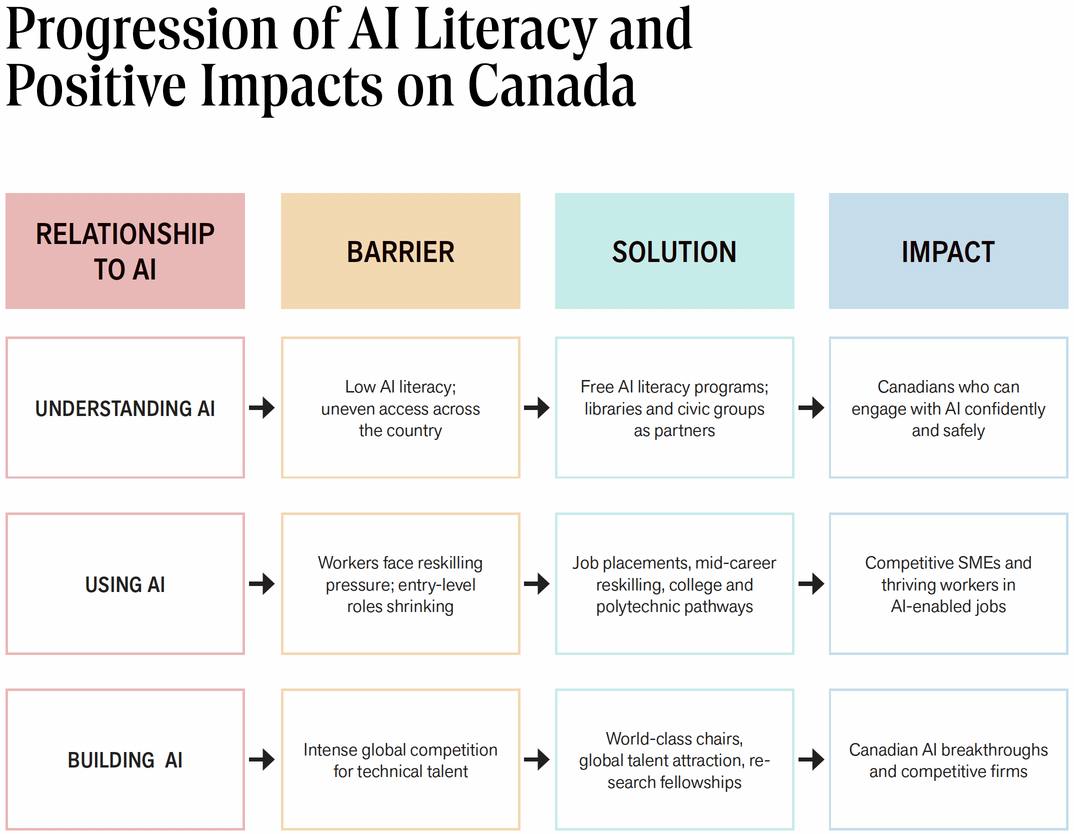
Canada’s new AI Strategy seeks to:
- Protect Canadians, particularly children, against AI risks and online harms, including by safeguarding their personal information and increasing AI transparency.
- Provide all Canadians with access to free AI literacy training, including reaching 1 million entry-level post-secondary students and doubling K-12 teacher training to more than 3,000 educators.
- Ensure all post-secondary students have access to trusted AI agents.
- Create up to 90,000 AI-related jobs and work placement opportunities for young Canadians to start their careers and support SMEs and nonprofits by 2031.
- Help create up to 250,000 new jobs through the adoption of AI by 2031.
- Increase Canada’s business adoption of AI from 12% today to 60% by 2034, through boosting SMEs and business adoption support.
- Support the unlocking of a 3% increase in GDP, representing nearly $200 billion in GDP gains, from labour productivity, including through the commercialization and application of AI in key sectors.
- Launch a new AI Missions Program to advance targeted, high-impact projects that deliver significant public good and demonstrate meaningful improvements in Canadians’ lives, starting with $200 million towards improving health outcomes for Canadians.
- Build a world-leading supercomputer as part of significantly enhanced sovereign infrastructure by 2031.
- Enhance access to public compute for SMEs to drive commercialization and adoption through the Compute Access Fund.
- Build a strategic multilateral alliance to ensure Canada moves from reliance to resilience by having sovereign autonomy in key AI and technology capabilities.
From AI Experimentation to AI Readiness
Many organizations have experimented with tools, but experimentation is not the same as readiness. AI readiness requires a structured understanding of the organization’s:
- Business goals
- Data environment
- Cloud and workspace security posture
- Identity and access controls
- Privacy and compliance obligations
- Employee skill levels
- Approved tools and use cases
- Vendor and third-party risks
- Cybersecurity exposure
- Governance model
- Implementation roadmap
Without this foundation, AI can easily become another form of shadow IT. Employees may upload sensitive information into public tools, departments may purchase disconnected AI products, and leaders may struggle to understand the true risk and value of AI adoption.
The opportunity for Canadian organizations is to move from scattered AI use to intentional AI adoption.
Trust Is the Foundation of AI Adoption
One of the strongest themes in Canada’s AI strategy is trust. This aligns closely with Reputiva’s view of secure digital transformation. Organizations will not adopt AI confidently if they do not trust the tools, data flows, vendors, governance model, or their own internal controls.
Trust is not a brake on innovation; it is the foundation that makes broad, confident adoption possible.
The strategy connects AI to some of the most important issues facing organizations today:
- Privacy
- Cybersecurity
- Data protection
- AI literacy
- Workforce skills
- Cloud infrastructure
- Business productivity
- Public trust
- Responsible innovation
- Canadian technology sovereignty
This is why the strategy matters beyond government and large technology companies. It creates a roadmap for how everyday organizations can begin preparing for the AI era.
At Reputiva, our view is simple: before organizations scale AI, they need to understand their readiness. That includes knowing what AI tools are already in use, what data is exposed, whether Microsoft 365 or Google Workspace is properly secured, and what policies are needed to guide responsible use.
The opportunity is significant, but the foundation matters. Organizations that combine AI innovation with cybersecurity, cloud readiness, and practical governance will be better positioned to adopt AI safely and create lasting value.
Is your organization exploring AI but unsure where to start?
Reputiva can help you assess your AI readiness, cloud security posture, Microsoft 365 or Google Workspace environment, cybersecurity risks, and implementation priorities.
Book an AI Security and Readiness consultation with Reputiva to identify your current risks, prioritize practical use cases, and build a secure roadmap for responsible AI adoption.