Artificial intelligence is no longer an emerging technology; it is rapidly becoming part of the core infrastructure of modern organizations. AI assistants are generating content, analyzing data, automating workflows, and increasingly making decisions without direct human intervention. Autonomous AI agents can now create accounts, modify records, interact with APIs, and execute tasks at machine speed.
The challenge is that security governance has not kept pace with AI adoption.
The Netskope/Cybersecurity Insiders 2026 AI Risk and Readiness Report is based on a comprehensive survey of 1,253 cybersecurity professionals. The report explores how organizations are securing AI, with consideration for governance, visibility, data protection, and agent control. The survey points to four architectural priorities: continuous visibility into all AI activity, including agent and M2M traffic; inline enforcement without creating friction and latency; semantic-aware data controls that evaluate meaning rather than patterns; and extending zero trust to non-human identities (NHIs).
73% of organizations have already deployed AI tools, yet only 7% have achieved advanced AI governance with real-time policy enforcement.
The findings point to a growing reality: organizations are moving quickly to adopt AI, but many are doing so without the visibility, governance, and controls needed to manage the risks associated with autonomous systems.
Key Findings
Adoption of AI has outpaced security governance
AI tools are now deployed in 73% of the organizations surveyed, but real-time governance that enforces security and policy has reached only 7%. That leaves a 66-point structural deficit, which is widening as AI adoption accelerates faster than controls.
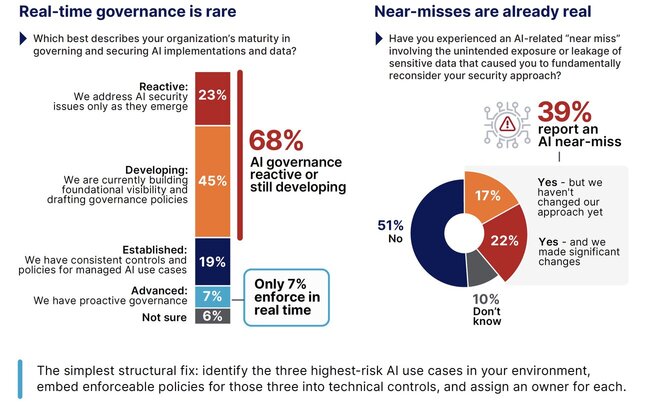
Today, 68% of organizations describe their AI governance as reactive or still developing. Only 7% have reached advanced maturity with real-time policy enforcement. The 66-point gap between the 73% deploying AI tools and the 7% governing them in real time is a structural mismatch—organizations are building at production speed on a security and compliance foundation that barely exists.
Organizations are building at production speed on a security and compliance foundation that barely exists.
Spending is up, but confidence is down
90% increased AI security budgets this year, yet 29% feel less secure than twelve months ago. The problem is outpacing the investment.
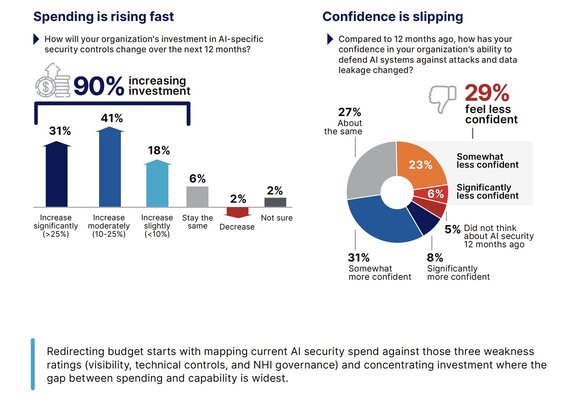
Paradoxically, the AI governance gap exists despite organizations investing more than ever in security. 90% increased AI security spending this year, with nearly a third raising budgets by more than 25%, yet 29% report feeling less secure than twelve months ago. Investment is increasing—confidence is not.
Existing security tools were designed for known file formats, predictable data flows, and human-speed interactions. Adding more budget to that stack buys more of what already fails against AI-driven risk.
Most AI activity is invisible to security
94% of respondents report gaps in AI activity visibility. 88% cannot distinguish personal AI accounts from corporate instances. Only 6% claim to see the full scope of their organization’s AI pipeline.
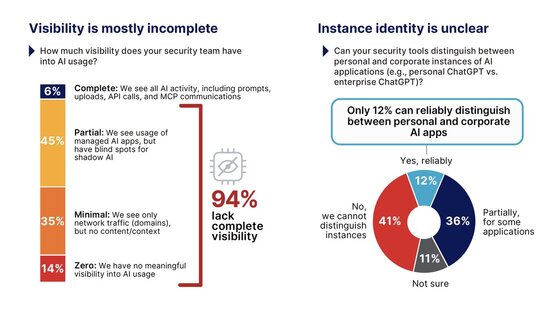
Even where detection exists, distinguishing what matters remains difficult. 88% cannot reliably tell personal AI accounts from corporate instances on the same platform, the #1 technical blind spot in the survey. When a security team cannot tell whether an employee is using an authorized AI tenant or a personal account with no data governance, DLP policies, access controls, and audit trails all become unreliable.
Closing that visibility gap means extending activity-level monitoring to those channels, starting with account-level distinction between personal and corporate AI accounts as the foundation everything downstream depends on.
AI is rendering legacy data loss prevention powerless
DLP matches patterns while AI transforms meaning; only 8% have controls that evaluate content semantically, regardless of how it has been rewritten.
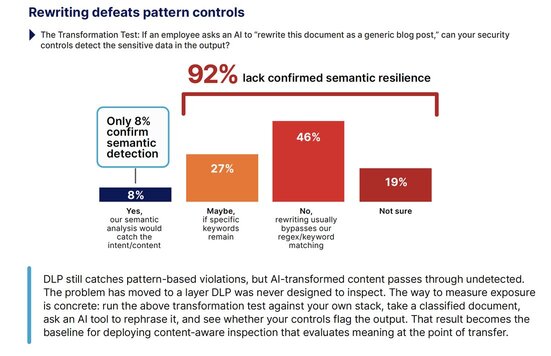
Even where organizations can see AI activity, the primary tool tasked with catching data in motion was designed for a fundamentally different kind of movement. DLP was built to find specific patterns: credit card formats, Social Security number sequences, regex matches against known sensitive content. While DLP may block the upload or the copy/paste of sensitive data into prompts by looking for these patterns, if AI gets hold of the data, it will rephrase sensitive content—retaining its meaning—while discarding its original digital fingerprint.
Agents act without guardrails
AI agents have write access to collaboration tools (53%), email (40%), code repositories (25%), and identity providers (8%). 91% of organizations only discover what an agent did after it has already executed the action.
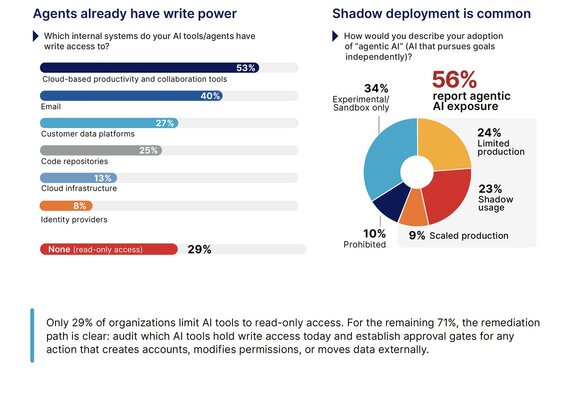
While data leakage through AI tools is the risk most organizations recognize, the deeper exposure is that AI systems are now acting on their own, with many operating in shadow mode outside security’s view. Organizations that cannot see agents cannot know they have shadow agents.
In practice, bans often drive activity underground, making it harder to govern and even harder to contain when something goes wrong.
Too much AI security runs on trust
31% rely on written policies and employee compliance as their primary enforcement. Another 11% have nothing at all. Only 23% say they enforce AI security in line, at the point of action.
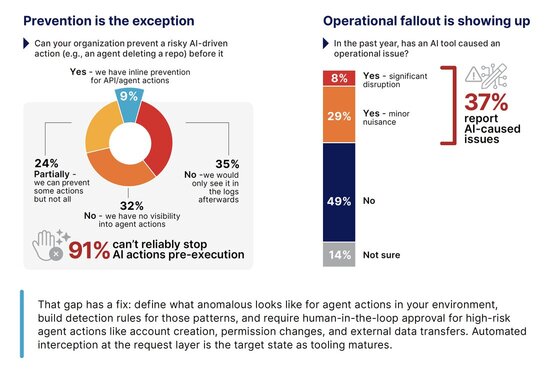
For every ten organizations running agentic AI, fewer than one can stop an agent from deleting a repository, modifying a customer record, or escalating a privilege before the action executes.
AI Readiness requires Digital Readiness
One of the most important findings in the report is that AI risk is no longer primarily about employees misusing AI tools. The risk is increasingly coming from autonomous systems, AI agents, shadow AI deployments, and non-human identities operating beyond traditional security controls.
AI readiness starts with digital readiness.
Many organizations are focused on deploying AI capabilities before establishing the foundational controls needed to govern them. As a result, they are encountering the same challenges that have historically affected cloud adoption, SaaS adoption, and digital transformation initiatives:
- Limited visibility
- Weak governance
- Fragmented security controls
- Identity sprawl
- Poor data classification
- Insufficient monitoring
The report highlights that only 6% of organizations claim complete visibility into AI activity and only 8% have data protection controls capable of detecting sensitive information after it has been transformed or rewritten by AI. This is where cybersecurity, cloud governance, and AI governance converge.
Organizations should focus on:
- Establishing AI governance before scaling AI adoption
- Securing non-human identities and machine-to-machine communications
- Extending Zero Trust principles to AI agents
- Implementing semantic-aware data protection
- Monitoring AI activity across corporate and personal AI platforms
- Building controls that prevent risky actions before execution
AI security is rapidly becoming an operational discipline rather than a compliance exercise. The organizations that succeed will be those that build secure foundations first and deploy AI capabilities second.
The future belongs not to the organizations that adopt AI the fastest, but to those that can adopt it safely, securely, and responsibly.
Build the foundation for secure AI Adoption
AI adoption is accelerating across every industry, but deploying AI without governance, visibility, and security controls can create significant operational and cybersecurity risks. At Reputiva, we help organizations assess and strengthen their AI readiness through:
- AI governance and security assessments
- AI risk management programs
- Microsoft 365 and Google Workspace security
- Identity and access management
- Non-human identity (NHI) governance
- Cloud security across AWS, Azure, and GCP
- Data protection and compliance
- Zero Trust architecture and implementation
- Digital readiness and digital transformation strategies
Whether you are evaluating AI tools, deploying AI assistants, or preparing for autonomous AI agents, now is the time to build the controls that will enable secure and responsible AI adoption.
Book an AI Readiness and Security Consultation with Reputiva to assess your organization’s governance, visibility, identity, and data protection capabilities before AI risks become business risks