The rise of AI workloads, multi-cloud adoption, and increasingly complex digital environments is forcing organizations to rethink how they manage technology spending. The FinOps Foundation 2026 State of FinOps Report offers a detailed look into how organizations are approaching cloud financial operations in the era of AI, automation, and multi-cloud complexity. The report highlights growing executive focus on cloud accountability, better forecasting, AI workload optimization, and cross-functional collaboration between finance, engineering, operations, and security teams.
FinOps is no longer just explaining past spend. It’s shaping future technology decisions before commitments are made.
The core message of the report: cloud financial management is no longer optional. Organizations that fail to establish visibility and governance over cloud and AI spending risk operational inefficiencies, budget overruns, and reduced business agility.
About the State of FinOps Annual Survey
The State of FinOps is an annual survey conducted by the FinOps Foundation, since 2020, to collect information about key priorities, industry trends, and the direction of the FinOps practice. The survey informs a range of Foundation activities and tells the broader market how FinOps is practiced in a variety of organizations.
The 6th Annual State of FinOps survey is a snapshot from the global FinOps community. FinOps is no longer just explaining past spend. It’s shaping future technology decisions before commitments are made.
Key Takeaways
1. AI Dominates the Agenda: Both Managing It and Using It
AI investment remains strong in the cloud but is also increasing in SaaS, data center, and private cloud. Many organizations report being asked to self-fund AI investments through optimization savings, tying traditional FinOps work directly to strategic technology enablement.
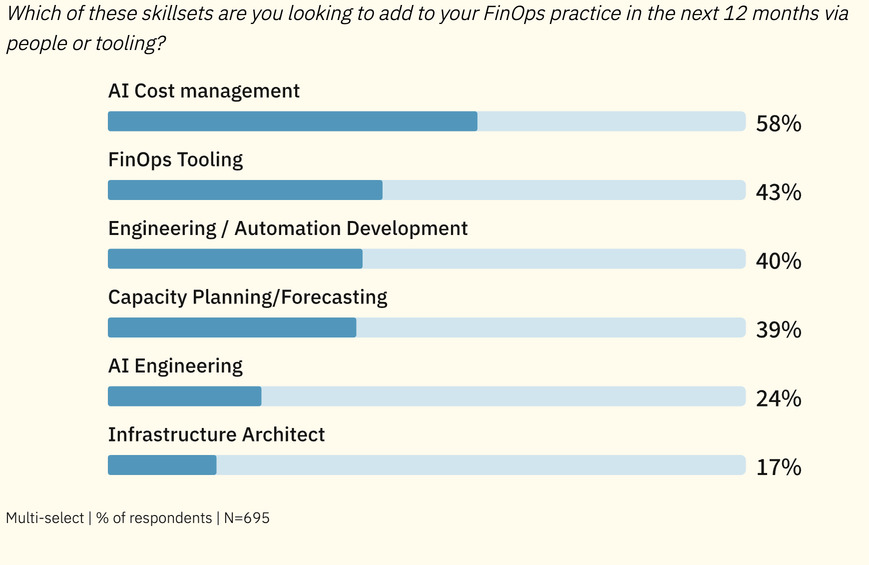
FinOps for AI is the top forward-looking priority. AI cost management is the #1 skillset that teams need to develop.
2. FinOps Has Definitively Expanded Across Technology
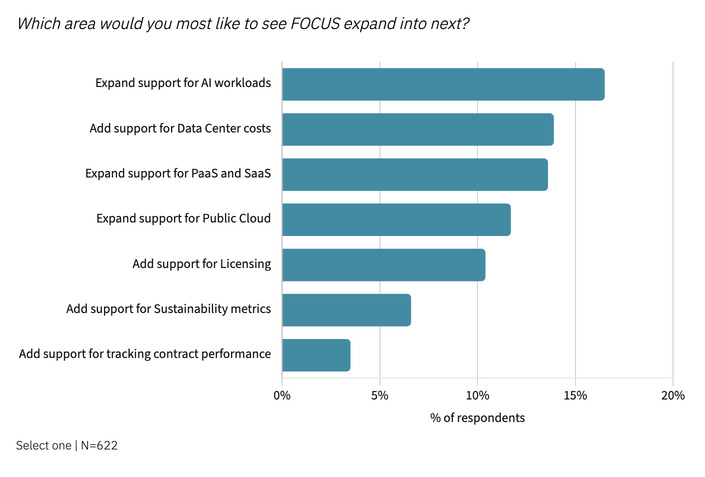
90% now manage SaaS or plan to in the coming year (up 25%), 64% manage licensing (up 15%), 57% manage private cloud (up 18%), and 48% manage data center (up 12%). An emerging 28% are including labor costs. Supporting this expansion is growing adoption of the FinOps Open Cost and Usage Specification (FOCUS), as practitioners seek consistent, unified cost and usage data across an increasingly complex technology landscape. Demand continues for more providers and services to support the specification.
Top expansion requests: AI workloads, data center, and broader SaaS/PaaS support.
3. Optimization is Table Stakes, Value is the Goal
Workload optimization and waste reduction remain a current priority for many, but the landscape is shifting. Collectively, Scopes expansion, Governance/Policy, Organizational Alignment, and Forecasting outweigh optimization alone.
The center of gravity is spreading as teams take responsibility for increasing technology value, not just reducing technology cost.
4. FinOps Has Shifted Up 78% of teams now report to the CTO or CIO.
FinOps practitioners who are engaged with Executives are much more likely to influence technology selection by determining which technology category will drive the most value based on business strategy. Practices overwhelmingly report into the Technology organization, with a dotted line to Finance.
FinOps leaders increasingly participate in strategic provider negotiations, multi-year investment decisions, and M&A technology due diligence. Some are influencing decisions about labor vs. AI technology investment.
5. Shift Left Is Happening, Measurement Remains Unsolved
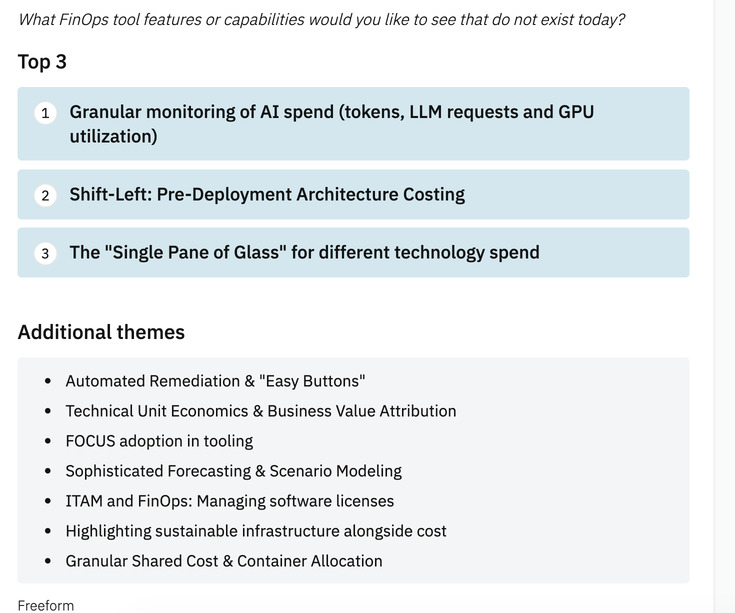
Practitioners are embedding financial requirements earlier in the engineering and product lifecycles. Pre-deployment architecture costing emerged as a top desired tool capability. FinOps teams are engaging with Platform Engineering and Enterprise Architecture teams, building pricing calculators and offering pre-deployment guidance, but incentive structures haven’t caught up.
6. Intersecting Disciplines Are Converging
FinOps teams are collaborating most often with ITFM teams to leverage shared data, followed by ITAM/SAM to ensure asset compliance and governance, ITSM on policies, processes, and procedures, and ESG on sustainability. Platform Engineering is increasingly participating in Shift Left conversations.
7. Small Enablement Teams with Federated Champions
The dominant operating model: centralized enablement with federated execution. Team sizes remain lean: organizations managing $100M+ average range of 8-10 practitioners and 3-10 contractors. Successful practitioners scale through federation with embedded champions executing, plus help from AI productivity and automation rather than headcount. They don’t build large central empires.
Desired Skillsets
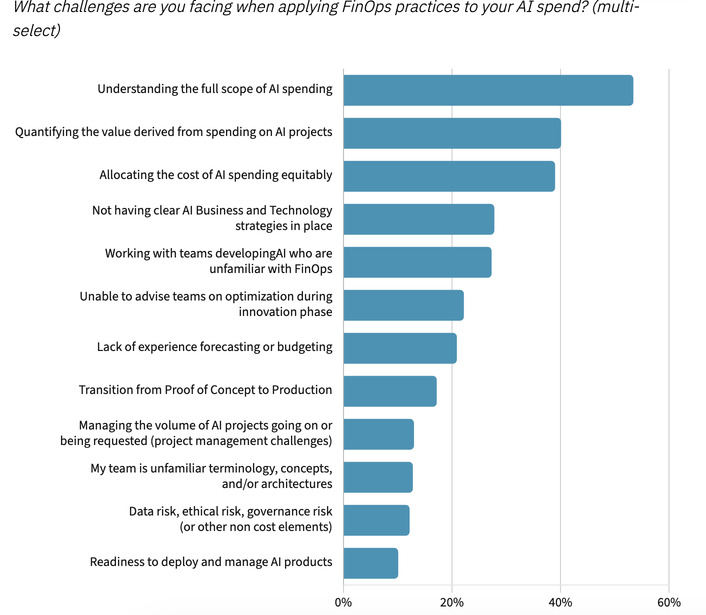
AI cost management stands out as the single most desired skillset across organizations of all sizes—reflecting both the rapid growth of AI-related spend and the complexity of understanding and allocating those costs. Tooling expertise and automation development follow closely, signaling that FinOps is becoming more data- and engineering-driven.
AI: Front and Center in the Next 12 Months
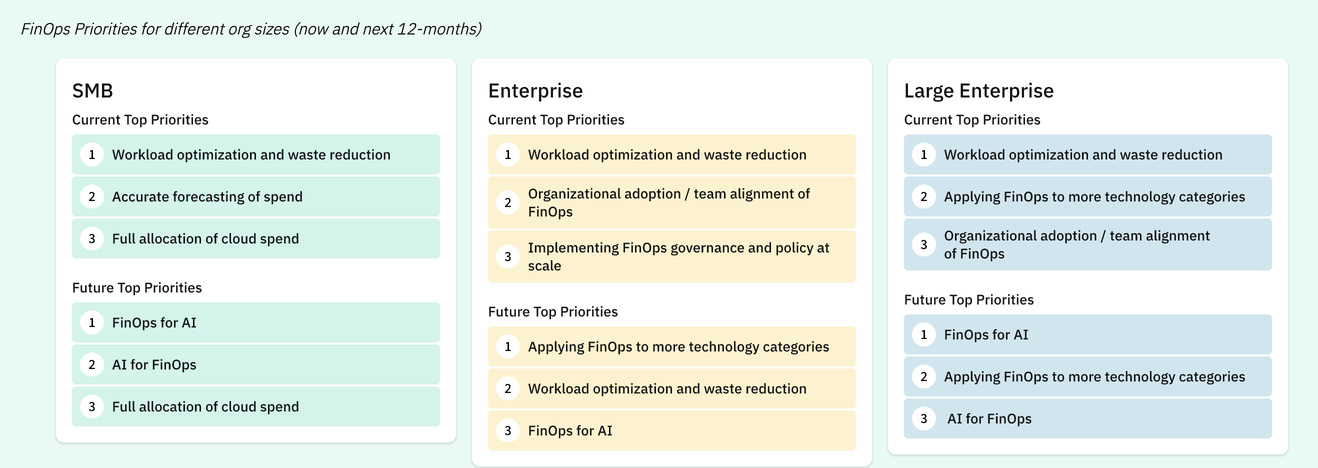
FinOps for AI emerges as the top forward-looking priority, outpacing traditional focus areas. Respondents also rank AI for FinOps among their top future priorities, signalling a dual mindset: govern AI value while leveraging AI to improve FinOps productivity and efficiency.
AI Is Not Just a Large-Enterprise Concern
Across organizations, AI-related priorities are rising to the top tier in future priorities. This signals that AI spend governance is becoming a mainstream need, not a niche or experimental effort.
Smaller organizations balance AI alongside foundational FinOps work, while larger organizations increasingly treat AI as a dedicated domain. But the directional trend is consistent: teams across all sizes are preparing for AI-related value management.
Technology Categories: FinOps Is a Multi-Technology Practice
What was once a cloud-focused practice is now definitively multi-technology. Practitioners describe this evolution in phases: “First they asked us to fix cloud. Then fix the software mess. Now it’s fix the contract and license mess, now fix the data center…” referring to the progression from cloud optimization to SaaS rationalization to strategic vendor relationship management.
Understanding Cost Comes Before Optimizing, Whatever the Technology
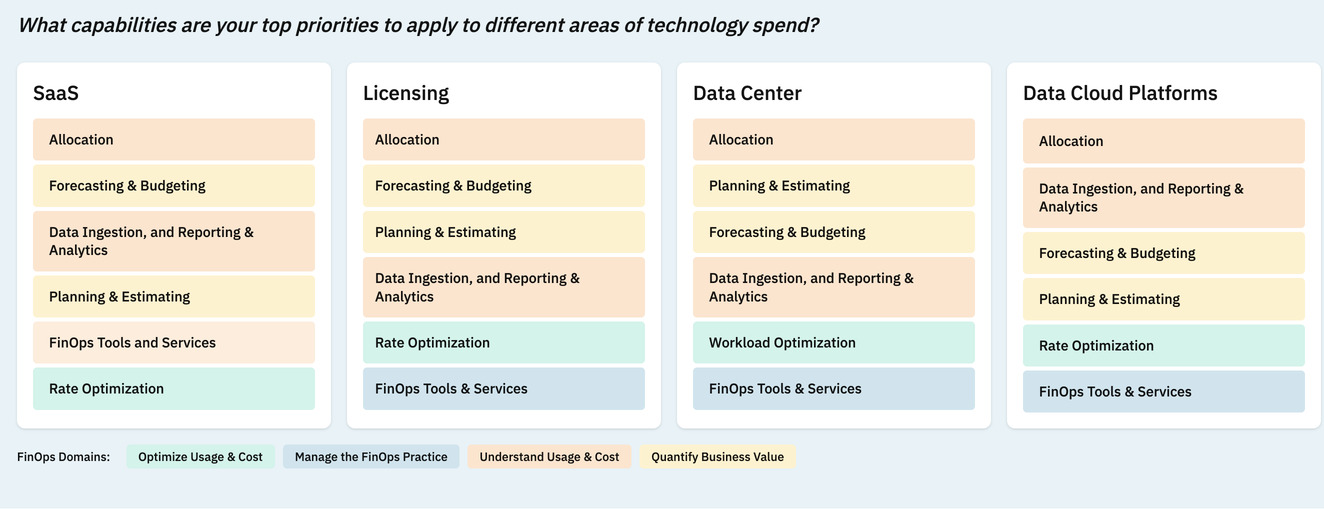
Across SaaS, data center, licensing, and data cloud platforms, the most prioritized capabilities are Allocation, Forecasting, Budgeting, Planning & Estimating, and Reporting & Analytics. This shows teams focus first on understanding and structuring cost before trying to reduce it. As FinOps expands into new domains, teams are applying the same maturity path they used in cloud into other technologies: first gain visibility, then build planning discipline, and only then optimize for value.
FinOps is a Technology Value Discipline
FinOps is no longer defined by cloud cost management alone—it’s become the method for identifying and communicating technology value across AI, SaaS, licensing, private cloud, and data center throughout the organization where needed. As the practice enables technology executives and “shifts left” into earlier decision points, teams are balancing two truths at once: optimization remains essential, but the next wave of impact will come from governing and shaping spend before it happens, especially as AI investment expands and diversifies.
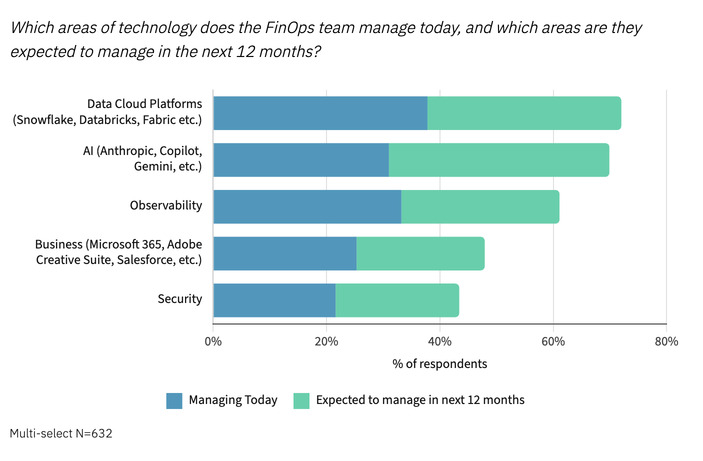
Underpinning this evolution is the growing role of the FinOps Open Cost and Usage Specification (FOCUS), which helps organizations normalize and analyze billing datasets across an increasingly complex technology landscape. As more providers and tools support FOCUS, practitioners gain a consistent data foundation to apply FinOps principles across all their technology spending areas.
From Cloud Adoption to Cloud Accountability
The FinOps Foundation 2026 State of FinOps Report highlights an important shift across modern organizations: FinOps is no longer just about reducing cloud costs; it is becoming a broader operational, governance, and business-resilience function.
As organizations continue expanding across cloud platforms while simultaneously accelerating AI adoption, these environments are becoming more complex, decentralized, and difficult to manage efficiently. AI workloads, SaaS sprawl, overprovisioned infrastructure, idle resources, fragmented visibility, and inconsistent governance models are creating both financial and operational risks for businesses of all sizes.
Many organizations initially approached cloud adoption with a primary focus on speed and scalability. But as cloud environments mature, leadership teams are now demanding:
- better visibility into cloud and AI spending,
- stronger accountability across teams,
- improved forecasting,
- operational efficiency,
- security alignment,
- and measurable business outcomes.
The report reinforces that FinOps is increasingly becoming a cross-functional discipline involving engineering, finance, operations, security, procurement, and executive leadership, not just cloud administrators or finance teams.
At Reputiva, we believe organizations must align cloud security, governance, and FinOps practices together rather than treating them as separate initiatives. Poor visibility, weak governance, and unmanaged cloud growth can increase both cybersecurity exposure and unnecessary operational spending.
Organizations that succeed in the next phase of cloud and AI transformation will be the ones that combine:
- cloud cost visibility,
- strong governance,
- security-first architecture,
- identity and access controls,
- operational accountability,
- and continuous optimization practices.
FinOps maturity is quickly becoming a competitive advantage for organizations looking to scale cloud and AI adoption sustainably and securely.
Whether your organization is struggling with rising cloud costs, fragmented visibility, SaaS sprawl, AI adoption challenges, or cloud security concerns, Reputiva can help you build a more secure, optimized, and resilient cloud environment.
Book a Cloud Strategy, Security & FinOps Assessment with Reputiva today and start building a smarter approach to cloud and AI operations.