Quantum computing is still an emerging technology, but its cybersecurity implications are already becoming urgent. The paper examines how businesses are preparing to use quantum computing for commercial applications. It defines quantum readiness as an exploratory, capability-building process and describes the practical steps firms take to develop it.
The OECD’s 2026 report, Building Business Readiness for Quantum Computing, notes that while broad commercial adoption remains uncertain, organizations should begin preparing now because quantum computing could eventually compromise many of today’s widely used cryptographic systems. The report also highlights the risk of “store now, decrypt later” attacks, where encrypted data captured today may be decrypted in the future once powerful quantum computers become available.
The OECD study draws on the experience of public and private organizations across 10 countries that support business engagement with quantum computing.
For business leaders, this makes post-quantum cryptography less of a distant research topic and more of a resilience planning issue. The question is no longer simply “When will quantum computers arrive?” but “Which of our systems, data, vendors, applications, and certificates depend on cryptography that may not be quantum-safe?”
The findings provide actionable insights for policymakers and industry actors on how to strengthen readiness efforts and enable wider business engagement with quantum computing.
What is Quantum Computing?
Quantum computing is an emerging paradigm in information processing that leverages the principles of quantum mechanics to solve certain complex problems that are difficult or lie beyond the reach of classical computers. Quantum information technologies exploit the unique properties of atoms, photons and other particles to offer capabilities in gathering, processing and transmitting information beyond the reach of classical information and communication technologies (OECD, 2025[1]).
Quantum computing is an emerging approach to information processing that harnesses the principles of quantum mechanics to perform computations in fundamentally new ways.
Unlike classical computers, which use binary digits, or “bits,” to represent 0 or 1, quantum computers use qubits, which can represent multiple states simultaneously through a quantum phenomenon called superposition. Moreover, entanglement allows qubits to become intricately interconnected. These unique capabilities are expected to enable quantum computers to tackle certain complex problems that classical systems cannot solve.
Qubits can hold and process far more information than classical bits: as more qubits are linked together, the number of possible configurations (the slots for encoding information) grows exponentially, allowing quantum computers to describe and process vast amounts of data.
In particular, quantum computing is emerging as a new paradigm that is expected to solve complex problems that are challenging or impossible for today’s classical computers. While the technology is not yet mature for wide commercialization, businesses are beginning to explore its potential as a source of long-term competitive advantage.
Building readiness will require expanding skills pipelines, strengthening industry-academic partnerships and ensuring that support mechanisms reach a wider range of firms. Hybrid approaches that combine quantum computing, artificial intelligence and high-performance computing are likely to serve as practical entry points for early commercial applications.
The analysis identifies four key barriers: limited technological maturity; unclear use cases and business implications; high costs of access and staff training; and shortages of talent combining quantum computing expertise with industry-specific knowledge.
Quantum Advantage
Quantum advantage refers to the point in time when a quantum computer built and operated in practice outperforms a classical computer in solving a well-defined problem (Preskill, 2012[3]).
Post-quantum cryptography
Post-quantum cryptography (PQC) refers to cryptographic methods designed specifically to withstand attacks from quantum computers. Unlike traditional encryption algorithms, which are vulnerable to quantum computing, PQC employs classical computing algorithms based on complex mathematical problems designed to be challenging even for quantum algorithms.
Quantum key distribution
Quantum key distribution (QKD) is a quantum communication technology that aims to secure key exchanges by leveraging the laws of physics rather than relying on mathematical complexity. QKD could help ensure that any intercepted information is rendered unusable. In practice, however, the security of practical QKD systems is highly implementation dependent.
For many businesses, the lack of commercial applicability makes it challenging to justify investing in quantum readiness. Until quantum economic advantage becomes a near-term prospect, many enterprises will remain hesitant to invest in a technology that is not yet aligned with operational needs or business timelines. However, many companies with substantial R&D budgets invest early, recognising that building readiness takes several years and can create a lasting competitive advantage.
Key barriers to readiness and related support measures
Quantum computing is not a sufficiently mature technology
While interest and investment in this field are growing rapidly, quantum computing is not yet a sufficiently mature technology for widespread deployment. Existing hardware is limited to small-scale processors with high error rates, and there are multiple competing quantum computing hardware platforms (e.g. superconducting qubits, trapped ions, photonic systems) with no single one emerging as dominant. These limitations mean that most potential commercial applications of quantum computing, such as optimisation and machine learning, remain experimental and do not yet represent an economic advantage over classical methods.
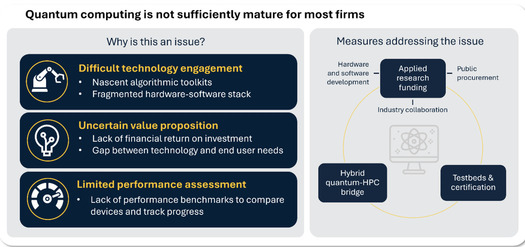
Businesses that are building readiness face significant frictions arising from the fragmentation of the quantum computing technology ecosystem. Multiple quantum hardware platforms are being developed in parallel, each with its own programming tools, languages, strengths and limitations. This diversity reflects a healthy and necessary phase of technological competition and experimentation. However, the coexistence of multiple, largely incompatible approaches across the full quantum computing stack, from hardware to middleware and software, makes it difficult for companies to navigate the ecosystem and plan long-term investments.
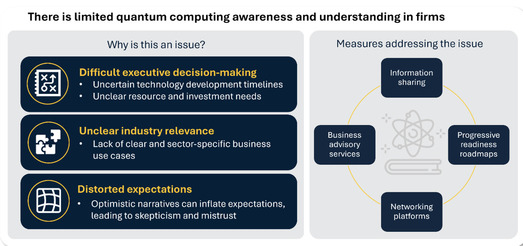
Limited awareness of quantum computing and understanding of its implications
Low levels of awareness and understanding around quantum computing’s actual capabilities and timelines pose another major hurdle. Even in sectors where engagement might be expected, firms often have not begun preparing because they lack the necessary knowledge base. Firms tend to postpone action, viewing quantum computing as something to address in the future. They may acknowledge the importance of quantum and express interest in its future relevance, yet they often stop short of acting on this recognition to build a deeper understanding of the technology, develop concrete strategies or engage in structured planning.
The cost of building readiness
Until recently, access to a quantum computer was considered prohibitively expensive for most prospective end users, since it required direct acquisition. In addition to the significant upfront investment, companies need to invest in specialised personnel to operate and maintain the machines, along with extensive infrastructure such as dedicated facilities with controlled environments and technical safeguards. Given these substantial and recurring costs, very few firms can realistically pursue this model.
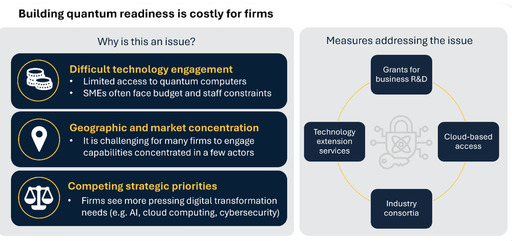
Cloud-based platforms are increasingly facilitating access to quantum compute time on remote machines. This model makes experimentation with quantum computing more accessible, shifting both the financial and technical burden away from the end user and enabling firms to participate in building readiness without committing to costly infrastructure. While this approach thereby significantly lowers the entry barrier, the cost of cloud-based access is not negligible. According to one estimate, using a remote quantum computer for 12 hours can cost approximately USD 70 000 (OECD, 2025[1]).
Given the uncertainty around when and where quantum computing could deliver a competitive advantage, many firms are reluctant to commit resources to a technology with unclear short-term returns. This limits engagement, even for firms with the means to invest.
Limited access to skills in the workforce
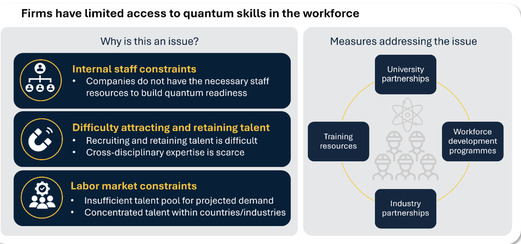
Readiness requires staff who combine computer science and quantum knowledge with industry-specific expertise, yet such cross-disciplinary skills are rare. Without individuals who can bridge these areas, firms will continue to struggle to progress beyond general awareness into more advanced stages of readiness. Beyond quantum-specific specialists, companies also need support from data scientists, technicians and other complementary profiles.
What it means for your Organization
Post-quartum readiness should begin with visibility. Organizations need to know where cryptography is used across their environment: applications, cloud services, APIs, VPNs, identity systems, databases, endpoints, third-party platforms, and long-lived data stores.
The OECD report emphasizes that quantum resilience involves identifying critical data, inventorying vulnerable algorithms, conducting risk assessments, and building transition plans. This is especially important for organizations that handle sensitive financial, health, government, legal, intellectual property, or customer data.
For most organizations, the practical starting point is not buying quantum technology. It is building a crypto-agility roadmap. That means being able to discover, replace, test, and govern cryptographic components as standards, vendor products, and compliance expectations evolve.
Key actions include:
- Create a cryptographic asset inventory
Identify where encryption, signing, certificates, keys, and protocols are used. - Prioritize high-risk systems and long-lived data
Focus first on sensitive data that must remain confidential for many years. - Assess vendor and cloud dependencies
Ask suppliers how they are preparing for post-quantum cryptography across their platforms. - Build crypto-agility into architecture
Avoid hard-coded cryptography and ensure systems can support algorithm changes. - Align cybersecurity, cloud, risk, and compliance teams
PQC is not only a security engineering issue; it affects governance, procurement, architecture, and business continuity.
Post-Quantum Readiness starts with Cyber Resilience
At Reputiva, we see post-quantum cryptography as part of a broader cyber resilience and digital trust conversation. Organizations do not need to panic, but they should not wait until quantum-safe migration becomes a compliance emergency.
The best approach is measured and practical: start with discovery, risk classification, vendor review, cloud architecture assessment, and a phased transition roadmap. For SMEs, financial institutions, public sector organizations, and regulated businesses, post-quantum readiness should be integrated into existing cloud security, identity, data protection, and compliance programs.
The organizations that act early will be better positioned to manage future cryptographic change without rushed remediation, operational disruption, or avoidable exposure.
Is your organization ready for the post-quantum security shift?
Reputiva helps organizations assess cloud, cybersecurity, and cryptographic resilience across modern digital environments.
Book a Cloud Security & Post-Quantum Readiness Assessment today.