Cloud Financial Operations (FinOps) is the practice of bringing finance, engineering, technology, and business teams together to improve how organizations plan, track, govern, and optimize cloud spending. The FinOps Foundation defines FinOps as an operational framework and cultural practice that maximizes the business value of technology, enables timely data-driven decision-making, and creates financial accountability through collaboration between engineering, finance, and business teams.
FinOps is a portmanteau of “Finance” and “DevOps”, stressing the communications and collaboration between business and engineering teams.
The goal of FinOps isn’t to save money, but to maximize revenue or business value through the cloud. It helps to enable organizations to control cloud spending while maintaining the level of performance, reliability, and security needed to support their business operations.
FinOps helps answer questions like:
- Where is our cloud money going?
- Which teams, products, or customers are driving cost?
- Are we overpaying for unused, oversized, or poorly configured resources?
- Are we using the right pricing models, discounts, and architectures?
- Is our cloud spend producing measurable business value?
FinOps is about getting the most value out of technology to drive efficient growth.
The Flexera 2026 State of the Cloud Report found that 73% of organizations operate hybrid cloud estates, while wasted IaaS/PaaS cloud spend has increased slightly to 29%, reflecting growing complexity from AI and new cloud services. Flexera reports that 64% of organizations now use “value delivered to business units” as a metric for assessing cloud progress, while cost efficiency remains important but is no longer the only measure of success.
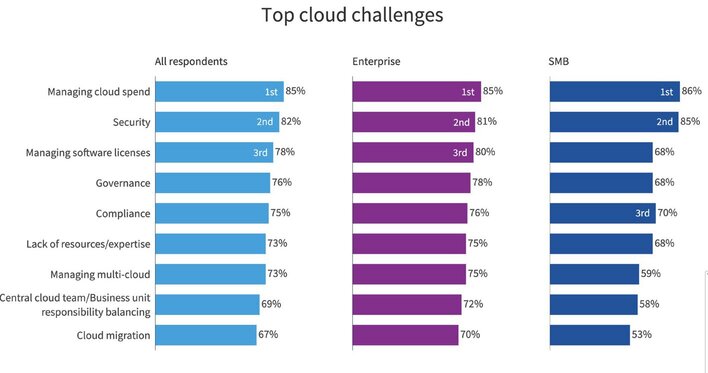
This aligns with the FinOps Foundation’s 2026 findings that FinOps is expanding beyond cloud infrastructure into AI, SaaS, licensing, private cloud, data centers, and broader technology value management.
FinOps in Action: Cost, Governance, Accountability, and Value
1. FinOps is not just cost-cutting
A common mistake is treating FinOps as a cloud cost-reduction exercise. It is bigger than that. IBM notes that FinOps is not about being “cheap” with cloud spending; it is about helping teams understand where to invest, when to optimize, and how to make better technology decisions.
2. FinOps creates shared accountability
Cloud costs often grow because engineering teams can deploy resources quickly, while finance teams only see the bill later. FinOps changes that model by making cost awareness a shared responsibility across IT, DevOps, finance, procurement, and business units. Intel describes FinOps as a shared-responsibility model for cloud infrastructure and cost management.
3. FinOps should start before deployment
FinOps is most powerful when it is included early in architecture and migration decisions. Flexera notes that organizations are increasingly “shifting left” with FinOps by considering costs during architectural planning before cloud applications are deployed.
4. AI makes FinOps more urgent
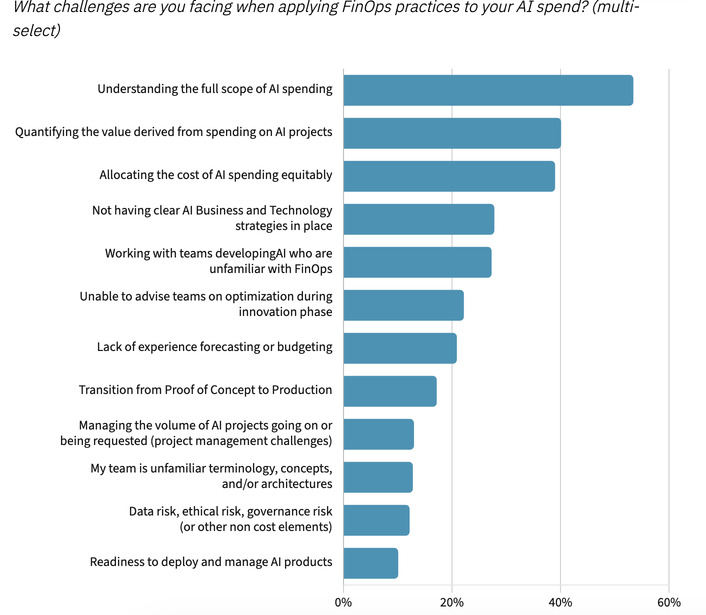
AI workloads introduce new cost drivers such as tokens, GPU utilization, inference costs, model training, data pipelines, and unpredictable usage. The FinOps Foundation reports that AI cost management is now a major priority, with organizations seeking granular monitoring of AI spend across tokens, LLM requests, and GPU utilization.
5. FinOps supports better governance
As cloud environments grow, organizations need clearer policies for tagging, budgets, usage visibility, rightsizing, reserved instances, savings plans, committed-use discounts, SaaS management, and accountability. Flexera found that 71% of organizations now have a Cloud Center of Excellence or similar function, and 63% rely on a FinOps team.
Native FinOps Tools from AWS, Azure, and GCP
The three major hyperscalers all provide native tools to help organizations monitor, allocate, forecast, and optimize cloud spend.
AWS Cloud Financial Management
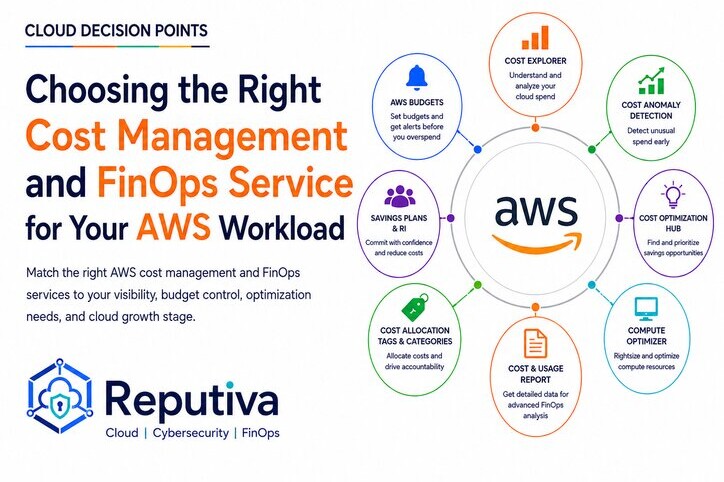
AWS offers a broad Cloud Financial Management toolkit, including AWS Cost Explorer, AWS Budgets, AWS Cost and Usage Reports, AWS Compute Optimizer, Savings Plans, and Reserved Instances. These tools help teams analyze usage patterns, forecast spend, set budget alerts, rightsize resources, and identify savings opportunities across AWS environments.
Microsoft Azure Cloud FinOps Management
Azure provides Microsoft Cost Management, Azure Advisor, Budgets, Cost Analysis, Reservations, and Savings Plans for Compute. These tools help organizations visualize spending trends, monitor expenses, detect anomalies, forecast costs, allocate spend to teams, and improve accountability through governance and budget controls.
Google Cloud Platform (GCP) Cloud FinOps Management
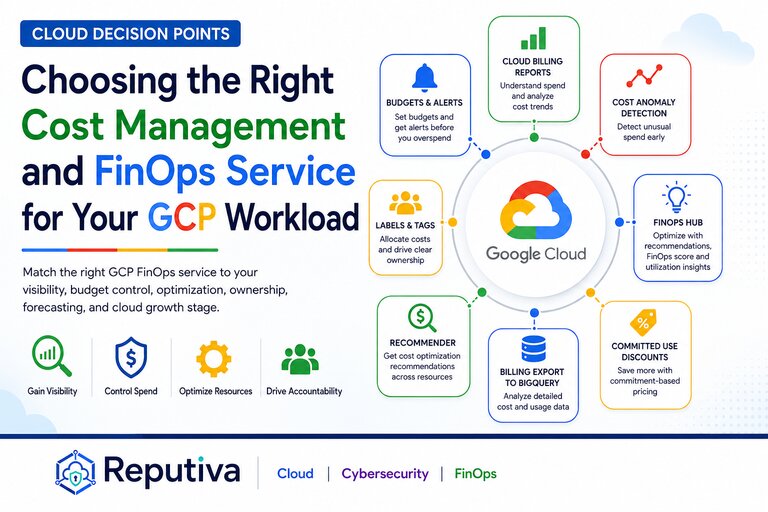
GCP provides Google Cloud Cost Management, Cloud Billing Reports, Budgets and Alerts, Billing Export to BigQuery, Recommender, Committed Use Discounts, and FinOps Hub. These capabilities help organizations gain cost visibility, optimize resource usage, improve forecasting, track commitments, and use recommendations to reduce waste.
For organizations using AWS, Azure, and GCP, the challenge is not only using each provider’s native tools, but also creating a consistent FinOps operating model across all three: tagging standards, ownership, budget controls, executive reporting, security alignment, and regular optimization reviews.
FinOps is becoming a board-level cloud governance discipline
At Reputiva, we see Cloud FinOps as more than cloud cost optimization. It is a governance discipline that helps organizations connect cloud spending to business outcomes, risk, performance, and operational resilience.
For growing businesses, the problem is often not that they are using too much cloud. The real issue is that they may not have enough visibility into what they are using, who owns the spend, which workloads are driving cost, and whether the architecture is aligned with business priorities.
This becomes even more important as organizations adopt AI, SaaS platforms, data services, and hybrid cloud environments. Without strong FinOps practices, cloud spend can grow quietly through unused resources, overprovisioned workloads, poor tagging, shadow IT, underused discounts, duplicated SaaS tools, and AI workloads with unpredictable consumption patterns.
Reputiva’s view is simple: organizations need to move from reactive cloud billing reviews to proactive cloud financial governance. That means building a model that integrates cloud architecture, cybersecurity, cost optimization, and business value.
For SMEs and growing organizations, this does not always require a large FinOps team. It can start with a practical operating model: cloud spend visibility, tagging standards, budget alerts, workload reviews, rightsizing, discount strategy, security posture checks, and executive reporting that explains not just what cloud costs, but what value it delivers.
Ready to Take Control of Your Cloud Spend?
Cloud adoption should accelerate your business, not create financial blind spots.
Reputiva helps organizations assess cloud usage, improve cost visibility, strengthen governance, and align cloud investments with business value across AWS, Azure, and GCP.
Start with a Cloud FinOps and Security Assessment to identify wasted spend, cloud risks, optimization opportunities, and practical governance improvements for your environment.