The banking industry is entering a new phase of transformation and modernization, one defined not by experimentation, but by proven outcomes. Today, agentic AI and modern cloud architecture let banks build personalized, contextual experiences while improving efficiency. Three shifts have made this change possible.
As highlighted in Banking on the Cloud: Where Possibility Meets Proof (2026) by AWS for Financial Services, banks are fundamentally rethinking how financial services are delivered. Advances in cloud architecture and agentic AI are enabling institutions to move beyond traditional, product-centric models toward personalized, context-aware experiences that improve both efficiency and customer outcomes.
This shift is driven by three key forces: reducing cost-to-serve through modern cloud infrastructure, automating complex, nuanced processes with AI, and transitioning to outcome-based banking that aligns services with customer goals rather than products.
However, as banks scale these capabilities, the challenge is no longer innovation; it is execution. Security, compliance, and governance must evolve alongside cloud adoption to ensure resilience in highly regulated environments. In this article, we explore the key insights from the report and what they mean for financial institutions looking to securely scale their cloud adoption.
The Three Shifts driving banking modernization:
Collapsing costs, expanding access:
Architectural modernization is collapsing cost-to-serve, making previously underserved customer segments economically viable. Gig workers, thin-file borrowers, and small businesses with irregular income now represent growth opportunities rather than margin drains.
Building for nuance:
Agentic AI is eliminating the trade-off between scale and nuance. Traditional automation handled common cases but struggled with edge cases requiring specialized expertise. Banks can now automate across the full range of customer needs, not just the majority that fit standard workflows.
Outcome-based banking
Banks are shifting from product-centric to outcome-based models. Multi-agent systems coordinate across cash, credit, and investments in real time, organizing around what customers want to achieve rather than pushing individual products.
2026 Banking Trends
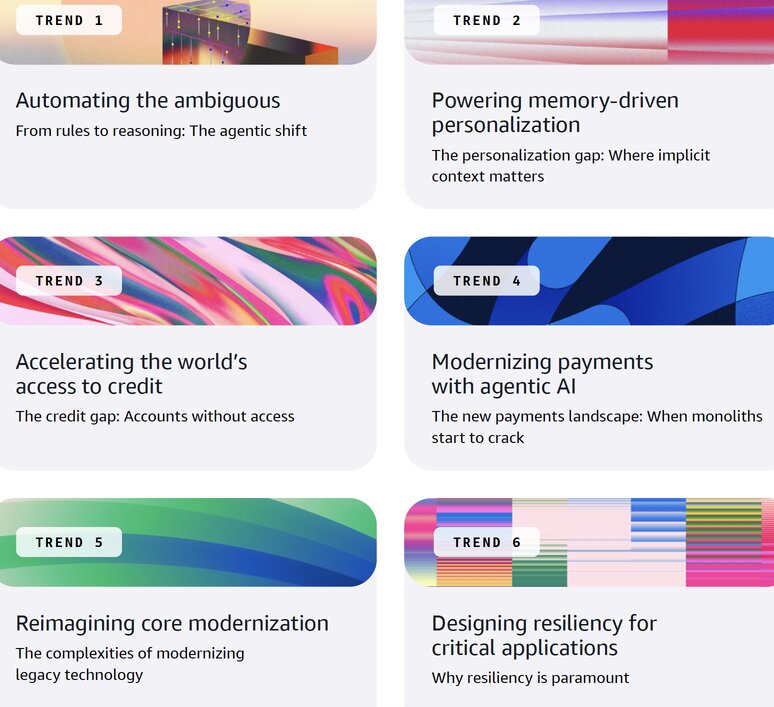
Building on the foundations established in recent years, these six trends highlight the most significant shifts shaping the industry in 2026, from emerging AI-driven capabilities to the architectural patterns needed to support them at scale.
Trend 1: Automating the ambiguous
From rules to reasoning: The agentic shift
Traditional banking automation was built for structured, repetitive tasks with predictable outcomes. Rules-based systems could process high-volume transactions efficiently, but they struggled when work required interpretation, nuance, or adaptation. Building exceptions into these systems meant extensive development cycles, while anything requiring genuine human reasoning or comprehension remained out of reach.
Agentic AI breaks through these constraints. These systems understand context, extract insights from unstructured data, and adapt to changing conditions. Rather than just executing tasks, AI agents can analyze situations, understand context, and improve with each cycle. It’s a fundamental shift, from deterministic automation to learning systems that can handle complex decisions within defined guardrails.
In practice, agentic capabilities create value for banking customers across two key areas:
- Automating historically un-automatable aspects of human reasoning and interpretation in core processes, such as a know your business or credit memo generation.
- Applying AI to build specialization in high-variability, low-volume work, such as syndicated lending or regulatory compliance review.
Staff supported by specialist agents can move into markets that previously didn’t make economic sense or had higher barriers to entry. The agent provides domain expertise; the human brings judgment and relationship management.
AWS Services for Agentic AI Workflows
Amazon Bedrock AgentCore
Amazon Bedrock AgentCore is an agentic platform for building, deploying, and operating effective agents securely at scale—no infrastructure management needed.
Amazon Nova Forge
Build your own frontier models using Nova
Trend 2: Powering memory-driven personalization
The personalization gap: Where implicit context matters
Seventy-two percent of consumers say personalization influences where they choose to bank,3 yet most banking experiences remain broad, reactive, and disconnected from customers’ actual financial lives.
Banks are moving from standalone tools to agentic ecosystems where multiple interoperable agents collaborate across the institution, partners, and customer-owned systems to deliver continuous, personalized outcomes.
Instead of a single advisor or chatbot, customers now benefit from networks of agents that coordinate cash, credit, investments, and spending in real time. Leading banks build these systems by combining conversational agents with purpose-built product agents for deposits, lending, and investments. They then connect these to agents across insurance, wealth, and retail, particularly when pursuing an ecosystem approach to banking.
AWS Services
Amazon Bedrock AgentCore Memory: Building context-aware-agents
Provides both short-term context and long-term knowledge retention, enabling a coherent understanding of customers over time without requiring banks to build complex infrastructure from scratch.
Amazon Memory DB
Provides the low-latency persistent layer underneath, delivering the speed, durability, and governance needed for real-time personalized context retrieval at scale.
Amazon Bedrock AgentCore Runtime
A fully managed serverless agent runtime that supports both execution modes within the same conversational experience.
Memory enables a fundamentally different banking model: goal-based, proactive guidance that meets customers at moments that matter.
Trend 3: Accelerating the world’s access to credit
The credit gap: Accounts without access
When it comes to bridging the credit gap, data integration only solves half the problem. Rethinking the cost-to-serve calculation solves the other half. Historically, banks could not profitably underwrite small-dollar loans to non-standard borrowers. Small business owners with irregular income, gig economy workers with multiple revenue streams, and new-to-country customers with foreign credit histories all required manual review. Each application demanded human judgment that automated systems could not replicate.
The economics did not add up. Exception-based processing consumed underwriter time. Decision turnaround stretched across days or weeks. Thin-file segments remained unprofitable to serve. Agentic AI changes this calculus.
Where rule-based automation fails with non-standard cases, agentic systems reason through complexity. Multiple AI agents work in parallel rather than following linear decision trees. They handle the nuanced assessment that previously required human loan officers.
AWS Services
AWS Entity Resolution
Easy-to-configure, ML-powered entity resolution service.
AWS Clean Rooms
Provides secure environments where financial institutions and partners analyze collective datasets without exposing underlying data.
Trend 4: Modernizing payments with agentic AI
The new payments landscape: When monoliths start to crack
The changing approach to modernization
In the early days of cloud adoption, financial institutions moved monolithic payment applications wholesale to cloud infrastructure. This approach delivered real benefits: infrastructure cost optimization, improved security posture, and on-demand scalability when compared to on-premises environments.
Today, financial institutions decompose payment workflows into independent, business-aligned microservices with API-first architectures. They build orchestration layers to control payment logic, business rules, and customer experiences. They integrate specialized ISV capabilities for fraud detection, compliance monitoring, and card processing, preserving differentiation while avoiding the need to build non-differentiating capabilities from scratch.
AWS Services
AWS security services
Provide end-to-end protection, helping institutions meet stringent regulatory requirements for payment data and processing
Trend 5: Reimagining core modernization
The complexities of modernizing legacy technology
The critical nature of mainframe applications in financial institutions made any modernization attempt prohibitively risky, while the scarcity of talent that could bridge legacy and cloud architectures compounded resource constraints.
These legacy systems often contain millions of lines of COBOL, PL/1, and Assembler code, making manual modernization extraordinarily time-consuming and error-prone. Further, extracting and preserving decades of embedded business rules proved exceptionally difficult with available tools.
Banks recognize that refactoring COBOL into monolithic Java preserves legacy coupling, limits agility, and constrains product evolution, creating technical debt in a new language. Instead, leading institutions are leveraging agentic AI to extract business intent, formalizing it as precise domain-centric specifications, and generating cloud native, composable microservices.
AWS Transform + Kiro: An intelligent pipeline
AWS Transform
AWS Transform delivers automated code assessment, intelligent business rule extraction, and deep dependency mapping that rapidly surfaces legacy system logic and data relationships.
Kiro
When combined with AWS Transform, Kiro extends modernization beyond automated code conversion into intelligent refinement. Through adaptive prompt-driven refinement, teams can iteratively optimize converted code through natural language interactions, cutting weeks of manual review into hours.
Trend 6: Designing resiliency for critical applications
Why resiliency is paramount
Traditional on-premises disaster recovery exercises, typically conducted annually with months of preparation, are fundamentally inadequate for cloud environments where applications change continuously. Regular production-based resilience testing builds operational confidence and eliminates decision latency when real incidents occur.
Designing resilient architecture is only half the equation. Banks must also validate that systems perform as designed under real-world failure conditions. This requires adopting cloud-native resilience practices centered on a continuous lifecycle of assessment and automated testing.
AWS Services
Helps define and validate recovery objectives (RTO/RPO)
AWS Fault Injection Service
Injects realistic failure modes
AWS Application Recovery Controller
Orchestrates multi-region failovers with guaranteed regional independence.
Cloud transformation in banking is no longer about possibility; it’s about execution.
At Reputiva, we help financial institutions and regulated organizations design and implement secure, compliant cloud architectures across AWS, Azure, and GCP – aligned with industry frameworks and best practices.
Start with a Cloud Security & Architecture Assessment to identify gaps, reduce risk, and build a clear roadmap for secure cloud adoption.